Activity
Mon
Wed
Fri
Sun
Oct
Nov
Dec
Jan
Feb
Mar
Apr
May
Jun
Jul
Aug
Sep
What is this?
Less
More
Owned by Travis
For adults 35+ ready to build muscle, burn fat, and optimize hormones. Aging is inevitable. Decline isn’t. Train smarter. Optimize everything.
Digital Success School
263 members • $997
Fowl
6.3k members • Free
Built With // MS
27 members • Free
AI Money Lab
92k members • Free
The Iron Forge Brotherhood
52.5k members • Free
Dirt To Dollars
2.6k members • Free
Wholesaling Real Estate
82.3k members • Free
Research Radar
11.7k members • $10/month
Skoolers
157.3k members • Free
264 contributions to BioOptimization Collective

12d •
THE SCALE CAN LIE TO YOU
This is one of the biggest reasons people give up too early. They've been training. They're eating better. Their clothes are fitting differently. They're getting stronger. They look better in the mirror. Then they step on the scale... And they've only lost 2 or 3 pounds. So they think it's not working. STOP letting one number determine your progress. If you're losing body fat while building muscle, the scale might not change nearly as much as you expect. That's called body recomposition. You could weigh almost the same... But have a smaller waist, more muscle, better definition, and look like a completely different person. That's why I pay attention to more than body weight. Pictures. Measurements. Strength. How clothes fit. Body composition. Energy. Performance. The goal isn't always to become a lighter version of yourself. Sometimes the goal is to become a completely different version of yourself at almost the same weight. Now I'm curious... Would you rather lose 15 pounds on the scale OR lose 8 pounds of fat and gain 5 pounds of muscle? Drop your answer below 👇
0 likes • 6d
@Mark Brumfield what are you trying to accomplish?
0 likes • 3d
@Mark Brumfield, I don’t know what you currently have your macros set at, but if the goal is to put on some muscle, I’d definitely want to make sure your protein is up. I’d shoot for around 1.5 grams of protein per pound of body weight. Since you’re already on TRT and doing HCG three times a week, how much TRT are you actually taking right now? If you’re looking to bulk up a little more, there are other peptides people look at too, like IGF-1 LR3 or CJC-1295/Ipamorelin. But at the end of the day, it’s really going to come down to what you’re eating and how you’re training. The peptides or hormones are more of an added benefit—they’re not going to replace having the basics dialed in. So if the goal is adding muscle, we probably need to get you into a slight calorie surplus, make sure your protein intake is where it needs to be, and make sure your training is actually set up for progressive muscle growth. Once all of that is dialed in, then we can look at everything else you’re taking and go from there.
3d •
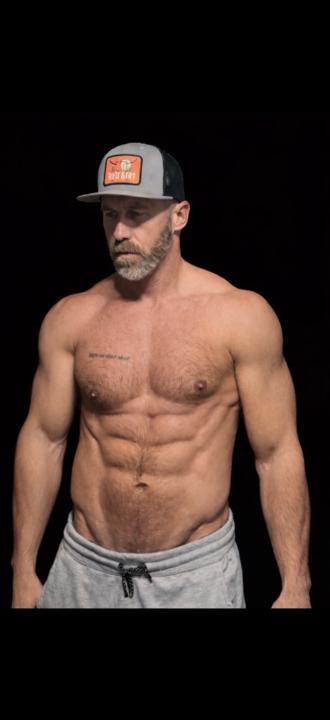
First Dexa scan
To think about 2.5 years ago I was about 380lbs. Lost a ton of weight, started hear shit like “I think he dying” “he must have cancer” etc. to “dang you’re pretty jacked for an old guy” (41). I did my first bulk, than cut to this. Set my goal to be around 11-12% started April 19th took this scan today, because I just could t diet anymore my body was fighting me for foods every single day! I was like damn I don’t think I hit my goal so I’ll just bulk to a certain weight and cut and bulk and cut. To anyone struggling or starting out, just stack days. This was all done living out a hotel (because of my work situation) commuting long hours driving back home on weekends and than again back to work, minimal sleep etc. I’m excited to see how things gonna be when I get my transfer back home and I’m actually sleeping and recovering properly!

1 like • 3d
Thanks for sharing, that's badass!

3d •
Quality Sleep
Lets talk about sleep..... Travis: I hear you and Bill mention something that can be taken to help your quality of sleep. What is it?
0 likes • 3d
DSIP is basically a peptide that’s been researched for sleep. It may help you fall asleep faster, stay asleep longer, and improve overall sleep quality. Some of the research showed fewer wake-ups throughout the night and better sleep efficiency. It’s not necessarily a knockout sleep aid, and the research is still pretty limited and mixed, but it could be an interesting option for people looking to improve their sleep naturally without feeling completely sedated.
4d •
The Math Mistake That's Probably Costing You Results (Vial Math 101)
If I had to guess, I'd say at least a third of the DMs and comments I get every week are some version of the same question: "I have a X mg vial, I want a Y mcg dose, how many units do I draw?" And almost every time, the person asking has already tried to answer it themselves by doing this: "I have a 5mg vial. I want 10 doses. So each dose is 0.5mg." That's wrong. Not a little wrong — completely skips a step wrong. Here's why. The mistake: dividing the total mg by the number of doses you want, and stopping there. That math only works if you're drawing the whole vial dry with no water in it, which obviously isn't how any of us are dosing. What's actually happening: the second you reconstitute a vial with bacteriostatic water, you've created a concentration — mg of peptide per mL of liquid. That concentration is what actually determines how many units you draw. The vial size alone tells you nothing about your syringe. The real formula: Concentration (mg/mL) = Total mg in vial ÷ mL of bac water added Dose volume (mL) = Desired dose (mg) ÷ Concentration (mg/mL) Units on syringe = Dose volume (mL) × 100 Worked example: Say you've got a 5mg vial and you add 2mL of bac water. Concentration = 5mg ÷ 2mL = 2.5mg/mL. You want a 250mcg dose (0.25mg). Dose volume = 0.25mg ÷ 2.5mg/mL = 0.1mL. Units = 0.1mL × 100 = 10 units on a standard insulin syringe. Notice the vial size (5mg) never directly told you the units — the water you added is doing half the work. Add 1mL instead of 2mL to that same vial and your concentration doubles, meaning the same 250mcg dose is now only 5 units, not 10. Same peptide, same dose, completely different number on the syringe — because the water changed. This is exactly why "just tell me how many units" without knowing your reconstitution volume is a question nobody can actually answer for you, including me. Drop your vial size + water added in the comments and I'll walk through the math with you — better you learn the formula once than have to ask every time you restock.
0
0
5d •
Cold & Flu Season Is About To Sneak Up On You — Here's How To Get Ahead Of It
We're heading into the stretch of the year where cold and flu season quietly ramps up. It usually hits hard October through winter, but the groundwork gets laid now, not after you're already sick. Most people wait until they feel it coming, and by then it's not prevention anymore, it's damage control. Here's the difference: prevention means keeping your baseline strong before your body has to fight anything off. That means the fundamentals first, always sleep, hydration, protein, vitamin D, and not running yourself into the ground the way a lot of us do heading into the busier fall and winter months. From a research and educational standpoint, a few peptides come up often in conversations around gut and immune support: - BPC-157 — studied for gut lining integrity and general inflammation modulation - KPV — commonly discussed for calming inflammatory signaling, both gut and skin - Thymosin Alpha-1 — studied internationally for immune regulation, used clinically in some countries None of these are a substitute for the basics, and none of them are a free pass to skip sleep and run yourself down all fall. They're support, not a shield. The mistake I see every single year is the same one: people wait until they're already sick, then ask what they should take. By that point you're managing symptoms, not building resilience. This is educational and research discussion only, not medical advice. 👇 What's your go-to move the moment you feel that first scratchy throat or run-down feeling creeping in? Curious what's actually worked for people in here?
1
0
1-10 of 264
@travis-dickey-2146
I’m here for people 35+ who refuse to decline. We’ll optimize body, mind & business to reclaim power & build a legacy.
Active 2d ago
Joined Aug 24, 2025
Powered by