Activity
Mon
Wed
Fri
Sun
Jul
Aug
Sep
Oct
Nov
Dec
Jan
Feb
Mar
Apr
May
What is this?
Less
More
Memberships
AI Bits and Pieces
744 members • Free
103 contributions to AI Bits and Pieces

🔥
1d •
AI in Real Life: ChatGPT Became Our Family Interpreter 🇮🇹
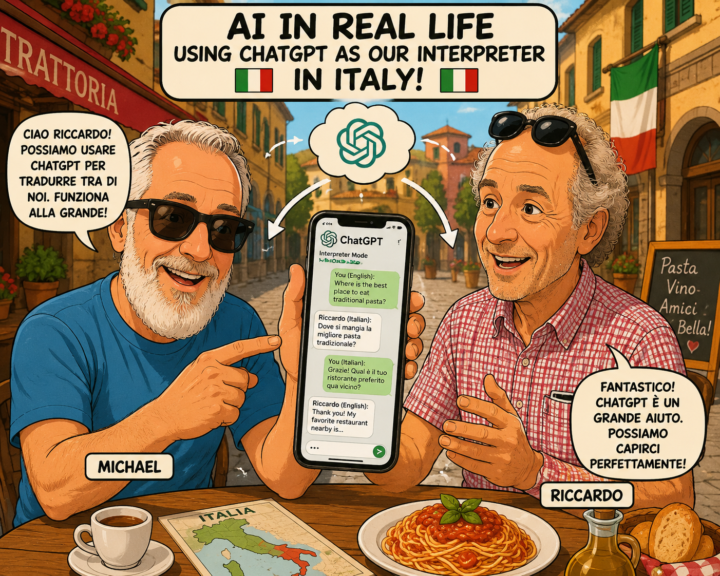
One of the most unexpected uses of AI during our trip to Italy wasn’t coding, content creation, or business strategy. It was family. My wife’s cousin, Riccardo, speaks Italian. I speak English. Other family members fall somewhere in between. Some speak only Italian. Some speak a little English. Some know just enough of the other language to get by. After arriving in Italy, I realized ChatGPT could help. So I created a simple custom instruction: “We are visiting Italy and do not speak Italian fluently and need a translator. If you hear someone speaking English, translate to Italian. If you hear someone speaking Italian, translate to English.” That was it. Then I opened Voice Mode. I would speak English. ChatGPT would translate it into Italian. Riccardo would respond in Italian. ChatGPT would translate it back into English. Suddenly, more people could participate. Stories were shared. Family history was discussed. Jokes landed. Questions about ancestors and life in Italy were answered more clearly. It was not perfect. In poor cell areas, it struggled. When we hit Voice Mode limits, the translation stopped. Sometimes the flow broke. But even with those limitations, the overall experience was a huge net plus. The other unexpected benefit was context. Every conversation started in a different chat. But after a few days, ChatGPT had helped capture enough context around our family ancestry, our kids’ life journeys, family relationships, and stories from Italy that each conversation became more meaningful. After one conversation, I was even able to create a family tree. That was amazing. It was not just translating words. It was helping preserve the story. The result was not seamless technology. It was practical connection. In a small mountain town in Italy, surrounded by family, history, great food, and generations of stories, ChatGPT helped bridge a language gap that had existed for years. When people talk about AI, they often focus on productivity, automation, coding, or business transformation.

1 like • 2h
So beautiful
🔥
4d •
📊 AI in Real Life: My Personal AI Health Dashboard
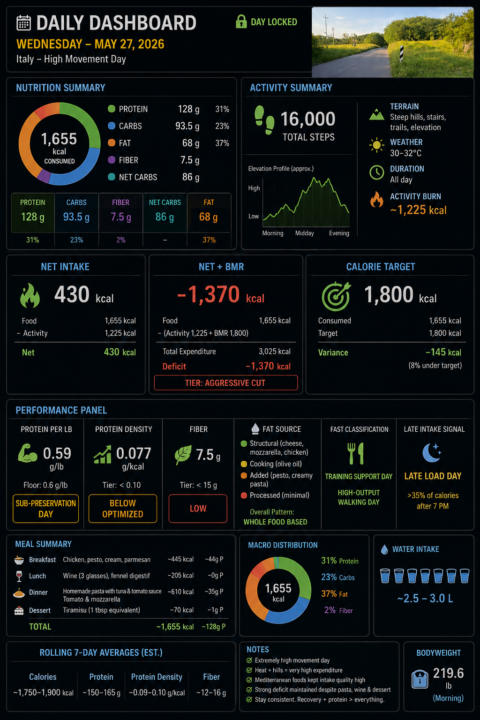
One of the most practical AI systems I use every single day has nothing to do with coding, agents, or automation workflows. It’s my personal nutrition and activity tracker and daily dashboard. I log the food. I log the activity. ChatGPT does the rest. Every day: I log food, activity, bodyweight, and water as it is happening. ChatGPT estimates activity burn, subtracts it from my food intake, and then factors in my BMR to show whether the day is trending toward maintenance, fat loss, or an aggressive calorie deficit. Then, at the end of the day, it turns the raw inputs into a dashboard showing calories, macros, activity burn, net calories, net + BMR, protein density, protein per pound, fiber tier, fat-source patterns, etc. Because I follow a higher-protein diet, I also created a metric I call Protein Density: Protein grams ÷ total calories consumed (by snack, meal, day). The metric is useful because I can monitor food quality as I eat throughout the day, not just total calories. A good Protein Density score is: 0.10 or higher That generally means the day is optimized for muscle preservation and fat-loss efficiency. A lower score around: 0.05 That usually signals a less efficient nutrition day where calories are climbing faster than protein intake. For example: Chicken Breast (100g cooked, skinless): - ~165 calories - ~31g protein 31 ÷ 165 = 0.19 Protein Density Compare that to potato chips: Potato Chips (100g): - ~536 calories - ~7g protein 7 ÷ 536 = 0.01 Protein Density Both are food. But one is highly protein-efficient, while the other is primarily calorie-dense with minimal protein value. That simple ratio gives me immediate feedback on whether my meals are supporting my goals before the day is even over. The key for me is context. A 1,600-calorie day means one thing if I barely moved. It means something very different after 16,000 steps, hills, heat, and a high-output activity day. That is where AI becomes useful. Not just tracking data.
2 likes • 3d
As I read your health dashboard, I am thinking of my friend Lori today(Happy Birthday Lori) who has been battling cancer for almost 30 years, a testament in itself. She's pretty bad now but still fights, thinking how this may help people in the future, food is medicine. Her problem is she can't eat, I bet chat or some AI could help. We just do our best. You prove there is no end to what AI can assist you with, of course at the end of the day its all up to us. Thanks for your insight.
🔥
10d •
AI Week Update: The Real Problem Behind Artificial Intelligence - Water. 💧🤖
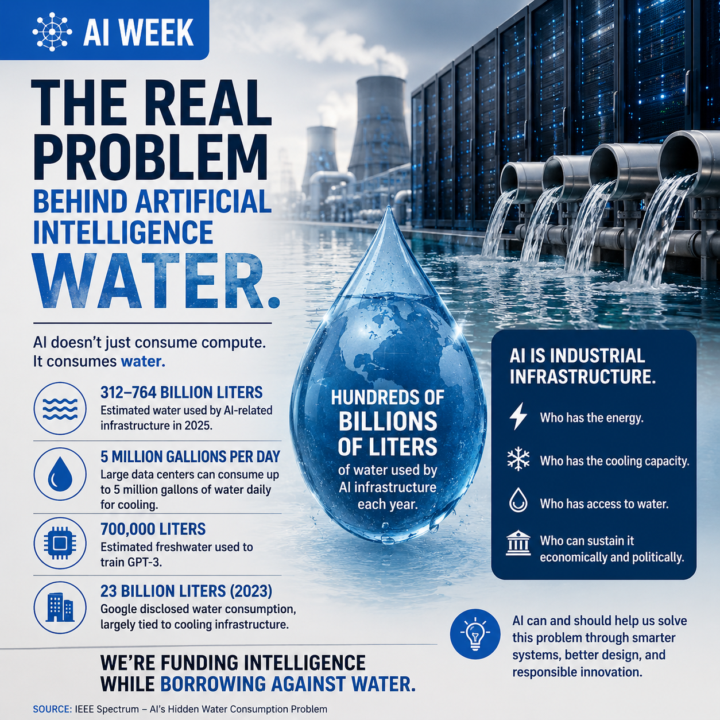
Everyone is talking about AI productivity. Faster coding. Smarter agents. Digital labor. Autonomous systems. But underneath the excitement, another conversation is quietly emerging: Water. 💧 Not metaphorically. Actual water. We keep drawing analogies between AI and humans. How we will work with it. How we will manage it. How it may change our relationship with labor, creativity, and knowledge. But I never fully connected one basic fact: Like humans, AI needs water to survive. Not emotionally. Not philosophically. Physically. Data centers need water for cooling. AI infrastructure needs water to operate. And as AI grows, that demand grows with it. No false pretenses here. In the United States especially, these resources are often taken for granted. There is an assumption that water, energy, and infrastructure will simply continue to be available in the future because they always have been. But the numbers are becoming too large to ignore. Some estimates now project AI-related infrastructure consuming hundreds of billions of liters of water annually. Large data centers can consume millions of gallons of water per day for cooling. Researchers have also estimated that training GPT-3 alone required roughly 700,000 liters of freshwater. At AI Week, this issue was barely discussed compared to compute, chips, models, or agents. The industry talks constantly about scaling intelligence, scaling infrastructure, and scaling automation. Sure, we occasionally hear about a city council meeting where citizens are protesting a proposed data center. But rarely do we seriously discuss the scaling of the physical resources underneath it all. Electricity. Cooling. Land. And water. That was my biggest realization. AI is not just software anymore. It is industrial infrastructure. And industrial infrastructure has physical consequences. The next major AI race may not simply be about who has the best model. It may become who has the energy, who has the cooling capacity, who has access to water, and who can sustain all of it economically and politically.
1 like • 7d
Well Arizonia always seems to be on a water watch. Michigan is surrounded by the lakes, but when they wanted a data center in Novi, there was alot of NO's.
🔥
8d •
AI Week Update: The AI-Native Workplace
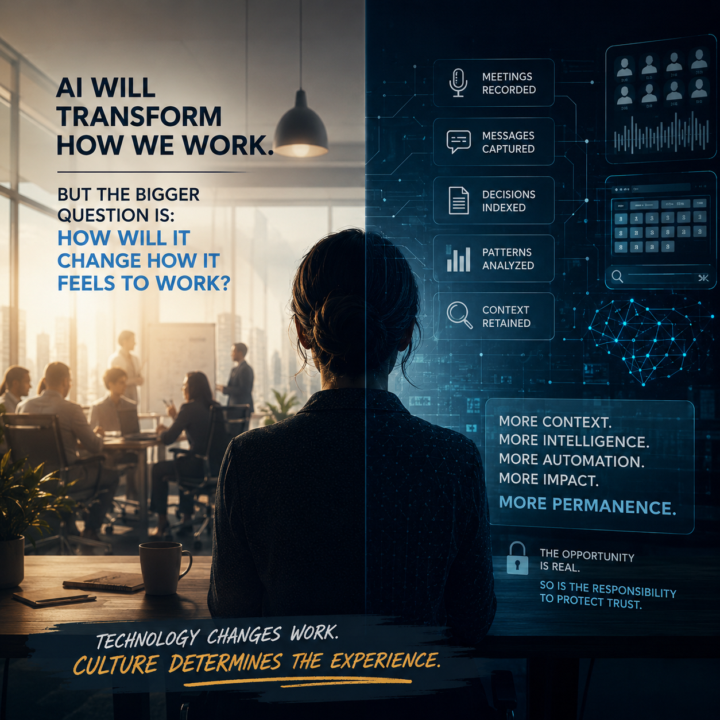
One thesis keeps forming in my head as I reflect on the lessons learned from AI Week: The more AI becomes enterprise infrastructure, the more organizations will be pressured to capture the full context of work. That may unlock enormous operational value, but it also challenges the psychological contract between employer and employee in ways we have barely begun to discuss. It is not that this thought was completely new to me. But after a week of pure AI focus and reflection, I can feel my business experience starting to connect the dots: - Operationalizing AI at enterprise scale will fundamentally reshape the human experience of work itself. - AI is no longer being discussed as an experiment sitting on the edge of the business. - It is increasingly being treated as core operational infrastructure. And once AI becomes infrastructure, the enterprise requirement for context changes everything. Because AI infrastructure requires context. And context at AI scale increasingly means visibility:recording, transcribing, indexing, analyzing, monitoring, and retaining enormous amounts of organizational activity. Meetings. Messages. Decisions. Workflows. Behaviors. Patterns. The industry talks constantly about: AI agents digital workers hybrid workforces governance oversight performance metrics drift management But underneath all of those conversations is an uncomfortable operational reality: AI systems are fundamentally context engines. The more organizational context they can access, the more operationally valuable they become. More context improves intelligence. More intelligence improves coordination. More coordination improves automation. More automation improves operational efficiency and reliability. The logic is straightforward. Yet there is another side of this equation that feels far less discussed. The challenge is not just technical. It is the psychological contract that exists beyond laws, compliance frameworks, policies, and corporate best practices between employers and employees.
2 likes • 7d
@Liz Frost That is so true!
🔥
12d •
AI Week Update: Bad (Humanoid) Robot 🤖
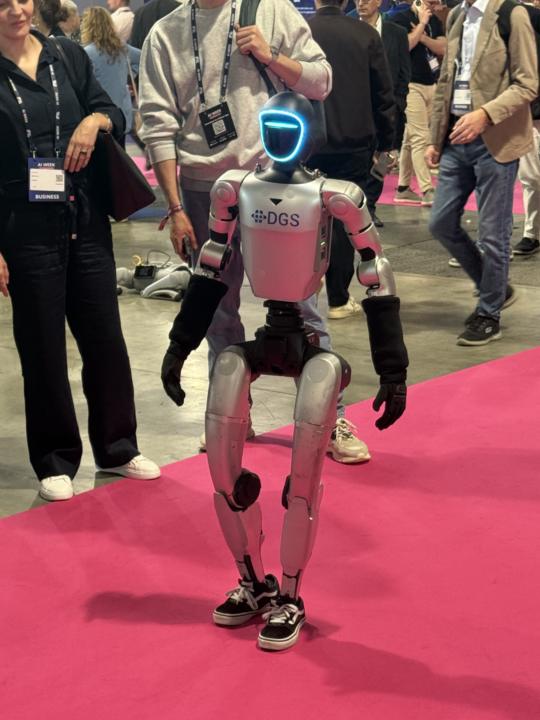
One surprise from AI Week: I expected more discussion about humanoid robotics. A lot more. Instead, it felt like a category sitting just outside the center of the AI conversation… despite potentially having some of the largest long-term implications. One of the few talks focused on humanoid robotics came from Porsche Consulting. Their perspective was insightful, partly because it lacked some of the hype that surrounds, dare I say it, conventional AI conversations. The physical robot presence at the event told its own story: a non-working Tesla Bot replica, two robot dogs on leashes, and one robot that did not move. That was it. For all the talk about robotics, there was very little actual working robotics on the floor. And maybe that was the point. The category is exciting, but still early. The demos are ahead of the operations. The social media clips are ahead of the business use cases. The backflips are ahead of the pick-and-pack work. Porsche Consulting highlighted that same point. The robot doing backflips on social media creates a lot of buzz, but that does not mean it can pick and pack simple items inside a real workflow. They showed a video of that same robot attempting basic pick-and-pack work. Honestly, it was not impressive at all. Movement is not the same as operational usefulness. A backflip creates attention. Real value comes from repeatability, accuracy, exception handling, uptime, safety, and cost per completed task. As a former COO, there was one statement that jolted my thinking: Humanoid robotics is probabilistic. These systems operate on confidence levels: identifying objects, understanding environments, making movement decisions, handling exceptions, and deciding whether to continue or escalate. Robot logic increasingly sounds like this: “Proceed at 92% confidence or stop?” As someone who spent years in operations, that statement was hard to ignore. In traditional operations, no self-respecting process would be designed around a 92% confidence threshold. If a manufacturing line was wrong 8% of the time, it would be considered broken.
2 likes • 10d
Lots of ideas, some not there yet, some maybe in a different direction, but certainly all on the radar of exploration. Thanks Michael for sharing.
1-10 of 103