Activity
Mon
Wed
Fri
Sun
Sep
Oct
Nov
Dec
Jan
Feb
Mar
Apr
May
Jun
Jul
Aug
What is this?
Less
More
Inspiring Philosophy Academy
69 members • $25/month
8 contributions to Inspiring Philosophy Academy

6d •
Skool course/guidance for writing academic papers
So I just mentioned in today’s IPA stream about possibly using Skool for help writing academic papers for those with little or no experience, as with myself. Than said that it’s a good idea, and Ryan said he actually has a lecture he had on the topic he could use. So like/comment if that is something you’d be interested in and/or if you have some ideas for it. For me, a mini to full course on it would be interesting, but even just 1-3 lectures would be helpful. I’d be interested in: — ofc having some sort of lecture(s) or even a mini/full course on it (possibly explaining the process and how long it takes for different kinds of papers/journals, how to help your chances of getting published, a list of good journals and how to know which you should publish in, how to know if your idea is worth writing on or if it’s an overly saturated topic or whatever, how to find (and take notes/cite) relevant papers to pass the bar for academic rigor to be published, how to get feed back from philosophers, how to possible work with a philosopher for them to co-author or even just helping edit/finalize it and what that entails, be especially focused for those who aren’t college for a field for active academics, etc) — community feedback on in progress papers (from other Skool students or possibly Than/Tim, potentially from Ryan or other academics if they can/want to) where we discuss general good prose, relevant papers/sources to use, etc. May also be cool to possibly have a Skool tab for those to talk about various papers they’re working on and anything related to this, though the tabs we already have may be better… kinda depends on how easily they get buried by other discussions people start. — It would be very cool to run an IPA stream with Than/Tim and possibly a Skool academic reviewing community papers… like going over: • fully published papers and whatever interesting implications, impact for the field, etc or whatever they want to talk about (possibly doing several papers in a stream if one paper doesn’t have enough to talk about for a full stream)
0 likes • 6d
Also… doing the streams could potentially transition people from IPA YT to possibly subscribing to IPA Skool if they want involved in a community or watch course for people new to writing papers. Idk, just an idea. I also will be a student for like 5-6 years, so I personally may not be able to afford this course if it’s on the premium tier until I graduate (especially since I’ll be doing a bunch of clinical rotations all year long once my program starts)… but I also know that balancing the value/effort with the price for a course is important, so I understand that as well and won’t be upset if that’s what you decide is best for the ministry. But idk, it could be a good way to add value to the lower/standard tier if it’s not too difficult to make. Idk. Up to you guys to decide what’s best. I don’t get upset about these things easily since I know balancing the ministry and business side to keep the ministry afloat is very important and can be difficult… Paul even says to not muzzle the ox.
6d •
Course on helping others through doubts
Another cool mini-course or whatever to do at some point would be something that helps people who on more knowledgeable/mature on the philosophy/apologetics side learn how to talk with others who have came to them about doubts or whatever… basically Tim/Than using their psychology knowledge or papers they’ve read and their experience to help teach how to bridge the rational side of apologetics with the emotional, psychological, and pastoral side of using it effectively. Just an idea. I know there’s some thing that I could learn from Than/Tim or others, but I’m also not in desperate need for this. One guy messaged me on IG from him seeing a comment I made on someone’s post recently. The conversation has just started, so I’m not in any particular need rn, but it may be something I possibly encounter more often… especially since there’s been 1 or 2 guys from the IP discord I’ve talked with. So it may need to be a skill I develop over time, even if I’m not directly involved in a ministry. Plus, I’m sure others could benefit from this too. So I have no rush or real need for this to happen soon or at all (not sure if others do tho), it was just an idea of something I’d possibly be interested in some day. Oh, this could also be the same course where you could possibly talk about parenting your current/future children in ways to teach them philosophy, apologetics, theology, etc and helping them through doubts or other issues that’s relevant to the IPA ministry, or possibly even more general parenting advice if you see it valuable and doesn’t contradict the scope of the broader IP ministry.
0
0

May '25 •
I was called out
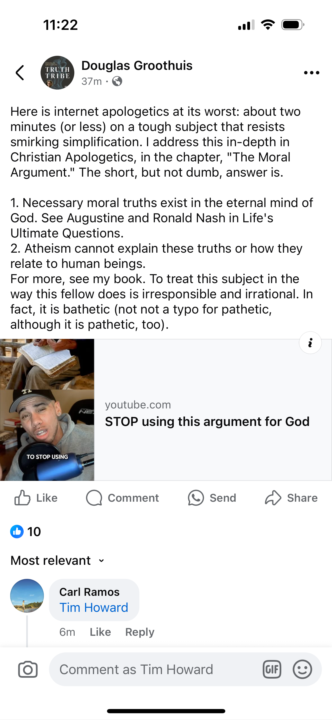
Looks like all of you are being taught by the worst internet apologist 🤣💀 But in all seriousness, this is a really REALLY bad take from someone who is a scholar. My take is entirely informed by the theistic heavy weights such as Joshua Rasmussen and Trent Dougherty. Remember this one for the rest of your lives: 1️⃣Logically, the argument with the weakest premise is the strongest argument. 2️⃣The perception of morality is obviously a weaker premise than the objectivity of morality. This is not hard.
0 likes • May 12
Idk… I don’t think you considered those two facts. 😭
Jan '25 •
Bayesianism, Problem of Evil, and Defeat Condition.
I’m kinda new to Bayesianism and the defeat condition, so I’d like to know if I’m kinda on the right track with my thoughts here or if there’s something I’m missing… When the atheist presents the problem of evil, couldn’t that just be used as evidence for something like a defeat condition more than it can be for atheism? Like God is an agent who is aware of things like the defeat condition, so he’d take into account things like the problem of evil in order to change how he orders the world. So if the atheist is right about animal suffering, God would just create an afterlife for the animals. Why would this decrease the probability of theism rather than merely making the defeat condition sub theory of theism closer to the probability of theism simpliciter? Like this is more evidence for a particular aciology than it is for atheism. So as long as the theist has a plausible explanation for Gid allowing evil, the atheist’s argument is rendered useless. This is basically just the logical problem of evil where the theist just has to offer a possible explanation. The atheist would have to show that the probability of that explanation is importable given theism. The theist could run the same problem of evil to show that their theodicy is highly probable, given theism, rather than atheism being more probable, given suffering. Am i misunderstanding how Bayesianism works or something?
0 likes • Feb '25
@Joseph Corrigan yeah, I’ll have to look into that… tbh, I’ve never really studied the topic of Hell that much… but what do you think of that other post I made, “The Hero’s Theodicy”? Edit: I’m also curious if you think it actually entails the defeat condition. It seems like it to me since no instance of suffering is necessarily needing to be tied to any end goal of God’s. However, there is a goal, namely God’s triumph. However, I think that’s just necessary for having prediction that Gods would allow prima facie pointlessness suffering that is genuinely not directly connected to nor needed for any goal. I also don’t think that’s Trent Dougherty would say that any instance of suffering is truly, in the ultimate sense, absolutely pointless but just that the impression atheists have about many instances of suffering having no purpose for people nor being directly connected to any goal is true. My theodicy agrees with that sentiment. It also bases every instance of suffering in whether it can be redeemed, or made valuable in the whole of each person’s life.
0 likes • Jun '25
@Joseph Corrigan sorry for the late response, I don’t think I seen this. So my theodicy basically says that there will be a world redemption narrative that has climax with God incarnated on earth. In order to achieve this, the world must seem completely irredeemable, otherwise, there’s no actual narrative. Suffering for the sake of soulbuilding doesn’t actually seem irredeemable as it’s redeemed in the subsequent soulbuilding. So you need suffering that actually is seemingly irredeemable. Definitionally, gratuitous suffering is that, and I can’t think of any other kind of suffering that seems quite as irredeemable as gratuitous suffering. And, ofc, this redemption narrative is just the same as the meaning making out of past gratuitous suffering. So this “hero’s theodicy” which I now call a World-Story (WS) framework entails the defeat condition.
Nov '24 •
Favorite kinds of arguments for God?
What is your favorite kinds of arguments for God?
Poll
20 members have voted
0 likes • Jun '25
With my latest interested… I’d say narratological arguments if it was an option. It COULD be classed under either teleological or moral, as it’s basically a value-design argument.
0 likes • Jun '25
@Joseph Corrigan how is that different from a moral argument?
1-8 of 8