Activity
Mon
Wed
Fri
Sun
Aug
Sep
Oct
Nov
Dec
Jan
Feb
Mar
Apr
May
Jun
Jul
What is this?
Less
More
Memberships
Fellowship of Mad Scientists
44 members • Free
235 contributions to Fellowship of Mad Scientists

2d •
Breakthrough in Thermoacoustic Sterling Engine
I love Sterling engines! I think they are way underused in daily life for reasons I won't explain here. But Chinese scientists have taken the concept to a new level and now folks are talking about using Stirling engines in space propulsion. Over 100 kW output! (Huge for this type of engine.). From the YouTube channel "Scientists from China have achieved a breakthrough in engine development: They have developed a so-called thermoacoustic Stirling engine. It is said to be extremely quiet and practically wear-free. The technology behind it has been known for some time. However, the new development is probably significantly more powerful than all previous engines of this type. And this could mean major progress for space travel and military technology. Watch this video to find out what the thermoacoustic Stirling engine is all about, why it could be the future of space travel and why Stirling engines have not yet caught on!" I found this very interesting and I hope you will to. Enjoy!

0 likes • 16h
One problem, though, is that whenever you convert energy from one form to another, there's a loss of efficiency. In this case, they're going from heat energy, to mechanical energy, to electrical energy, with a corresponding loss at every conversion. And, of course, with any system involving mechanical motion, there exists the potential for producing sound and/or vibration, which, as has been mentioned, is deadly in certain marine environments. As a result, modern submarines use "rafting", where the mechanical components are mounted on rubber shock absorbers, to keep the mechanical motion-induced sound from radiating into the ocean, although this adds considerable weight and complexity to the system. Even something as simple as the water-filled sonic dampers, as developed by British naval cook Thomas Lawson, which resulted in a significant quietening of British warships during WW2, added a fair amount of weight, even if they were conceptually rather simple. https://www.youtube.com/watch?v=5llr0axQ30A One solution is to go directly from thermal energy to electrical energy, such as with a Seebeck cell. Somewhere, I have a collection of Seebeck/Peltier cells. I need to find them, and start doing some work with them. The problem, though, is that most of these are reasonably low powered devices, and, even worse, tend to only produce milliVolts per junction. Even an array of 144 of them will only produce less than a Volt, given a modest temperature differential, and it's traditionally been difficult to work with such low voltages, even given a decent current capacity. I just recently (within the last week) obtained a board with a Linear Technologies LTC-3108 Ultra-Low Voltage switching converter. This will let me take the sub-1-Volt output from an array of 144 Seebeck cells (which are typically constructed from Bismuth Telluride crystals) into a usable voltage (5 Volts), which will run some solid state logic devices. These should be wonderful for constructing remote, unattended environmental monitoring devices, driven by the heat of sunlight, or from geothermal sources.
2d •
Herpetologist camera in field; death of a frog by a black colored snake with HUGE FANGS. Seems the frog once bitten lost body nervous system very quickly
Not for squemish..... I cannot fathom the clear images of the fangs.... HUGE. Curious to know more about that snake. Where is a herpetologist when you need one? https://www.facebook.com/reel/781302411506080
0 likes • 17h
I'm not a herpetologist, so I certainly can't identify the snake. But, many snake venoms contain neurotoxins, which bind to Acetylcholine receptors at neuromuscular junctions, and this can result in rapid paralysis. You really don't want to screw around with things which affect Acetylcholine. Due to a medical condition, I was prescribed Atropine, which blocks the action of Acetylcholine. One drop of a .02% (Not 2 percent, but .02%) solution was enough to dilate my eye for two weeks. Somewhat strangely, Neostigmine and Atropine are often used in conjunction to treat venomous snake bites (Don't do this yourself! See a doctor if you're bitten by a venomous snake.).
19h •
Shadows On the Bottom of a Swimming Pool are Very Strange Indeed
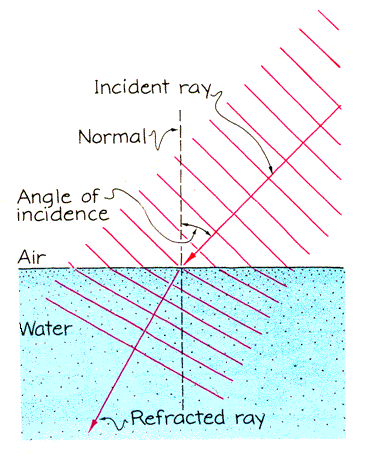
Underwater shadows shouldn't do this. A leaf floating flat on a pool casts a plain gray blob — until the water gets a bit deeper, and suddenly its shadow sprouts a glowing white rim, as if lit from below. Drag a hairbrush through your bathtub, pull it out, and dark rings with luminous edges keep swirling on the tub floor for minutes after — nothing is even there anymore. Poke a pencil into a basin at an angle and its shadow splits into two fat "sausages" with a bright gap between them, like the pencil is casting two shadows of itself. None of this is a trick of the eye. As detailed in this delightful article from The Amateur Scientist by the great Jearl Walker, it is refraction, and it is stalking you in ordinary bathwater. A floating razor blade dents the water surface just enough to bend light into razor-sharp focal lines called caustics — the same optics that paint the wavering bright net you see on a pool floor, or the ring inside a coffee cup on a sunny table. Depending on the water's depth to the millimeter, that blade's shadow can be smaller than the blade, bigger than the blade, ringed in light, or perfectly normal. A vortex left behind by your hand has a paraboloid core wrapped in a hyperboloid skirt, and the article works out — with a drinking straw, a stack of razor blades, and a sheet of paper you can raise and lower — exactly which rays are responsible for which bright line. The best part: every experiment described uses nothing but a bathtub, a razor blade, a pencil, a straw, and a lamp. It's a full afternoon of DIY physics that ends with you being able to predict, and then produce on command, effects that most people go a lifetime writing off as "weird stuff." If you've ever wondered why your own shadow in a pool looks a little off, this is the article that explains it — read it before your next bath.
0 likes • 17h
Somewhat related to that is the Jeffree Cell, which was an electro-accoustical-optical modulator, based on varying the refractive index of a fluid, to produce visual images, and which was used in some early television devices. https://en.wikipedia.org/wiki/Jeffree_cell Could a modern, computer controlled, electro-accoustial-optical modulator be used to form a holographic display system?

2d •
INTRO>>>
Hello, my name is Jerry, and I’m from North London. I wouldn’t describe myself as a science nerd, but I am deeply fascinated by how the human body works and how science and technology can help us better understand ourselves. I’m especially interested in the future of mental health, human development, and the possibility of creating tools that help people build greater self-awareness, resilience, and mastery over their own lives. I’m currently exploring several ideas that combine emerging technology with human wellbeing. They’re still in the experimental stage, but I’m passionate about turning these concepts into something that could make a meaningful difference. I’m always open to connecting with scientists, researchers, engineers, entrepreneurs, and curious minds who enjoy discussing bold ideas. If there’s an opportunity to collaborate, share knowledge, or help bring these visions closer to reality, I’d be delighted to connect and see where the conversation leads.
2 likes • 17h
Welcome, Jerry. That's an interesting field of study, although one fraught with dangers and ethical considerations. Still, there's a huge amount of potential there. A number of decades ago, I had a friend (who shall remain nameless), who was working with a doctor, to develop a TMS system. I don't believe that he ever published any research, sadly due to an unrelated catastrophic event. But, the preliminary results he had obtained were promising, mainly along the lines of reducing migranes. Still, he was an engineer, and understood Murphy's Law, so he had designed many safety systems into his test, although, when you're exploring the unknown, there are many dangers, both known and unknown. https://en.wikipedia.org/wiki/Transcranial_magnetic_stimulation There are, of course, many less invasive techniques, although "less invasive" doesn't necessarily equate to "danger free". Even something as simple as a DreamMachine can induce epileptic seizures. But, one wonders whether a modern implementation, using various colored LEDs, being pulsed at varying rates, perhaps using neural feedback, could improve on the original design? But, of course, use extreme caution, and be aware of both the known and unknown dangers (Have an automatic shutoff? Have an assistant?). https://en.wikipedia.org/wiki/Dreamachine In any case, it would be interesting to hear of your theories.
3d •
See you at today's live LabChat event
Like always, our weekly get together will take place at 2:00PM Eastern time. The URL is https://meet.jit.si/fellowshipofmadscientists. When you join, make sure to select the option that turns your microphone on. I suggest you download the jitsi application. See you soon! Shawn

0 likes • 3d
Arg! My clock is two hours ahead. Must have been the power glitch I had two days ago. Sorry.
0 likes • 3d
I'll come back at 2PM.
1-10 of 235

@david-glass-3016
BS in Engineering Arts, BS in Electrical Engineering, MS in Electrical Engineering, Extra class Amateur Radio operator, LCD pioneer, Cryptographer.
Active 10h ago
Joined May 28, 2025
Kentucky