Activity
Mon
Wed
Fri
Sun
Feb
Mar
Apr
May
Jun
Jul
Aug
Sep
Oct
Nov
Dec
Jan
What is this?
Less
More
Owned by Darvis
Memberships
Lovable AI
436 members • Free
InstaIncome School
679 members • Free
Ai Titus
856 members • Free
AI Automation Society
227.8k members • Free
Creators
16.3k members • Free
Software Developer Academy
26.6k members • Free
InsightAI Academy
12.2k members • Free
3 contributions to Ai Titus

2d •
THE AI LIE: Why Corporate Leaders are Gaslighting the American Worker.
In 2024, the customer service department at Klarna, the Swedish fintech company, completed a quiet revolution. The company announced that its AI assistant was now handling the work equivalent of 700 full-time customer service agents. The chatbot resolved two-thirds of customer inquiries in under two minutes, down from eleven minutes previously, with satisfaction ratings matching human agents. The company projected $40 million in annual profit improvement.¹ This wasn't automation in the traditional sense. This was something different. (An important postscript: In May 2025, Klarna reversed course, announcing plans to hire human customer service workers again. CEO Sebastian Siemiatkowski acknowledged that "quality of human support" had suffered and that the company's AI-focused path "wasn't the right one." The reversal is instructive, it reveals both the limitations of current AI and the relentless pressure to try again. We'll return to what Klarna's stumble tells us about the shape of this transition.)² --- The Familiar Script We've been through this before, or so the argument goes. Every technological revolution triggers the same cycle of panic and adaptation. In the early 1800s, the Luddites smashed textile machinery, fearing the machines would steal their livelihoods. By 1900, most Americans worked in agriculture; today, less than 2% do. Yet unemployment hasn't steadily climbed, it's fluctuated within a relatively narrow band for over a century. The economy adapted. New jobs emerged. Human ingenuity prevailed. The reassurances come from economists, technologists, and business leaders in predictable refrains: It's just a tool. It augments human capability. Yes, some jobs will change, but we'll create new ones. We always have. There's comfort in this narrative. It's backed by 200 years of evidence. It suggests that our economic anxieties, however real they feel, are ultimately misplaced, that we're once again mistaking transformation for catastrophe. But what if the pattern doesn't hold this time? What if the very thing that makes us confident, our long history of technological adaptation, is blinding us to a fundamentally different kind of disruption?

1 like • 1d
For the most part people are optimistic about AGI. There are some that are keen on dooms day. This article tries to include both sides but looks like the author believe in bad consequences of AI. Personally I think the answer will always be in between. The AI is still just a tool, a good one for sure. It seems that most of the AI stories are created by people who don't understand how actually AI works (giving it emotion, and magic effect), or the ones that do understand and want a better adoption of it (personal gain).

Nov '25 •
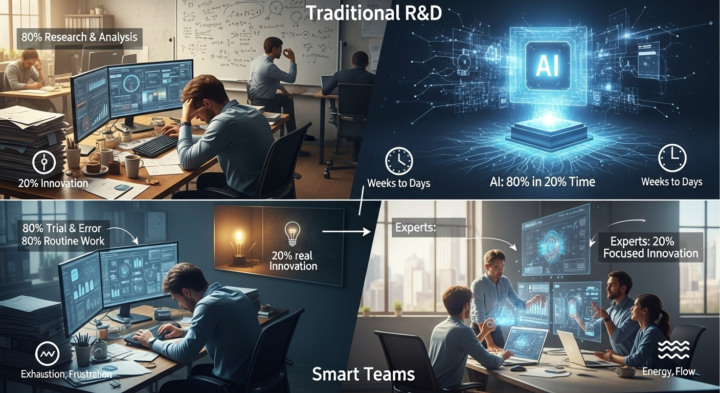
The 80/20 Rule for R&D
80% of your results come from 20% of the effort. Today presented to 6 companies the AI food R&D platform . Result 4 clients want to make the next step But in traditional R&D, we spend: 80% of time on research and analysis 80% of time on trial-and-error 80% of time on routine work And only 20% on real innovation and optimization. Smart teams flip this: AI handles the first 80% in 20% of the time. Experts focus on the last 20% that makes the difference. From weeks to days. From exhaustion to energy. From frustration to flow. How would your team perform with this ratio? Do you want to work smarter let me know.
0 likes • Dec '25
I'm not a statistician but Pareto 80/20 rule basically means 20% of work generates 80% of work results, and vice versa. What triggers me here is AI does 80% of work in 20% of time. Using same 20% it looks as it would be backwards, and confuses people. How long does Experts spend time on the remaining 20% of work? 20% of work in 20% of time? Or 20% of work in 80% of time, as Pareto principle would actually make sense? I don't think the client followed through on your message. It looks like he heard the first 80% of work in 20% of time and skipped the last part altogether. So wouldn't a simpler message would be: - 80% of work done in 20% of time equals up to 4 times faster process of R&D. Or a more advanced analysis with a clear outcome: - AI does 80% of work in 20% of time - Experts spend 20% of time on innovation (even though Pareto doesn't make sense) - The same whole process takes 40% of time a.k.a. innovate x2.5 faster with AI (you were missing the 3rd part, final result)
Sep '25 •
I just saw the future of learning, and it's incredible.
Think about the last time you had to learn something from a textbook or a dense manual. It's tough, right? It's just a wall of text that doesn't care if you're a visual learner, if you learn better by listening, or if you need to see examples to really get it. Well, Google just showed a project called "Learn Your Way," and it completely changes the game. Imagine taking that same boring wall of text and having an AI instantly transform it into a personalized lesson, just for you. It can turn the material into: Simple quizzes to check your understanding as you go. Slideshows with a narrator, like a custom-made YouTube explainer video. Mind maps so you can see how all the ideas connect. Audio lessons that sound like a teacher and student talking it out. Even better, it can explain things using topics you're actually interested in. Imagine learning a tough science concept, but it uses examples from your favorite video game or sport. That's what this does. For us, the builders in this group, this is a huge deal. It's a peek at the kind of stuff we can start creating. We can build tools that don't just throw information at people, but actually teach them in a way that clicks. Think about building a study guide for a subject you love, or creating a training tool for a new job that people don't hate using. The possibilities are endless, and it feels like we're just scratching the surface of making AI genuinely helpful. I'm really fired up about this. What would you build with technology like this? If you want to see it for yourself go here --> https://learnyourway.withgoogle.com/ --- More helpful posts from Ai Titus --> https://www.skool.com/@aititus?g=ai-automation-society&fl=posts

2 likes • Sep '25
Wow! How about teaching your own workflow in simple terms?
1-3 of 3

Active 7h ago
Joined Sep 21, 2025