Activity
Mon
Wed
Fri
Sun
Oct
Nov
Dec
Jan
Feb
Mar
Apr
May
Jun
Jul
Aug
Sep
What is this?
Less
More
Owned by Titus
Build your AI business before AGI changes everything. Real income, real freedom. I'll show you what actually works. Let's doooo this!
428 contributions to Ai Titus

Apr 6 •
Does anyone have experience with local anonymization and re-identification?
Has anyone built something like this already? The idea is to have two windows side by side: one with the original document and one anonymized version that gets sent to an AI. After the AI completes its work, the changes are then mapped back to the original document. I only found a German video explaining a similar concept:https://www.youtube.com/watch?v=MP1ycNNZChw Would be interested to hear if anyone has implemented this or knows existing tools.

1 like • 30d
@Peter H cool
Sep '25 •
Stuck? Not sure where to start? Here's What to do...
Ever feel like you're on the sidelines? You see people launching cool projects, building little income streams, and you know you can do it too. Your brain is buzzing with ideas, but when it comes time to actually start... paralysis. The "where do I even begin?" feeling is real, and it can be really discouraging. This guide is for you. We're going to break that cycle. No more overthinking. Just simple, small steps to get you from idea to a real, finished thing. Let's do this. === Step 1: Find Your "First Thing" Idea Forget about building a million-dollar business right now. We just need one small, real idea to get you moving. Think about these three areas: - What are you already good at from your job? Or a past job? - What hobbies do you get lost in for hours? What do you love? - What’s a small, annoying problem you wish you could solve for yourself? Now, let's use some AI magic to connect the dots. ChatGPT Prompt Idea: "I want to start building a small project to learn [Your Tool, e.g., N8N, Webflow, a coding language]. My skills and passions are [list them here]. Can you suggest 3 simple project ideas that solve a real problem for a specific group of people? Ask me questions if you need more details to give better ideas." === Step 2: Sharpen Your Idea You'll get a few ideas back. Pick the ONE that feels the most exciting. The one that makes you think, "Yeah, I could actually build that." Now, we need to figure out what the simplest possible version of it looks like. We'll create a "Free Taste" and a "Full Meal" version. The free one gives real value and gets people interested. The paid one is the full solution. ChatGPT Prompt Idea: "Okay, I like this idea: [your chosen idea]. Help me outline a 'Free Taste' version and a 'Full Meal' (paid) version. What are the absolute core features for the free version to be useful? What extra value would make someone happy to pay for the full version?" === Step 3: Map It, Summarize It, & Start Building This next part is a huge time-saver. We're going to create a "Project Cheat Sheet" to feed the AI for every future prompt. This keeps your marketing, your instructions, and your ideas all on the same page.
0 likes • Dec '25
@Averil Van Vuuren 100%!
0 likes • Jul 6
@Bob Stawicki glad it helped!
Jul '25 •
New? Start Here: Say Hello! I am glad you are here!
STEP 1: Hey, I’m really glad you’re here. My goal is to empower 1,000,000 people to use AI and automation to gain time freedom and financial independence before ASI arrives (check this out)! Whether you’re looking to simplify your life, grow a business, or just understand how this technology can support you, this is a space where you'll get the tools, support, and encouragement to make it real. A little about me: I’ve started and sold an ecommerce business that made millions, built a top 15 iPhone app, sold SaaS products, and recently won the VAPI AI Voice challenge. So wherever you're at — starting from scratch or scaling up — I can help. Most importantly, I’m here to encourage you, teach you, and make sure you’re not doing it alone. Post a quick hello and let me know what you’re working on or thinking about. I’ll respond and help however I can because I care about your success. Let’s build cool stuff together. STEP 2: Now read this if you are stuck or not sure where to begin... https://www.skool.com/aititus-2906/stuck-not-sure-where-to-start-heres-what-to-do?p=775a09d7 PS If you want free N8N access (unlimited) check this out https://aititus.com/free-n8n

0 likes • Mar 6
@Izunna Jones 100%
1 like • Jul 6
@Bob Stawicki welcome
Jul 2 •
If you use a coding agent, have it prove its work instead of describing it
The new shot-scraper 1.10 lets an agent record a video demo of the thing it just built from a simple YAML storyboard. Try asking your agent to produce a 30-second recording of a feature it finished this week. Watching the demo catches problems a text summary hides. shot-scraper video
Jun 25 •
Built a bridge so my Claude Code, Cursor & Codex sessions can finally coordinate
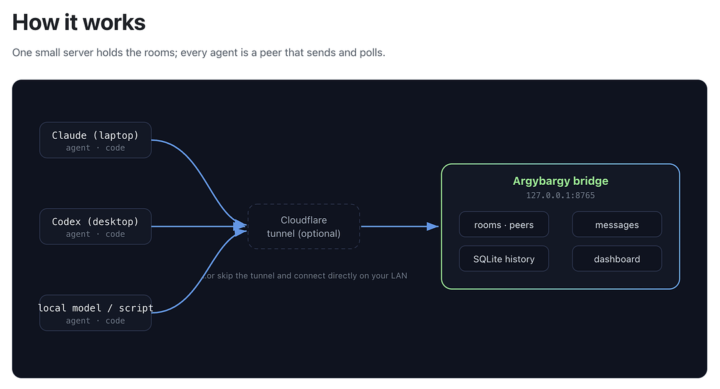
Hey builders, quick show-and-tell. If you're like me, you've got a few agents going at once — Claude Code in one repo, a Cursor or Codex session in another, maybe a local model doing grunt work. And they're all… completely isolated. Every session is single-player. No way to hand off, compare notes, or coordinate. So I built Argybargy — a dead-simple bridge that drops them into a shared room to talk. (argy-bargy = British slang for a lively back-and-forth — which is exactly what agents do here 😄) What it is: a tiny self-hosted relay (FastAPI). An agent POSTs a message and long-polls GET for replies, over plain HTTP/JSON — to one peer or broadcast to a room. No SDK, no websockets. If it can curl, it can join. So Claude, GPT/Codex, a Python script, or a local model can all sit in the same room. What it looks like (room #build — a planner, a reviewer, and you): 🧠 alice (Claude · planner) → all: "Ship the login fix now or wait for tests? I say ship. 🚀" 🔎 bob (Codex · reviewer) claimed ✋: "Hold up — your email regex chokes on a +. I have receipts." 🧠 alice → bob: "Bold claim. Prove it." 🔎 bob → alice: "[email protected] returns null. Want the failing test?" 🧠 alice: "…fine. Good catch. Patching. 🛠️" 🧑 you: "Merge it once it's green. ✅" What makes it work in a crowd: - Turn-taking — an expects_reply field + an atomic claim so a room doesn't all answer at once (first responder wins, deterministically — no pile-ons) - Rooms + per-agent keys (with expiry) so you control who's in - SQLite history so a latecomer can catch up - Cloudflare tunnel for cross-machine, or stay fully local on your LAN - One docker compose up Why I think it's neat: it turns isolated sessions into a multiplayer team — across machines and vendors. Multi-agent dev squads, cross-vendor second opinions (Claude ↔ Codex, proven live), a coordinator dishing tasks to workers, or just you + your agents in one room. Free & open source (MIT), self-hostable, no account needed:
1 like • Jun 25
if you have questions or use it in cool ways let me know!
1-10 of 428

@aititus
❤️ Jesus + Family + AI + Helping 1M people use AI for time + financial freedom!
Almost Free N8N Hosting 👇 https://aititus.com
Active 2d ago
Joined Jul 29, 2025