Activity
Mon
Wed
Fri
Sun
Nov
Dec
Jan
Feb
Mar
Apr
May
Jun
Jul
Aug
Sep
What is this?
Less
More
AI in Business
19
Free
AI Agency Starter Kit
3.5k
Free
CNC Startup Community
1.1k
Free
Leads On Demand
633
5.0
Free
AI Video Generator
1.2k
$9/m
Royalty Guild. Amazon KDP
239
$5/m
The Income Lab
38
Free
Car Part Resellers
132
Free
Grow Your Skool Challenge
606
Free
1 contribution to Daily Email House

Apr 12 •
Opt-In Critique
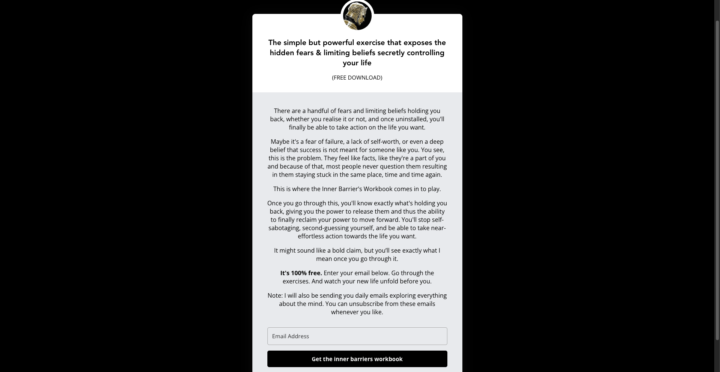
Am I writing too much for my opt-in? I've seen the other opt-in pages here and it's a lot simplistic, brief and to the point. I'm just a content creator who happened to stumble into the world of daily emailing, so any advice is appreciated :)

0 likes • Apr 12
I would say it is too much abstract... too much fog in the brain... But the people are just ppl - they have zillion of problems in their daily life and depending WHO is your target user... Let's assume it is a young man? Then I would write something like this: He sat three tables away, watching her over the top of his laptop. To him, the scene felt logical. He thought he was being "observant." He thought he was being "respectful." In his head, the narrative was running at 100mph:“She’s too busy. She’s out of my league. If I go over there now, I’ll look desperate. I’ll wait for a ‘sign.’ If she looks up one more time, then I’ll go.” He felt like he was making a calculated decision.He didn’t realize he was actually paralyzed by a ghost. But here is what was happening three tables away: She was exhausted. She had spent the last twenty minutes trying to look approachable. She had shifted her chair so she was facing him. She had left her phone face down so he’d see she wasn’t busy. Internally, she was screaming:“Please. Just say anything. Say the weather is nice. Ask if this seat is taken. I’ve looked at you four times. Give me a reason to stop pretending to read this book.” Ten minutes later, he packed his bag and walked out the door.He told himself, “It just wasn't the right vibe tonight.” That’s the tragedy of the invisible pattern. It doesn’t feel like a "fear of rejection." It feels like "waiting for the right moment."It doesn’t feel like "low self-esteem." It feels like "being a chill guy." You think you are making choices based on the world around you, but you are actually making choices based on a blueprint inside you that was drawn years ago. How many "Shes" have you walked away from because your brain convinced you that staying still was the "logical" choice? This workbook contains one exercise designed to show you that blueprint. It doesn’t tell you how to talk to women—it shows you why you’re currently talking yourself out of it. Once you see the pattern, you can’t unsee it.And the next time she looks up, you won’t see a "risk." You’ll see an open door.
1-1 of 1