Activity
Mon
Wed
Fri
Sun
Nov
Dec
Jan
Feb
Mar
Apr
May
Jun
Jul
Aug
Sep
What is this?
Less
More
Peptide Hub
516
$400/m
Peptide Researchers
8.1k
Free
Castore: Built to Adapt
1.2k
5.0
Free
TPC ARMY
240
5.0
$200/m
44 contributions to Castore: Built to Adapt

Jan 3 •
Sleep, Rewritten: Why Kids Sleep, Adults Don’t, and How to Restore the Signal Part 1
If you watch a child fall asleep, it looks effortless. Not because the child is relaxed or well behaved, but because nothing inside them is fighting the process. Sleep is not something the brain turns on. Sleep happens when nothing is left on. That distinction matters. Children fall asleep because their systems are quiet by default. Adults lie awake because their systems never fully stand down. Think of sleep like landing a plane. Kids approach the runway with clear airspace, working instruments, and a cooperative control tower. Adults are trying to land during a storm, with half the gauges flickering, while still answering emails from the cockpit. The issue is not motivation. It is interference. Biological coherence means all systems agree on three things at the same time. What time it is. What state the body is in. And what the priority should be. In children, these signals are aligned. Light exposure matches the sun. Food intake follows hunger. Movement happens outdoors. Stress resolves quickly. Sleep pressure builds naturally. Nothing has to be forced. In adults, those signals are fragmented. People wake before sunrise under artificial light. They eat late while stressed. They spend most of the day indoors. They carry unresolved cognitive load into the evening. They ask the brain to shut off while feeding it stimulation. Sleep does not fail because melatonin is low. Melatonin is low because the brain does not believe it is nighttime. Children do not need magnesium, glycine, mouth tape, white noise machines, or expensive mattresses because none of those fix the root problem. Children do not have chronic circadian drift. They do not live in a constant sympathetic state. Their blood sugar is more stable. Their mitochondria are more efficient. Their nervous systems are not flooded with anticipatory stress. Adults have all of these issues layered together. So adults try to override biology instead of restoring it. That is the sleep industry in one sentence. One of the biggest blind spots in sleep discussions is safety. Sleep is a vulnerable state. The brain will not enter it unless it feels safe at a biological level, not a psychological one. Children feel safe because they are not responsible for outcomes. They are not anticipating tomorrow. Stress resolves quickly in their system. Their environment is predictable. Their bodies trust the signal to let go.

0 likes • 12h
"The real question is not how do I sleep better. The real question is what signals am I giving my body all day long. Sleep reflects the day that came before it, and the years that came before that. If you try to solve sleep at night, you are always late. Sleep is the receipt, not the purchase." I hate the pale of water at the end type solutions!!!! Tnx curt

Aug 25 •
Blood pressure help
Looking for something to help lower my blood pressure, which typically sits around 150/80. Open to peptides or supplements.. especially anything you’ve personally had good results with.
1 like • 12h
IMHO everyone over 50iish should be taking NOx, nitric oxide boosters. We drop off like all hormones etc. https://www.amazon.com/dp/B0D3SMDLRG AM and PM. both sexes a PE5 inhibitor; 5mg cialis in PM 7 days/week forever. Re test BP 3x a day for a week. If more help, then this is a low side effect and has broader health benefits as well drug I also take for longevity and some glucose sensitivity rolled into one. 40mg telimisartan For additional glucose control which can under lie hypertension I take the OTCS for glucose control, MOTSC 2mg 3x a week AND - SGLT2, dapagliflozen (??) 10mg - Imeglimin 1000mg 2x day. Both have side effects of better health and healthspan extension. I buy both from India via email/telegram contacts. BUT any US MD should prescribe especialy if you go a functional sports / HRT clinic. Oh right, you need all your hormones normalized. Nothing functions well when low. Take control, buy you own full blood panels. Then go to one of the online hormone clinics. Dump local know-nothing insurance based MDs. You are here because you already realize health is only found in the cash based system. best, curt
0 likes • 12h
Motsc at 1-2mg 2-3x a week is well known for raising insulin sensitivity. BUT diet and excersize is the first stop in better health. A true keto, meat oriented diet is most effective. Drugs on top of a pizza diet is wasting time and $$. OTCs are in play here. https://www.google.com/search?client=opera&q=OTCs+to+increase+insulin+sensitivity&sourceid=opera&ie=UTF-8&oe=UTF-8 Weight lifting, enough weight to fatique in 10 reps is a good strategy. MEE min effictive effort. Goal; triglicerides <70, HDL >60, A1C <5.6 or better, fasted insulin <10 ideally <6. GLP-1's at low dose if no weight to loose is also a big help. I'm 10.5% body fat yet micro dose tirzepitide at 1mg total / week or less in 2 doses. Actually run around 750mcg in 2 doses. I also reco everyone needs to wear a CGM for a mo 2x a year as a glucose spike checkup. We like the Lingo OTC off Amazon best for best accuracy and resolution. curt

May 15 •
Eczema
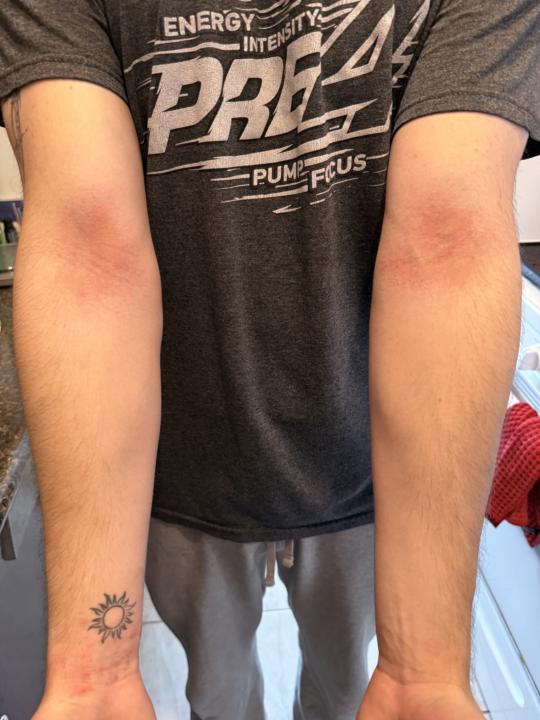
Looking for some guidance- my 20 year old son has been battling eczema for the last couple of years. After a strict diet change (gf no dairy) some gut rebuilding and 1 cycle of GHK KPv - big improvement (almost fully cleared up). Took a 2 week break then restarted and it is now 10x worse. He trains 4x a week but his job (server) can be long hours and the sweat makes things worse.
1 like • 13h
@Simone Young Agree!!! We buy grass finished regeneratively grown beef from piedmontese.com and other direct to ranch sources who use exclusively regenerative raising tactics. Might also be called mob-grazing, frequent movement via portable electric fences. HUGE improvement in omega 3 vs omega 6 and I didnt know about lectins. Not surprised. We don't buy industrial vegitables either (krogger et al) and largely avoid vegetables. Read the book; Toxic super foods by Sally Norton. Best, curt
1 like • 13h
@Anthony Castore Metagenics SMS supreme at >>5 / day also helps suppres MCAs in a supportive way. The source of this uses 10pills / day for her patients. https://www.iherb.com/pr/metagenics-spm-active-body-joint-soreness-60-softgels/125363 Tnx curt
Nov '25 •
Understanding Redox: The Last Article You Will Ever Need To Read And The Keys To The Kingdom
Redox is one of those concepts that everyone has heard of but very few people truly grasp, and yet almost everything in human physiology depends on it. For trainers and clinicians, redox is the hidden language that tells you why someone can train hard one day and crash the next, why fat loss stalls even with perfect macros, why motivation drops without a psychological trigger, why inflammation rises mysteriously, or why protocols that used to work suddenly stop producing results. Redox isn’t a supplement, a lab marker, or a buzzword. It is the most fundamental process life uses to create energy, repair damage, and adapt to stress. When redox flows, people adapt. When it gets stuck, people stagnate. Understanding redox at a deep level gives you the ability to see beneath symptoms, beneath lab markers, beneath surface-level physiology, and down into the actual physics and molecular dynamics that determine whether a person is moving toward resilience or toward dysfunction. This redox deep dive will walk through what redox is, why it matters, how it gets stuck, what “stuck” actually means at the molecular level, and how different stressors push the system into different dysfunctional patterns. Throughout this, I’ll use analogies and imagery that make the invisible world of electrons and membranes feel intuitive and concrete, allowing you to visualize exactly what is happening inside cells when energy is being made—or when the system jams. You’ll see how mitochondrial membranes behave like electrical waterfalls, how electrons move like crowds of people flowing through hallways, how redox imbalance can freeze a system the way traffic jams choke off a city, and how trainers and clinicians unintentionally worsen stuck redox by focusing on quantity of activity instead of the phase of the system. Redox is short for reduction and oxidation the transfer of electrons. To understand why this matters, imagine every cell in your body as a tiny city. Energy isn’t created in one burst; it’s created by passing electrons down a series of steps, like handing a baton from one runner to the next. Reduction is when a molecule gains electrons, oxidation is when it loses electrons. In biology, electrons fall down an energetic staircase inside mitochondria called the electron transport chain. As electrons move, they power tiny pumps that push protons across a membrane, building what can be imagined as a “pressure gradient” or electrical tension. This tension the mitochondrial membrane potential is like the charged battery that lets ATP synthase spin and generate ATP. Think of it like water flowing through a hydroelectric dam: the higher the water pressure behind the dam, the more electricity you can generate. If the water level drops too low, the turbine stops. If the dam wall gets blocked and pressure rises too high, the system becomes dangerous. Mitochondria work exactly the same way. Redox is the management of electron flow across the mitochondrial inner membrane. Everything hinges on whether electrons are moving, whether they have somewhere to go, whether the membrane potential is balanced, and whether the cell can match energy demand with supply.
2 likes • Dec '25
My question is how to know (guess) what state one is in? IMHO this gap has lead me / many others into the kitchen sink protocols probably setting things back. LOL 🤣
1 like • 13d
@Ed Stacey owning an hbot, I suggest watching on YouTube, hbot therapy. Hbot to me is a catalyst, aid to restore. Meaning it's a benefit for being sick, peripheral nerapohty, TBI, autism, hung over. Typically 10+ treatments, 20 is in range. 1.3 ata is still very efficacy no need for higher pressures. I do light calestics inside. I own a standup , sit down unit. Curt
1-10 of 44

@curtis-smith-7832
72yro male, 164#, 5'10", 31" waist, healthy, active, poly-nutricals, rapamycin 4yr, SGLT-2 etc, anti-aging / health span interests. Atlanta Georgia.
Active 11h ago
Joined Dec 26, 2025
Atlanta, Georgia, USA
Powered by