Activity
Mon
Wed
Fri
Sun
May
Jun
Jul
Aug
Sep
Oct
Nov
Dec
Jan
Feb
Mar
Apr
What is this?
Less
More
Owned by Collin
Premier hub for intelligent betting - offering winning picks, a transparent record, proven strategies, expert support, and a place to celebrate wins.
Memberships
Swing Trading Desk
7 members • $59/month
The Digital Marketing Bar
68.5k members • Free
Skool Speedrun
12k members • $9/month
BettrNation
802 members • Free
Bettor Bonfire
364 members • Free
Skoolers
193.3k members • Free
13 contributions to Swing Trading Desk

10d •
Weekly Watchlist — Full Zone Map + Game Plans (March 31)
The market is in distribution. Here's my full read across 8 names — zones, scenarios, and game plans. ZONE MAP — screenshot this for your charts: SPX — Supply — 6,542-6,616 — Distribution supply (short zone) ARM — Supply — 159-183 — Active short (entered last week) ARM — TP zone — 140-125 — Take profit area ARM — Extended target — 100 — If momentum continues META — Gap fill — 506-516 — Want filled before DCA begins META — Demand floor — 479 — Bottom of HTF demand META — T1 — 640 — First profit target PLTR — Demand — 126-138 — Low quality bounce play PLTR — Short entry — ~155 — Short on retrace PLTR — Bounce target — ~150 — Quick long exit AMZN — Demand 1 — 183-196 — Upper demand zone AMZN — Demand 2 — 165-178 — Lower demand zone NVDA — Supply — 188-197 — Short zone XAUUSD — Range — ~4,100-4,700 — Consolidation (low confidence) MU — POC / Supply — ~420 — Short zone ACTION RIGHT NOW: Set alerts at SPX 6,542 · ARM 140 · META 516 and 479 · PLTR 138 and 155 · AMZN 196 and 178 · NVDA 188 · MU 420. When one hits, come back to this post — your game plan is below. The market environment is distribution across most names. I'm biased short until structure says otherwise. Here's exactly what I'm watching and what I'll do when each scenario triggers. ━━━━━━━━━━━━━━━━━━━━━━━━━━━━ SPX 500 — Short from 6,542-6,616 (distribution supply) Clear distribution phase. Previous price action around these levels has been super efficient — the easiest path forward is down. I see at minimum a few more percentage points of downside unless a real catalyst changes the picture. Trigger: Price pulls into 6,542-6,616 + LTF rejection / selling pressure. 1. Watch for 1hr rejection or structure break inside the zone 2. Enter short on confirmed LTF selling pressure 3. Stop: Above 6,616 (above the supply zone) 4. Targets: Watching for continuation lower — will update with specific levels as price develops 5. Risk: 0.5% of account Why 6,600 is the highest probability level: Previous price action here was efficient — price moved through quickly without leaving unfilled orders. That efficiency means there's no demand to absorb selling. When price returns to an efficient area, it tends to continue in the same direction — down.

1 like • 9d
This is thorough. Nice work
17d •
Sunday Breakdown Tonight — Chart Requests Open
Building out the weekly breakdown and watchlist this evening. Market context + individual setups. Before I finalize — what are you watching? Drop a comment: — Any ticker you want a full execution read on? — Sector you're leaning into this week? — Anything from last week's setups you want a follow-up on? I'll work your requests into tonight's breakdown. Most-requested names get full execution packages with levels. Post below. Building this for you.
1 like • 17d
SMR. As a long term hold as well as a potential swing. Looks like it's nearly at the end of a distribution phase
21d •
For the Investors in Here
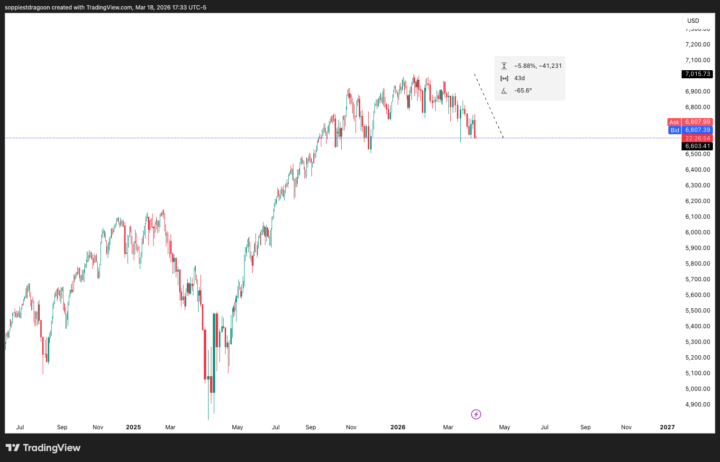
Let me be clear — this is NOT a trade. Not a setup. Just awareness. The Fear & Greed Index is at extreme fear. SPY has been consolidating since September 2025. And yet — we're only 5-6% from all-time highs. Extreme fear... 5% from the top. That gap between sentiment and reality is where most retail investors make mistakes. They sell when it feels scary and buy when it feels safe. That's backwards. The mechanical approach: If you have a long-term investment account (retirement, index funds, etc.), you don't need to figure out what's "going to happen." You need a system that removes emotion from the equation. Dollar cost averaging exists for exactly this reason. You buy on schedule. Not when it feels good. Not when headlines tell you it's safe. On schedule. Mechanically. The key is position sizing. You're not going all-in. You're allocating a portion — because either outcome works in your favor: IF SPY drops further → great. You buy more at lower prices. Your next DCA entry is cheaper. IF SPY doesn't drop further → you bought near a local bottom while everyone else was paralyzed by fear. That's the beauty of mechanical investing. You don't need to be right about direction. You need to be consistent with process. What I do personally: I DCA into my long-term index positions on schedule. Every time. I don't check the headlines first. I don't ask myself "is now a good time?" That's what the trading account is for — structure, levels, defined risk. The investment account runs on autopilot. Two accounts. Two mindsets. One is mechanical (investing). One is structural (trading). Never mix them. This is NOT financial advice. Your situation is yours to manage. --- How do you separate your trading brain from your investing brain? Curious how the group handles this — drop a comment.
1 like • 20d
I want it to drop more. This is barely a discount smfh
1 like • 20d
@Albert Wang that's true. I do feel like all the conditions are right for a larger drop though. Geopolitics are bad. Macroeconomics are bad. Inflation is going to get worse now before it gets better. But I know what they say about the market staying irrational. Best thing to do is DCA mechanically like you said, I suppose.
23d •
Cruise Line Sector — Ticker Request Breakdown
Someone asked about the cruise line sector. Here’s my read on all three names. --- CCL (Carnival) — Bullish (Position Trade Potential) Price is dropping right now. I’m not interested in trading this drop. What I am watching: price is trading into higher timeframe accumulation. There’s a fairly large demand zone at 15.07-21.78 that could be an entry if price retraces that far. There’s also a price inefficiency at 20.50-21.55 — price moved through here too fast and gaps like that tend to get filled. This one has potential as a position trade, but for me to get interested, price has to pull back further into that demand. GAME PLAN IF price retraces into 15.07-21.78 → potential long entry IF price fills the inefficiency at 20.50-21.55 and holds → early sign of buyer interest IF price breaks below 15.07 → thesis invalidated Risk: 0.5-1% of account per setup. Daily chart --- RCL (Royal Caribbean) — Bullish (Better Option If You Like Cruise Lines) If you’re bullish on cruise lines, RCL is the cleaner setup right now. Price is trading between HTF supply at 335.33-356.17 and HTF demand at 245.25-268.55. Right now price is near or inside that HTF demand — that’s good positioning. The issue: lower timeframe hasn’t shown strength yet — meaning on the shorter charts (1hr, 4hr), buyers haven’t proven they’re stepping in. No confirmation yet. Two approaches: 1. DCA approach (early entry): If you’re keen on entering before lower timeframe confirms, you can buy in small increments as price pulls deeper into the demand zone, as long as price respects the lower bound at 245.25. The idea is you’re building a position gradually rather than going all-in at one level. If 245.25 breaks, thesis is done — exit everything. Why consider this? Sometimes price bounces perfectly off the demand zone and we never get that clean lower timeframe confirmation. DCA lets you participate if that happens, at the cost of a wider average entry.
0 likes • 23d
Thanks man
24d •
Ticker Requests — Drop Them Here
Putting together this week's watchlist. If there's a name you want me to run through the framework, drop it below. I'll pull up the structure, check for clean zones, and if it scores well enough, it gets a full execution package with levels. What do you want me to look at?
1 like • 23d
Take a look at cruise lines. CCL, RCL, NCLH
1-10 of 13