Activity
Mon
Wed
Fri
Sun
Mar
Apr
May
Jun
Jul
Aug
Sep
Oct
Nov
Dec
Jan
Feb
What is this?
Less
More
Memberships
Project Biohacked
9.9k members • Free
Peptide Price
9.2k members • Free
Biohacking Peptide Playground
3.3k members • Free
Peptide Researchers
6.1k members • Free
13 contributions to Peptide Price

5d •
Energy peptide advice…..
I have a friend who is 68 years old and is interested in peptides for energy. I know it’s quite the rabbit hole. I have been using multiple peptides with great success, but I’m not sure that that’s the direction to recommend. What is best practice here?

🔥
6d •
Your Mitochondria Are Working Harder — Are You Keeping Up?
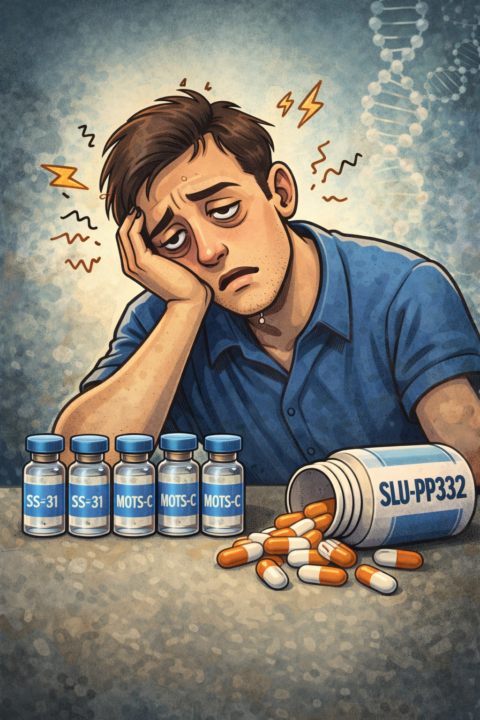
Let me walk you through something that almost nobody is talking about in the peptide space right now. If you push mitochondrial output hard without supporting antioxidant systems, you can create more stress than benefit — even though you’re using “energy-boosting” compounds. This came up while I was researching higher-dose SLU-PP-332 and looking deeper at mitochondrial up-regulation. Almost no one talks about this part. Make sure to read the whole post because it will benefit you in understanding oxidative stress and how to mitigate it. Let me break it down simply. You have tiny power plants inside every single cell in your body. They're called mitochondria. Their job is simple — take the food you eat and the oxygen you breathe and turn it into energy. The better they work, the better you feel. More energy. Faster recovery. Sharper thinking. That's the whole game. That's why mitochondrial peptides are so popular in research right now. Compounds like SS-31 and MOTS-C are designed to do two things: make your existing power plants run better, and tell your body to build brand new ones. At low doses, individually, these compounds are generally well-tolerated in research. Your body can handle the modest increase in output without much issue. But here's where it gets interesting. When You Start Stacking, The Math Changes The whole point of combining SS-31 with MOTS-C (or adding SLU-PP-332 on top) is synergy. You're not just nudging one pathway — you're pushing multiple mitochondrial pathways at the same time. More efficiency. More new mitochondria. Significantly more total energy output. That's the goal. And it works. But every power plant produces exhaust. At low individual doses, the exhaust is manageable. Your body has a built-in cleanup crew that handles it no problem. When you stack these compounds and really push mitochondrial output, you're now running way more power plants at way higher capacity. The exhaust — called reactive oxygen species (ROS), basically tiny molecular wrecking balls — scales up fast. And if your cleanup crew can't keep pace with that new volume of exhaust, it starts piling up inside your cells. That's called oxidative stress. And it can quietly undo the very benefits you're chasing.
0 likes • 6d
Thanks for the great information! I've recently started NAD+ and Glutathione.....WOW! The energy is incredible!
0 likes • 6d
@Derek Pruski Thank you!
22d •
Switching from Reta to Tirz
I’ve heard from a few people now that Tirz has really helped them with inflammation based pain. As I have a considerable amount of daily pain, I was thinking of seeing if it helps me. I’m currently on a very low dose of Reta (1mg/wk). What is the best way to transition? Again, I’m not looking for weight loss, just a reduction in pain. Thank you in advance!
0 likes • 18d
@Jeanette L that's very interesting! Thank you!
0 likes • 7d
@Derek Pruski What would you suggest my starting does be on Tirz?
🔥
10d •
If You Don't Get a Sting from GHK-Cu, Is It Fake?
Short answer: No. Let me explain why. This post is for educational and research purposes only. This is not medical advice. This is one of the most common questions I get, and I totally understand the concern. You spend your hard-earned money on a peptide, you reconstitute it, administer it, and... nothing. No sting. No burn. Meanwhile someone else is posting about how theirs lit them up like a campfire. So what gives? Let's walk through what's actually happening here. Why GHK-Cu stings in the first place GHK-Cu is a copper peptide. That copper component gives the solution a slightly acidic pH, usually somewhere around 4.5 to 5.5 once reconstituted. Your body's tissues, specifically the fluid between your cells (called interstitial fluid), sit right around a pH of 7.4. That's slightly alkaline. So when a mildly acidic solution meets tissue that's slightly alkaline, the body notices. That mismatch is what creates the sting. It's essentially a mild chemical irritation, not damage, just nerve endings going "hey, that's different." Think of it like squeezing lemon juice on a paper cut. The lemon juice isn't destroying your hand. Your nerves are just reacting to the pH difference on exposed tissue. So why do some people feel nothing? This is where it gets interesting, and why you can't use sting as a quality check. Individual pH varies. Not everyone's tissue pH is identical. Things like hydration levels, what you've eaten recently, your body's acid-base balance, even how much you've been exercising that day can slightly shift your local tissue pH. A person who's very well hydrated might have tissue that buffers that acidity faster, meaning less sting. Administration site matters a lot. Subcutaneous tissue isn't the same everywhere on your body. Your lower belly has a different nerve density and blood supply than, say, your upper arm or your love handle area. More nerve endings in an area means more sensation. Better blood supply means the solution gets absorbed and buffered faster. Same peptide, same concentration, two totally different experiences depending on the site.

1 like • 10d
I’ve tried the sub Q multiple times, diluting it more and more each time. It still burns for at least a day. With intramuscular, no issues whatsoever.
🔥
17d •
Do the Benefits from MOTS-C and SS-31 Stop When You Stop Researching Them?
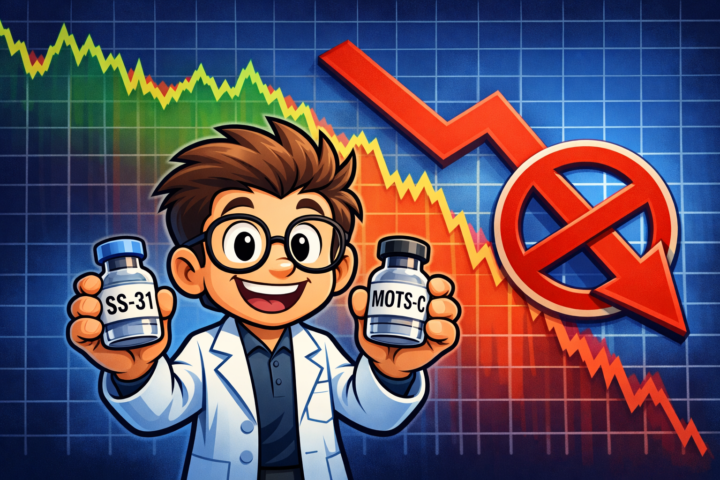
This is one of the most common questions I get about mitochondrial peptides, and the answer is more nuanced than a simple yes or no. Let me break down what's actually happening at the cellular level. What These Peptides Actually Do MOTS-C and SS-31 work through different but complementary mechanisms to improve mitochondrial function. Your mitochondria are the powerhouses inside your cells that produce ATP, which is essentially the energy currency your body runs on. When your mitochondria work better, you have more energy, better metabolism, and improved overall cellular health. MOTS-C is a mitochondrial-derived peptide, meaning it's actually a signaling molecule that your mitochondria naturally produce. When you supplement with it, you're amplifying signals your body already recognizes. It activates something called AMPK, which is your cellular energy sensor—think of it like a thermostat that detects when energy is low and kicks on processes to produce more. MOTS-C also enhances glucose uptake (how well your cells absorb sugar from your blood for energy) and improves insulin sensitivity (how responsive your cells are to insulin's signal to take in that glucose). One of its most important functions is promoting mitochondrial biogenesis, which is simply the creation of brand new mitochondria. More mitochondria means more energy production capacity. It also helps regulate fatty acid oxidation (your body's ability to burn fat for fuel) and reduces oxidative stress (the cellular damage caused by unstable molecules called free radicals). SS-31, also known as Elamipretide, works differently. It targets the inner mitochondrial membrane directly, which is where the magic of energy production actually happens. It binds to something called cardiolipin, a special fat molecule that's essential for keeping the electron transport chain running smoothly. The electron transport chain is basically an assembly line inside your mitochondria that produces ATP. When SS-31 stabilizes this process, it reduces reactive oxygen species production (those damaging free radicals I mentioned) and improves ATP synthesis efficiency, meaning you get more energy output with less cellular damage.
0 likes • 15d
@Lisa G is am and pm dosing recommended for NAD+ & Glutathione? I'm about 1 week in and have only done am dosing. The energy is pretty amazing and would love it mid-day as well. Would I split the dose between the two, or use the same dose each time?
0 likes • 15d
@Lisa G I wonder if I could split it. Thoughts? I’m thinking early and then late morning.
1-10 of 13

@cheryl-cohen-6172
Living with Ehlers Danlos Syndrome looking to improve quality of life.
Active 9h ago
Joined Jan 1, 2026