Activity
Mon
Wed
Fri
Sun
Mar
Apr
May
Jun
Jul
Aug
Sep
Oct
Nov
Dec
Jan
Feb
What is this?
Less
More
Owned by Carlo
The group for bilinguals, trilinguals and polyglots to connect, learn new languages and rebuild our cultures back. Join for Free
Memberships
Real Reels
106 members • Free
The AI Hub
263 members • Free
The Buyer's Mind
48 members • Free
Advertise Your Skool
911 members • Free
The Skool Hub
4.6k members • Free
Ascend Collective
70 members • Free
Skoolers
190k members • Free
ECOM Capital Nurture Community
1k members • Free
Be Inspired Fitness & Coaching
421 members • $60/m
6 contributions to The Buyer's Mind

7d •
What Does Status Mean To You?
https://www.instagram.com/reel/DUQ0Up3CC_j/?utm_source=ig_web_copy_link&igsh=MzRlODBiNWFlZA== People are moved by status more than almost anything else. When opportunity is combined with status, achievement, believability, or authority, it creates a powerful mix. This process happens pre-consciously. People don’t sit there logically calculating it. They feel it first, then rationalise it later. This is where the idea of conspicuous consumption came from. Social systems were engineered to reward the visible display of status. At the core of nearly every buying decision is a simple internal question running in the background: Will this elevate my status, or will it diminish it? You can’t usually say this directly. You can’t sell “status” head-on. But the best brands understand it intuitively. Apple is a perfect example. The product works, yes, but the icon itself is a status signal. Buying feels good because it subtly increases how the buyer sees themselves and how they believe others see them. Higher status attracts more buyers. People want to buy from those they perceive as worthy partners. That association increases their own status. This is why people want to be coached by “the best coach,” even if that coach isn’t objectively the smartest or the best teacher. Being able to say “I’m learning from X” carries social weight. Every proposal, presentation, or offer triggers an unconscious mental equation. It isn’t verbal. It isn’t logical. The decision brain doesn’t use language. It reacts to primal signals. If there’s a perceived risk of status reversal, people hesitate. If there’s a strong chance of status elevation with little downside, action becomes easy. This is why improvement-based offers work best when there’s nothing to lose. Faster. Stronger. Smarter. Better. When the perceived risk to status is zero, resistance drops. An example of this kind of framing looks like this:

2 likes • 7d
A marvellous insight into status driving the modelling of buying decisions and behaviour
10d •
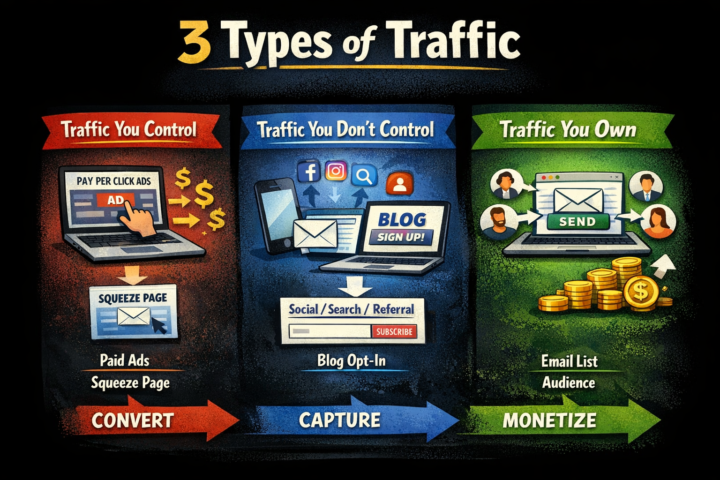
The 3 Types of Traffic
There are only three types of traffic. 1️⃣ Traffic you control. You control traffic when you have the ability to tell it where to go. For example, when you purchase an ad on Google, you don’t own that traffic, but you do control it. By buying the ad, you decide exactly where the people who click are sent. Any form of paid traffic falls into this category. The main problem with traffic you control is that every time you want more of it, you have to spend more money. Because of that, the goal is always to send purchased traffic to a squeeze page. A squeeze page has one goal and no distractions. There is only one thing for the visitor to do. It exists for a single purpose: to convert traffic you control into traffic you own. When paid traffic is sent to a squeeze page, visitors only have two options. They either give you their email address or they leave. Some people will leave, but a percentage will give you a personal email address. Once that happens, traffic you controlled becomes traffic you own, and you can move that person through your sales sequences. 2️⃣ Traffic you don’t control. This type of traffic simply shows up. You don’t control where it came from or where it goes. For example, someone might mention your brand on Facebook, their followers search your name, and they land on a random blog page. You had no control over that chain of events. Just like traffic you control, the only goal with traffic you don’t control is to turn it into traffic you own. The way to do this is by pushing all uncontrolled traffic back to your blog. The top third of your blog can function as a modified squeeze page. When people arrive, the primary action available to them is to give you their email address. Once they do, they become traffic you own and can be placed into your communication funnels. Blog posts should be structured as modified squeeze pages to convert as much uncontrolled traffic as possible into owned traffic. 3️⃣ Traffic you own. This is the best kind of traffic.
Poll
3 members have voted
1 like • 10d
It's certainly easier on the bank balance for traffic I own, however doing the grunt work is what's required in this traffic system. Building it up where I have others generate the traffic is the goal for me here.
0 likes • 10d
@Joshua Whitlock Hire people to send messages and create ads
12d •
DM's To Dollars Has Moved 👀
Most content people encounter online is informational. It gives context, perspective, or awareness. It helps someone understand a topic better, but it doesn’t necessarily change what they are capable of doing once the information is consumed. It informs, but it doesn’t transform. Skill-based material is different. A skill is something that alters your behaviour in real situations. It changes how you act, how you respond, and what results you can reliably produce. When a skill is learned and applied correctly, it creates outcomes independent of motivation, mood, or inspiration. Free information is abundant because it’s low-risk to give away. It helps people think differently, but it rarely forces change. Paid skills, on the other hand, tend to require commitment because they only work when someone is willing to practice, apply, and refine them through repetition. The DMs to Dollars course falls firmly into the category of paid skill development. It does not exist to be read once or understood conceptually. It exists to shape how conversations unfold when money is involved. It teaches the mechanics of momentum, decision-making, hesitation, and progression inside one-to-one interactions where outcomes actually happen. When applied correctly, it can directly generate revenue. The return on that skill is not capped, because the same principles can be applied repeatedly across different conversations, offers, and contexts. This is why skill-based material cannot be treated the same way as general-access information. Information increases awareness. Skills increase capability. And capabilities are what create leverage. A person with more information may feel more confident, but a person with better skills produces better outcomes regardless of how confident they feel. That’s why skills compound while information plateaus. Because of that, skills that have a direct impact on revenue need to be positioned differently. They belong in environments where people have consciously opted into execution, not casual consumption.
1 like • 11d
I was just using it before it went to premium. Highly recommend.
0 likes • 10d
@Santana Vega Yturralde I'm good. Business and travel are okay, building it better on here. Let's absolutely go.
12d •
Day 2 - The Fear Of Judgement
https://www.instagram.com/reel/DUFrDsJDhhC/?utm_source=ig_web_copy_link&igsh=NTc4MTIwNjQ2YQ== The closer you get to the edge of your comfort zone, the more outside of your known world you are. For most people, this loss of certainty and state of confusion is an uncomfortable experience. Whilst some rise to the challenges, the majority will retreat back to the known. It is a retreat back to security, comfort and certainty. The edge of comfort zones is unfamiliar territory, it is unknown, and it is scary. Comfort is familiar, and familiarity leads to certainty, one of the most powerful of human motivators. People who are strongly motivated by certainty always default to the familiar. They resist change by maintaining old patterns. Familiarity is certainty, and certainty generates feelings of reassurance, pleasure, dependability, satisfaction and knowing what is happening. It is the breakdown of familiarity and certainty that most people fear the most because it affects habitual patterns. In any process of change, it takes courage to leave the familiar and travel towards the unknown. If you have a high need for certainty in your life, there is little possibility of change taking place because, by definition, change is an uncertain activity and it destabilises the way people choose to organise their lives. Any talk of major change will be seen as a threat, an attack on the familiar, and will be met with strong resistance. Certainty is about doing the same things over and over again because it is comforting. Whilst people complain about their financial results, at least they are familiar and they can keep reproducing them. There is no mystery in comfort, there are no adventures, no challenges beyond survival, no requirements beyond the known, no variety beyond misfortune, no newness beyond consistency, no progress beyond immediate gratification, and no demands beyond the daily immersion in the 'rat race.
2 likes • 12d
I relate to this post so much, living in resistance is heavy
Dec '25 •
📌 Community Standards: Read Before Participating!!!
Welcome to The Buyer’s Mind! A community for people who want to think deeper, communicate smarter, and master the psychology behind why people buy. This group lives and dies by quality. The only way to maintain that quality is through clear standards that keep the environment sharp, focused, and genuinely valuable for everyone inside. Here’s how this community works 👇 1️⃣ Engagement Is Required (Minimum: 1 Contribution Every 14 Days) This is an engagement-first environment. Not a passive “join and drift” group. To stay active in the community, you must contribute at least once every 14 days in one of the following ways: ✔ Comment meaningfully on a discussion Add insight, perspective, or a real question.(“Nice post” or an emoji doesn’t count.) ✔ Start a thoughtful discussion Ask a question, share an insight, or break down something you’re learning. ✔ Complete a lesson or module Skool tracks this. It counts as engagement. ✔ Share an implementation win or takeaway Show that you’re applying the work. ✔ Engage with call recaps or participate live This also counts. These actions shape the community.They keep the energy alive, the thinking sharp, and the quality high. 2️⃣ What Does NOT Count as Engagement To be clear: - Likes - Emoji reactions - “Thanks” comments - Generic replies - Silent lurking - Logging in without participating These do not count toward your engagement cycle. This community is built on active thinking, not passive consumption. 3️⃣ Inactive Members Will Be Removed If a member has 0 contributions within a 14-day period: 1. They’ll receive a DM reminder to stay active. 2. If there’s no response, they’ll be removed from the community. Nothing personal, it’s about maintaining a high-quality environment for the people who show up. You can always rejoin later when you’re ready to participate. 4️⃣ Bring Value, Not Noise No spam. No shallow posts. No vague advice. No “look at me” content. Share things that: - sharpen thinking - deepen understanding - challenge assumptions - or move conversations forward
1 like • 19d
I'm committed
1-6 of 6

@carlo-tassone-1113
CEO of the Linguists Society, avid learner, reader, traveller and doer.
Online now
Joined Jan 22, 2026
Sydney
Powered by