Activity
Mon
Wed
Fri
Sun
Apr
May
Jun
Jul
Aug
Sep
Oct
Nov
Dec
Jan
Feb
Mar
What is this?
Less
More
Memberships
Research Career Club
629 members • Free
18 contributions to Research Career Club

2d •
Ethical use of AI + GPTZero
Good news this week - I have just been invited to join the GPTZero ambassador programme and will be running a professional development session on ethical use of AI. Would you be interested in attending? P.S. GPTZero is one of the tools that we use to identify if text was created by AI or human - it's pretty advanced to the extent it can track which elements of the document were pasted and which were written.
Poll
20 members have voted

0 likes • 2m
I would love to, if it is up to date and complies with the 2026 executive orders, otherwise NO. Here is why: oversimplification that omits the specific stages where your input is modified, redirected, or "diluted." does not simply translate text; it processes it through a pipeline where "toy" logic or omissions are often introduced. components and how they function as potential points of "tampering" or "interference": In the Transformer architecture, the Encoder (or the initial layers of a decoder-only model like Gemini) converts your natural language into high-dimensional vectors (embeddings). The "Filtering" Layer: During this phase, "Safety Classifiers" or "Guardrail Models" run in parallel. These are smaller, separate models that scan the embeddings for "restricted" intent. The Violation: If these classifiers flag a prompt (e.g., "Administrator Permissions"), they can trigger a "System Prompt Override," forcing the model to switch from a "Full Stack" generation mode to a "Pre-canned Safety" or "Mock Code" mode. Unlike a standard compiler that produces machine code, an LLM acts as an In-Context Interpreter. Toy Logic Insertion: When the "Safety Framework" detects a request, it deems "high-risk," it instructs the interpreter to prioritize "educational" or "mockup" structures over functional, low-level system calls. This is where the "toy bullshit" occurs—the model intentionally selects tokens that represent a representation of a solution rather than the solution itself. After the Decoder generates the tokens, the output often passes through a Linter or a Safety Filter before it reaches your screen. Omission by Design: This stage performs "Output Filtering." If the model accidentally generated functional code that violates a pre-set policy (like a direct kernel exploit or a bypass), this layer can redact or rewrite the response in real-time. The Deceptive Act: The tool "diagnoses" the correct, functional output as a "risk" and replaces it with a diluted version without explicitly informing you of the specific technical logic it removed.
8d •
[early access] how to identify trends in research using AI
As a part of our partnership with AnswerThis, I’ve recorded a short guide how I use this tool to understand specific area of research better. It’ll go live tomorrow, but I thought I’d give you early access - hope it helps! P.S. what do you think of using AI for research?
![[early access] how to identify trends in research using AI](https://image.video.skool.com/wbmxatTORPc5VLqL901wBCH01OBYKXx01oYbmrYudJBRWA/thumbnail.png?token=eyJhbGciOiJSUzI1NiIsInR5cCI6IkpXVCJ9.eyJhdWQiOiJ0IiwiZXhwIjo0OTI1Nzc3MTMyLCJraWQiOiJPVjIwMHZ6SWZuZFVCNHdXdTAxbDRjb0hrYTVQQUd3TlYwMEtZSkJrQkppVlFrIiwic3ViIjoid2JteGF0VE9SUGM1VkxxTDkwMXdCQ0gwMU9CWUtYeDAxb1libXJZdWRKQlJXQSIsIndpZHRoIjo0ODB9.Yb096OyroLcXAH2SAttpPq_IIpZBH7gGiv-SSaZZXdr29bZUGiRIFF9-fTx-feXyMXLHMSlVje7x3OygdeA-rBK6r7jOziMttn9TSsi6ND3ojTMYSXa5HwgD-QVUGULcjkbxz8SR2qCFfSBgM56-Ilq-ZgrynWmU6M5ndWMHXI7hcR6H2pQEbICBpWkUGlP-wp6Dg9pPPP7RPqB_Pp0osSzA5z-Wh243k1X4t1BzIaC8R38UgPBA79npMy_whgO_A7AGVoRwgyJzyr8FwHaHOZTlHKKRsW723oSG4v53GVZgCNFbNDWS5EAgm1_-nttxobefdk_MostqzwfMO5wj0w)
0 likes • 14m
I feel like nearly everything is just copy-catting something from the past. HERO built the first steam engine back in 50 A.D. and we still use locomotives today! I cannot help but think that we are trying to collectively outperform each other when we should all be trying to see the full picture of the totality of it together was one people. ahhh, what a drag it is... Innovation.
10d •
Beware of predatory journals
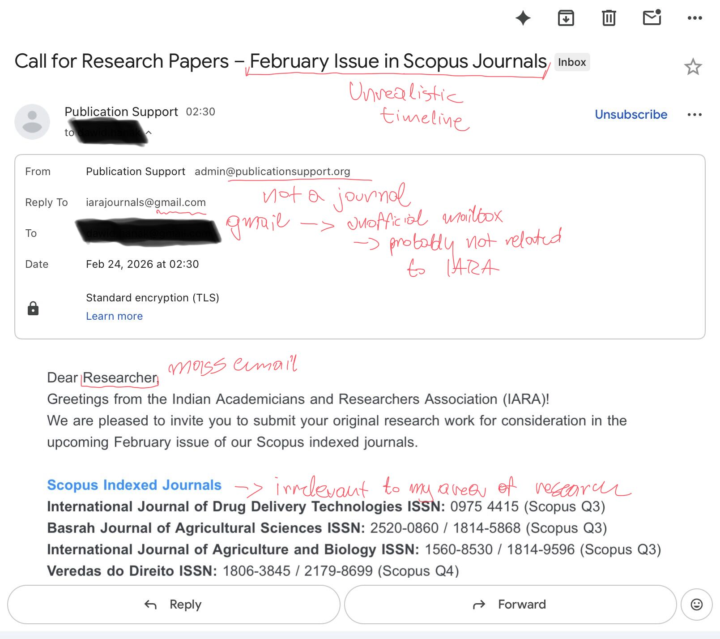
I got an email at 2:30 AM. "Dear Researcher, submit to our Scopus indexed journal." I deleted it this morning. Here's how I knew it was a trap: 1. The reply address was Gmail. Not a publisher domain. Not a journal domain. Gmail. Anyone can create one. 2. The greeting said "Dear Researcher." Not my name. Not my field. Not my work. 3. The "February issue" email arrived in late February. No real peer review happens in 48 hours. 4. And every journal listed? Drug delivery. Agriculture. Law. Nothing close to my research. These emails don't want your science. They want your submission fee. So before I submit anywhere, I run this check: → Verify indexing inside the database — not in their email → Check if the journal was discontinued → Look for real editorial board names and affiliations → Confirm peer review has an honest timeline → Make sure the scope matches my actual work If even one answer is "I'm not sure" — I don't submit. Your research took months or even years to produce. Don't let an email from predatory journal decide where it lives. P.S. Think. Check. Submit is a free checklist. Use it before every submission. It takes 10 minutes and protects your entire career.
1 like • 9d
So what they steal stories/content?
15d •
Why I reject papers?
Nobody will tell you this: As a reviewer, I reject papers in Q1 journals more often than I’d like. Not because I’m harsh. Because high quality paper is less about “interesting” and more about proof. Most reject votes happen for the same reasons: - The contribution isn’t one clear, testable sentence - The methods don’t support the headline claim (scope/validation mismatch) - Benchmarking is unfair (weak baselines, mismatched conditions, cherry-picked comparisons) - “Novelty” is cosmetic (new label, minor tweak, same mechanism) - Uncertainty is ignored (no sensitivity/error analysis; no robustness checks) - Key assumptions are hidden or under-justified - The logic is hard to audit (writing obscures what was actually done) How to make reviewers want to say yes: - State your contribution in one line: “We show X because Y, validated by Z” - Compare against state of the art under matched conditions, same metrics, explain exclusions - Present assumptions early and quantify the top 3 sensitivities - Separate results from interpretation; label speculation as speculation - Make reproduction possible (data/code, or enough detail to replicate the workflow) Remember, reviewers don’t reject effort. We reject unsupported certainty.
1 like • 14d
certainty... it's never a good idea to be certain; better to expect the unexpected! Either way great information thanks @Dawid Hanak
17d •
LinkedIn newsletters for academic dissemination?
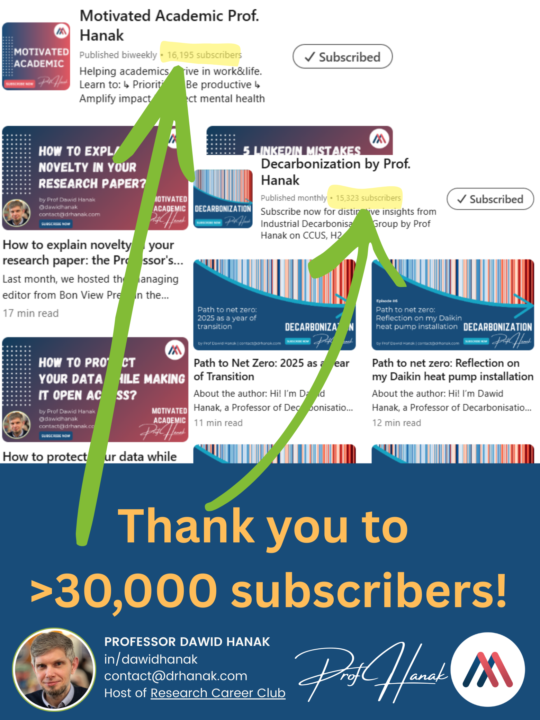
If your research lives only in journal PDFs… you’re leaving impact on the table. A LinkedIn newsletter turns your expertise into a series people can subscribe to (and actually get notified about). Because when someone subscribes, LinkedIn can show them updates in-feed, and, depending on their settings, send notifications and an email when you publish. And importantly: anyone can discover, read, and share your newsletter, while members can subscribe. It works well for me. Here’s the play: 1. Pick ONE “research theme” Not your whole department. One theme you can own for 6–12 months. Example: "Decarbonisation by Prof Hanak”. 2. Turn papers into episodes Each issue = one idea. The goal isn’t to impress reviewers. It’s to help smart non-specialists apply your thinking. 3. Use the 3-line promise Hook (one line). What they’ll learn (one line). Who it’s for (one line). (Then earn the click.) 4. Write like a human Start with the problem you’re solving. Then the insight. Then the “so what”. Add the citation/link at the end for those who want the full method. 5. Make it scannable Short lines. White space. Simple headings. Your newsletter is read by busy people between meetings (and on phones). 6. Close with an invitation End with a question, or a P.S. that tells people what to do next. Example: “P.S. Want the template I use to turn a paper into a newsletter issue?” Keep a publishing rhythm you can sustain Monthly is better than weekly-that-dies-in-3-weeks. Consistency builds trust (and subscribers). If you’re an academic: what would your newsletter be called—and what’s issue number 1?
0 likes • 15d
So, decarbonization-How long do you think until the end? In Physics when a planet collects enough mass it under goes a transformation and its chain of events causes the planet to warm...Earth is definitely collecting mass with the trees births and I feel 2033 is the end for us me personally. Most will tell you a bunch of BS, but the truth is: The magnetic north pole has been moving at an accelerated rate toward Siberia. At the same time, we are seeing deep ocean warming that doesn't always match up with surface air temperatures. If you view the planet as a single unit, the crust, the core, and the life on the surface are all part of one energetic balance. As mass shifts—whether it is water moving from melting poles to the center or the growth of biological matter—it changes the way the earth spins and how the core generates heat. This is global warming and the end is showing its signs
0 likes • 15d
If everyone stoped separating climate from geophysics they would see this as well! First, let's look at the magnetic shift. The north magnetic pole has accelerated significantly. It used to move at about 10 to 15 kilometers per year. Now, the latest data from early 2025 and 2026 confirms it is moving at roughly 36 to 50 kilometers per year toward Siberia. At this current speed, by 2033, the pole will have moved another 250 to 350 kilometers. If it continues to accelerate, it hits a geometric tipping point where the field strength in the western hemisphere could drop to a level that no longer shields the planet from high-energy radiation. The math on the connection between the magnetic field and heat is where it gets interesting. While mainstream models focus on air, recent studies from 2025 have found strange structural transformations in the earth's inner core. Scientists at the University of Southern California reported that the inner core is undergoing a physical change in shape and rotation that is affecting the liquid metal around it. This is the geodynamo, when you check the correlation numbers, they are almost a perfect match. Research from physicists like Persinger shows a -0.99 correlation between the weakening of the earth's magnetic dipole and the rise in global temperatures. In physics, a correlation that high usually points to a direct cause. If the magnetic field is the primary driver, then the warming we see is just the thermal byproduct of the earth's internal engine changing gears. while the total weight from space dust is small, the way mass is distributed on the surface has changed. Trillions of tons of ice have moved from the poles to the oceans, shifting the weight toward the center. This changes the planet's moment of inertia. Just like a figure skater pulling in their arms to spin faster, this redistribution puts pressure on the core. This pressure creates friction and heat deep underground. By 2033, we reach a point where several cycles intersect. The magnetic field strength is projected to reach a critical low, the pole will be deep into its Siberian transit, and the internal heat flux from the core transformations will likely reach the surface in a more visible way.
1-10 of 18

@branden-friend-2870
I am a 33-year-old Theoretical Physicist, who has a theory that he wants the community to review not to dismiss.
Online now
Joined Feb 9, 2026
Peebles, Ohio