Activity
Mon
Wed
Fri
Sun
Aug
Sep
Oct
Nov
Dec
Jan
Feb
Mar
Apr
May
Jun
What is this?
Less
More
Owned by Alex
🎯 For composers building profitable careers in film, TV, games, trailer music & sync. Not just making music - get paid for it.
Turn Your Music Skills Into a Sustainable Income Stream - Learn the Business Side of Composing from a 20-Year Industry Veteran
Memberships
Tantra Cat
4 members • $33/month
Japanese Grimoire Society
25 members • $33/month
OCS Step-By-Step
79 members • Free
Skoolers
168.6k members • Free
Circle of Interval Magicians
97 members • $18/m
Creating Music And Sound
26 members • $25/m
The Sync Circle
98 members • Free
Content Academy
14k members • Free
ListKit's Cold Email Community
4.5k members • Free
551 contributions to Audio Artist Academy

⭐
2d •
"JARVIS" is coming along nicely
Just wanted to drop this little update screenshot. If you are interested on what I can all take care of, zoom in to see the stuff at the left sidebar.

⭐
2 likes • 2d
@Desire Inspires It's 2000 USD if you are curious.
⭐
1 like • 18h
@Desire Inspires who or where does it say it's a week work?
⭐
3d •
TMT Interactive - first videos available NOW (18 out 20 seats left!)
Most composers I work with don't have a talent problem. They have a finishing problem. The folder of half-finished ideas. The track that was almost there in March, still almost there in November. That's the problem I built TMT Interactive to fix. 9 weeks. One complete, mastered trailer track, start to finish. We begin with a very basic concept and move one step a week, no jumping ahead. ⚠️ What makes it different from a normal course: ⚠️ Each week you do that week's assignment and send me the result. I send back a personal video reviewing your specific work and telling you exactly what to fix before the next step. Real feedback on your own music, from me, every week, for 9 weeks. And no worries, you can go at your own pace. If you feel like needing two weeks in betwee - no problem at all! I am ready when you are! Founding cohort, 20 seats, $397 (lowest it will ever cost). First video drops Wed 1 July, 3pm. Full details and enrollment: https://tmti.alexpfeffer.com/

⭐
0 likes • 2d
19 Seats left!
⭐
0 likes • 22h
18 Seats left!
⭐
6d •
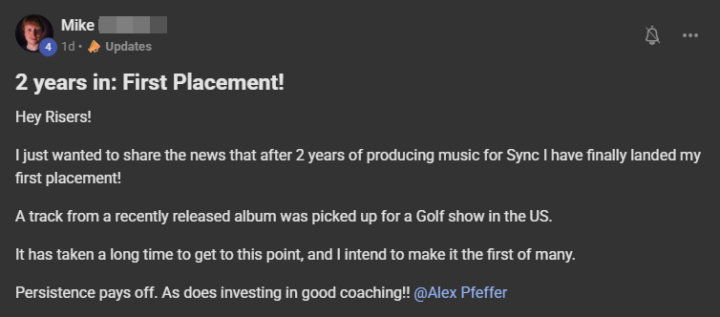
A first sync placement after 2 years (and a few Rise lifetime spots open)
A Rise member named Mike just posted this win inside the Rise community. Two years of writing for sync. First placement just landed, a track on a US golf show. The line at the end is what I keep coming back to: "Persistence pays off." That is the actual mechanic of sync. The track that gets picked is rarely your best one. It's the one in front of the right person on the right day, because you didn't stop sending. Mike took the lifetime spot in Rise because he kept showing up to the live calls and digging through the archive whenever he was stuck. The point of lifetime isn't access, it's that you stop having to think about it. A few Audio Artist Rise lifetime spots are open right now. If you want one, DM me and tell me where you're at.
⭐
0 likes • 3d
@William Marlot in Short, sync is when your music gets licensed for tv show, ad, etc. that you wrote for a production music company.
⭐
7d •
A personal and customized track visualizer and content creator
How awesome would it be to have your own customized - AI slop free - track visualizer that turns every composition into a polished, share-ready video in minutes? Oh wait, it gets better. What if you could also generate short clips from it automatically, with fade-ins and fade-outs handled for you, plus topic-related text, supporting video footage, or both layered on top?

⭐
2 likes • 7d
@Njord Tirotta Doesn't matter what you use. It works with every agent out there. Could be Codex, Claude, Gemini, GLM. Everything that can be implemented into a local system.
⭐
0 likes • 7d
@Ryan Trebilcock Yep, whatever you want it to do.

9d •
Hi Everyone! 👋
Hi, I’m Joshua. I produce and write full-time for major label artists in K-pop, J-pop, and C-pop. Though I started my career in scoring before I made the switch to pop, I still consider myself quite new to composing for media. 😊 Looking forward to learning from and connecting with everyone here, as well as sharing my own approaches to commercial production and songwriting. Sharing some songs I produced & wrote with my co-writers.
⭐
2 likes • 9d
Hey Joshua, welcome to the community!
1-10 of 551
⭐
@alex-pfeffer-6894
Music composer, creative consultant & growth engineer. I help creative businesses turn their passion into sustainable, scalable revenue.
Active 12h ago
Joined Apr 13, 2024
Hamburg, Germany
Powered by