Activity
Mon
Wed
Fri
Sun
Oct
Nov
Dec
Jan
Feb
Mar
Apr
May
Jun
Jul
Aug
Sep
What is this?
Less
More
Free Email Marketing Community
2.3k
Free
ListKit's Cold Email Community
4.5k
Free
Copywriting Launchpad
375
5.0
$5/m
Imperium Academy™
78.4k
5.0
Free
The Founders Club
61.7k
Free
44 contributions to Copywriting Launchpad

8d •
How I learnt to copywrite high converting scripts like Nabeel Azeez
Many of you know that you should be studying more copy, especially if you want to become a better copywriter. But you're not, and you come up with 10 other reasons why your progress is stagnating. But can you really be blamed? If you follow the conventional wisdom, having to handwrite the whole reference piece is just the first step, and it takes forever. By the time you finally get to studying the copy and annotating, you're already tapping out. Don't get me wrong, handwriting copy is a great way to learn because it slows you down and gives you room to think. But how much thinking are you doing? How often do you try and mindlessly copy the words across without thinking about much more than the word itself? You're probably more busy daydreaming about your copywriting life of hella cash, a nice place, and flash cars. Anyway, I've been there, and this is how I've made studying and annotating copy so frictionless it's honestly fun. And you spend more time thinking about the structure of the copy you're looking at, and writing your thoughts about that, than focused on the pain in your hand as you write for hours. The goal isn't to write copy for the sake of it. The goal is to deeply understand the persuasive structure that's doing the selling and the subtext that makes it work. So instead of studying a great piece once and moving on you build a reference you can return to, reinforce what you noticed and make sure the time you spent studying never goes to waste. With enough repetition the patterns in copy structure become familiar and you start using them automatically in your own work. And every time you come back to use the same reference you notice more than you did before. Each time you use that structure to create something new you will understand it a little deeper. This is how you can do that. /// (practice copy for the day^, feel free to make copy critique) /// In the video, please review this example where I broke down the script structure of one of Alicia's videos. This example shows what you can get out of breaking down video scripts. The essence of creative strategy.


1 like • 8d
Genuinely love the idea of this @Jacob Ross I can see the time you’ve put into it. I do a lot of hand copying myself writing case studies in B2B myself and this honestly seems quite exciting! I’d love to give it a go. Popping over a DM now mate👊

26d •
The "Info Trap": How do you organize your notes so you actually use them?
We all fall into the info-hoarding trap. We read books, binge podcasts, and take endless notes. But when it’s time to execute, those insights stay buried in Notion, Docs, or journals. I'm refining my workflow to bridge the gap between capturing knowledge and actually applying it. I'm curious to hear your advice: What is your exact system for organizing notes so you actually use them?
3 likes • 26d
One of the best pieces of advice I’ve heard on the subject is from one of my marketing mentors Instead of organising notes in ways you remember- consume things with the intention of using what’s helpful practically. So a good example if your consuming course content- think while doing- “where can I apply this today?” And then from there add to your to do list Hope this was helpful mate!
Aug 12 •
Happy Clients
Hey all! Quick win from me to share! Popped onto LinkedIn today and it felt really good getting a tag and a lovely comment from a client I’ve written a case study for and interviewed! (This was not a freelance / business client but a customer of the startup I’m the marketing exec for) Exciting to work with these awesome businesses! link: https://labdesk.co.uk/blog/how-jcs-nuclear-solutions-halved-time-lost-to-it-issues-with-labdesks-microsoft-365-accelerator A NUGGET of wisdom I will share if anyone fancies writing case studies is to make the customer (Oliver in this case) be perceived as intelligent, smart, and trustworthy. Make the person you are writing about look good- not just your company for helping them.

1 like • Aug 13
@Waisale Naqiolevu https://labdesk.co.uk/blog/how-jcs-nuclear-solutions-halved-time-lost-to-it-issues-with-labdesks-microsoft-365-acceleratorI’ll pop the link in now for you Waisale🚀
1 like • Aug 14
@Nonalee Eilon Alipda appreciate you Nonalee!
Jul 14 •
3 Game-Changing Lessons for B2B
it’s been ages guys! Popping over the 3 massive corporate B2B marketing lessons I learned from June + July after interviewing 5+ of my MSP’s clients to hopefully save you from the same pitfalls I’ve gone down… 1. Delete your “marketing fluff”. This might seem controversial but genuinely I’ve bathed in this mistake for a very long time and it’s crippled my copy. Superfluous words like the following should be DELETED from your B2B copy (they are making your copy stink): 1. "Streamlined operations" 2. "Leveraged synergies" 3. "Drove efficiencies" 4. "Enabled scalability" 5. "Optimised workflows" 6. "Delivered value" 7. "Empowered teams" 8. "Accelerated growth" 9. "Transformed the business" 10. "Best-in-class solution" 11. "Seamless integration" 12. "Robust framework" 13. "Future-proofed infrastructure" 14. "Strategic alignment" 15. "Unlocked potential” 1. “Seamless design” 17. “Automated workflow” (Yes the list stops at 17 as that’s all I can pin down from the top of my head but I hope you get the point) 1. You are not in DTC Kansas anymore. B2B Sales processes drive B2B Marketing. This means that when either pitching yourself or writing copy for a B2B client you need to understand the B2B sales process behind how your offer is actually processed. This goes for any B2B marketing. For example you will usually have 3 tiers to how descisions are made: 1., 1st Tier is a champion. A champion is someone who sees your offer and STEPS UP to the blockers / gatekeepers getting a decision or deal approved. 2., 2nd Tier: The main blocker to deals and payment is the CFO for B2B. So for example when you want to write a compelling proposal or just pitching yourself and your services, use financial justification that FOCUSES on the metrics the specific financial decision-maker you are speaking to actually cares about. Research the sector- each sector has different ways of making business purchasing descisions. 3.,3rd Tier. This is gold. And for any B2B email marketers… (I picked this up from an interview with a Founder of a Defense Technology startup- super cool guy btw) Essentially all descisions route around the existing STRATEGIC SETUP and MARTECH (marketing tech) of a business… so I’m talking everything from how they manage their payment systems to their CRM and ESP choices + Software for operational management… if YOU can show that YOU know and respect your clients pre-existing builds and investments and that you provide little friction working with and only upsides you will be a very special marketer.
0 likes • Jul 20
@Shafaq Kazmi appreciate you Shafaq! Cheers
0 likes • Jul 20
@Jeremy Holden absolutely Jeremy, glad it was helpful! Love your comment about smaller businesses wearing many hats at once it’s spot on. For this reason alone it can sometimes be easier to reach out to larger B2B corporations because you know exactly who you’re speaking to!

Jun 26 •
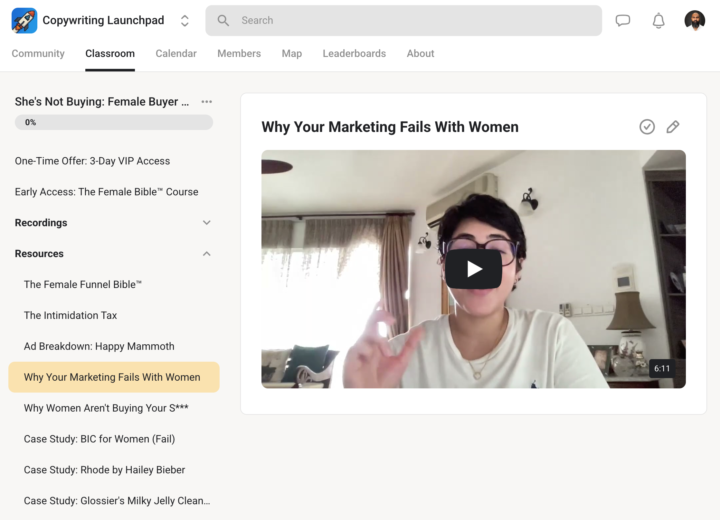
Bonus Material Added to “She's Not Buying”
While you're waiting for the Female Buyer Psychology workshop next week, Lina sent me some valuable bonuses for you to go through. You'll find it in the classroom. I moved the course up to the first spot so you don't have to scroll down to access it. If you're considering joining Lina's workshop, check out the details here: https://linasworkshop.manus.space/
2 likes • Jun 26
Awesome! Cheers to Lina
1-10 of 44

@benjamin-villette-8504
Consumer Psychology Nerd. I write Customer Success Stories for B2B SaaS + dabble in amateur boxing.
Active 2d ago
Joined Apr 26, 2026
INTJ
Powered by