Activity
Mon
Wed
Fri
Sun
Jun
Jul
Aug
Sep
Oct
Nov
Dec
Jan
Feb
Mar
Apr
What is this?
Less
More
Memberships
Research Career Club
661 members • Free
15 contributions to Research Career Club

10d •
5 steps that cut the time I spend on responses to reviewers for my academic journal submissions from 3 weeks to 4 days.
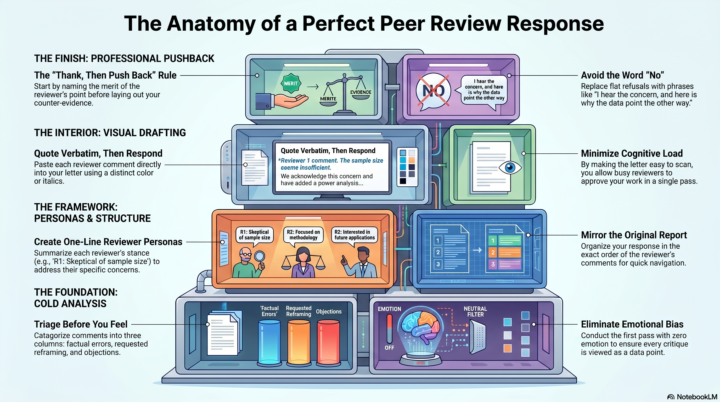
(Steps 4 and 5 are the ones nobody teaches.) Most researchers treat "major revisions" as a near-rejection. It isn't. It is an invitation to publish, with conditions. Here are the rules I use, and now teach my PhDs and postdocs. 1) Triage before you feel Open the decision letter and make three columns: factual errors to fix, reframing the reviewer wants, and objections you will push back on. No emotion on this pass. 2) Write a one-line summary of each reviewer "R1: wants a broader intro, sceptical of the sample size. R2: accepts the contribution, wants tighter results. R3: silent on methods, has issues with our writing." Knowing who each reviewer is before you write the response saves you from arguing with the wrong one. 3) Answer in their order, not yours Reviewers reread their own comments. If your response letter jumps around, they scan for their point and get annoyed when they can't find it. Mirror the structure of the original report. 4) Quote, then respond Paste each reviewer comment verbatim in a different colour or italics. Respond underneath. As journals are short of good reviewers, such an approach will lower their cognitive load, and they can approve your work in a single pass. 5) Thank, then push back When you disagree, open with one sentence that names the merit of the reviewer's point, and then lay out your counter-evidence. Never use flat "no". Use a specific "I hear the concern, and here is why the data point the other way". One paper. Cleaner response letter. Faster turnaround. Save this for your next major revisions letter.
2 likes • 9d
For me major revisions feel like that I cross the largest barrier for publication... after that almost always is article accepted, and many times based on the comments, I do not understand why "major revisions"?
10d •
Feeling like a fraud in your PhD or academic job even when everyone says you’re “doing fine”?
You’re not alone. Scroll through Reddit and you’ll see thousands of researchers quietly burning out while telling themselves they’re just “lazy” or “not smart enough.” The reality: you’re running marathon effort on sprint expectations. That’s not a personal flaw. That’s a broken culture. In my 15 years in academia and 70+ papers, the one thing I wish I knew earlier is this: impostor syndrome rarely disappears, but you can stop it from driving the car. Here’s what I recommend: 1. Set a minimum viable day: 30–60 minutes of deep work on your most important task (methods, results, or revision). Once that’s done, you’ve already had a “successful” day. Everything else is a bonus. 2. Keep an “evidence file”: every acceptance, kind email, positive comment from a supervisor, or good result goes in one document. On bad days, don’t trust your feelings—read your evidence. 3. Reduce hidden expectations: write down what you think your supervisor, examiners, or PI expect from you this month. Then reality-check it with them in one short meeting or email. Most of the time, you’re carrying expectations no one actually asked for. 4. Protect one non‑negotiable boundary: sleep, a weekly day off, or exercise. Burning two extra hours at night is not what gets papers published; consistent, clear-headed work does. If this resonates, don’t try to “fix your whole life” this week. Pick one of these changes, apply it for seven days, and see how your stress shifts. 😊 What’s one small promise you’ll make to yourself this week so impostor syndrome doesn’t run the show? Drop your answer below 👇
2 likes • 9d
I have defined a hard hour to disconnect, and specific time slots for my kids. Sometimes I feel bad about that, but I had to, I feel better now.
16d •
Recent hack that saved my time.
Ever since we started using computers, we have been taught to type everything on keyboards. And as a result, this is how we interact with the machines. So whether you write papers, you write responses to emails, you write LinkedIn posts, anything, essentially, you're just typing. Recently, I was introduced to VoiceInk, an application that lets you dictate what you want to say and transcribes it into text. I know I've been trying to use Google Docs for this. I've been trying to use MS Word for this and then including some of the transcription services available on Mac. But I always found that it was fairly inaccurate. I couldn't really rely on it because the grammar was off, and it missed words because of my non-native accent. But now we see that AI tools actually make it much more profound. So you can essentially leverage AI to understand how you speak and convert your speaking to text with very high accuracy. So the tool that I'm using, as I mentioned, Voice Inc, it uses some of its own AI tools, but you can also hook it up to OpenAI or any other tools that you have available. You can use open source tools like Ollama. To get that AI enhancement. And it has already saved me quite a lot of time. So I started using that two weeks ago. Right now, it has saved me about 40 minutes to 60 minutes of my time. It's a little bit weird for me to speak to the PC rather than type. So I'm still learning. But I thought I would share this with you. I know we are all kind of struggling with time, and essentially, you speak faster than you write. So that could actually help you with writing papers because you can just start talking about your paper, talking about your results, talking about your discussion, and then just fix the grammar, fix the writing and everything else. So that's one of the main reasons why we have a writer's blog, because I posted on LinkedIn today. We do want to make sure our writing is perfect. And as a result, we write and then we edit, we write and then we edit. And as a result, we waste time.
1 like • 16d
good tip, and way cheaper than Dragon Naturally Speaking and similar software. And, does it needs to be trained extensively as the software needed?
Mar 2 •
Next training on paper writing
I'll be sharing details of the next training later this week. Based on your inputs, it'll focus on how to make sure your work is novel & original and, thus, easy to publish. To make it relevant, let me know what do you struggle with in this regards. I'll make sure to cover it in the training.
2 likes • Mar 2
On of my problems is how to know when enough is enough.
Feb 12 •
What’s your core research area?
Many of you are here to network but we don’t often know who is doing what - let’s change this: In a few words, please explain what is your core research area. Enjoy!
2 likes • Feb 12
LCA and sustainability assessment of products and processes
1-10 of 15
@antonio-martins-5398
Researcher in LCA and Sustainability Assessment of Products and Processews, focusing in Energy Storage and CCUS processes
Active 11h ago
Joined Oct 20, 2025