Activity
Mon
Wed
Fri
Sun
Mar
Apr
May
Jun
Jul
Aug
Sep
Oct
Nov
Dec
Jan
Feb
What is this?
Less
More
Memberships
Peptide Lab
447 members • Free
Peptide Price
9k members • Free
Heather Dawn Research Wellness
2.9k members • Free
Project Biohacked
9.9k members • Free
Exploring Peptides Community
10.7k members • Free
Bio Health Peptides Proteins
1.5k members • Free
The.Peptide.Edit
86 members • Free
KRISTINA’S PEPTIDE JUNKIES 24
811 members • Free
The 7-Figure_Affiliate
9 members • Free
101 contributions to Peptide Price

🔥
7h •
You Asked for Higher Standards... Vendors Are Listening 🔥
Remember back in December when I broke down what conformity testing is and why it matters? 🔗 What is Conformity Testing? (And Why It Matters) If you missed it — the short version is that most vendors test ONE vial from a batch that could be hundreds or even thousands of vials. Conformity testing means testing MULTIPLE vials from the same batch to make sure what's on the COA actually reflects what you're getting. Well… conformity testing is starting to catch on in the research space. Big time. In just the last two weeks, 7 companies have reached out to me to let me know they're adding conformity testing across the board — for every new batch of peptides going forward. Let that sink in for a second. That's not a coincidence. That's YOU guys. That's this community pushing the standard higher. Trust me when I say your opinion matters. Companies that truly care about the customer WILL go the extra mile — and it's happening right now in real time. We're 9,000+ strong in here and it wouldn't be possible without you guys supporting peptideprice.store! Over the next week or so, I'll be highlighting the new companies that have stepped up and added testing. And we've got some exciting ones coming that are going beyond just purity — we're talking sterility and heavy metals testing 👀 Stay tuned. This is just the beginning. The bar is rising, and it's because of all of you. 💪


2 likes • 6h
That is fantastic, Derrick. If everyone that is on your Peptide price list can provide a minimum of five out of the six tests. Those people would do fantastic that’s what I typically sell friends family, and folks that I coach is on those brands. Good job, my friend. And I’m RegenCRNA on other social medias in case you’re wondering you probably knew that already.
🔥
17h •
You Decide Who You Share Your Research Journey With
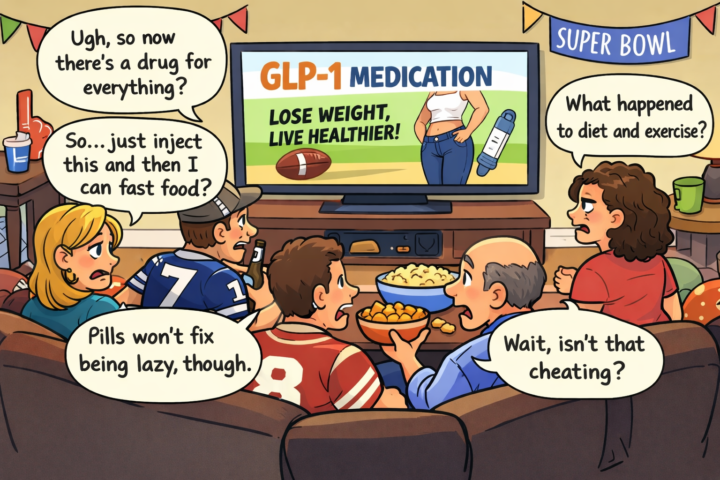
Quick reminder — you get to determine who you share your research journey with. Yesterday, like many of you, I was sitting around watching the Super Bowl and saw the commercials for compounding pharmacies like Hims and Hers. Every time a GLP-1 commercial popped on, I saw all the different reactions across the room. Some people had no reaction at all, while others had plenty of comments to make about GLP-1s. To be honest, if someone has never been in a situation where they can't control their appetite or food noise to the point where it takes over their life, they'll never understand peptides or GLP-1s. There were comments like "that's the fat loss pill" or "that's the drug for overweight people." Just remember that everybody has different experiences and struggles. A lot of hunger is genetically driven. I know many of us have tried going the natural route — just eat less, just have more willpower — but our genetics literally drive us to eat more. That's not a character flaw. That's biology. Did I feel like I needed to share with anybody how much GLP-1's changed my life? No. Because sometimes it's just not worth explaining to people who would never understand. And if people don't support your journey to fixing your health, they don't deserve to be a part of your life in my opinion. Don't feel bad about other people's comments. They'll never understand until they're in the exact position you were in, and chances are that's never going to happen. That's okay. It's not their journey. You're responsible for your own research, and you also get to decide who you share that with. Protect your peace.
2 likes • 12h
Indeed!
🔥
2d •
Tesamorelin Storage Experiment: Initial Testing Is In
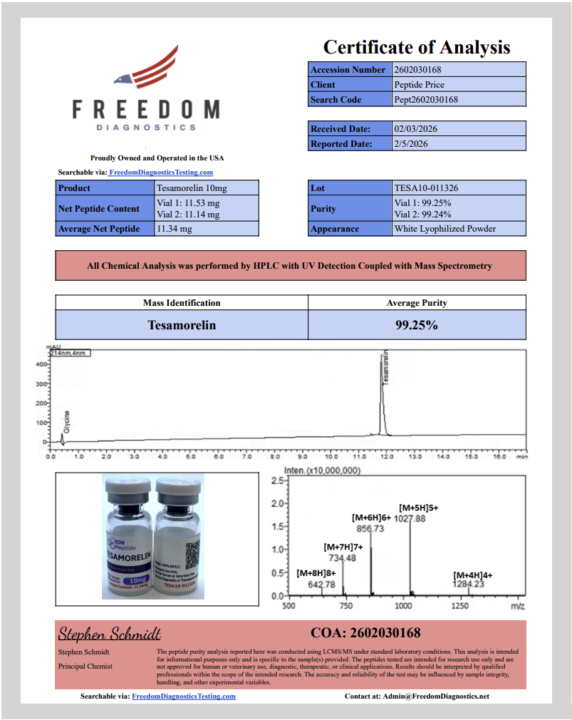
The results are starting to come in. For those just joining: there's been a debate in the peptide community about whether research-grade tesamorelin should be stored at room temperature or refrigerated after reconstitution. Instead of arguing theory, I partnered with Freedom Diagnostics to run an actual degradation study. Here's how it works: We took two identical samples of reconstituted tesamorelin. One stays at room temperature. One goes in the fridge. Both get tested once a week for four weeks. Initial baseline results: - Sample 1: 99.24% purity - Sample 2: 99.25% purity Essentially identical starting points — exactly what we need for a fair comparison. I've attached the original COA so you can see the data for yourself. Over the next four weeks, we'll track whether purity holds, drops, or differs between the two storage methods. No speculation. Just numbers. Big shoutout to Ion Peptides for providing the samples for this study. I'll post updates each week as new results come in. Appreciate everyone following along — this is how we get real answers.
0 likes • 2d
@Derek Pruski some SM people love to be front and center. I listen to them to solidify my knowledge on topics (really to point out and critique them) for myself. And, for entertainment, yeah I know, I am just wasting my valuable time.
0 likes • 12h
@Lisa G I wa referring to a SM talking head that spouts off misinformation from time to time. IYKYK, but yes you are correct. I had the lab do me a solid when in Houston for my sake on a product and results are always welcome as peace of mind.
🔥
2d •
Your Mitochondria Are Working Harder — Are You Keeping Up?
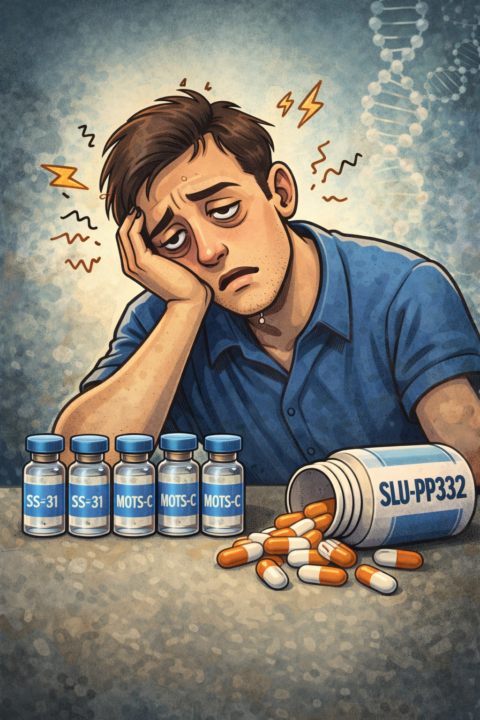
Let me walk you through something that almost nobody is talking about in the peptide space right now. If you push mitochondrial output hard without supporting antioxidant systems, you can create more stress than benefit — even though you’re using “energy-boosting” compounds. This came up while I was researching higher-dose SLU-PP-332 and looking deeper at mitochondrial up-regulation. Almost no one talks about this part. Make sure to read the whole post because it will benefit you in understanding oxidative stress and how to mitigate it. Let me break it down simply. You have tiny power plants inside every single cell in your body. They're called mitochondria. Their job is simple — take the food you eat and the oxygen you breathe and turn it into energy. The better they work, the better you feel. More energy. Faster recovery. Sharper thinking. That's the whole game. That's why mitochondrial peptides are so popular in research right now. Compounds like SS-31 and MOTS-C are designed to do two things: make your existing power plants run better, and tell your body to build brand new ones. At low doses, individually, these compounds are generally well-tolerated in research. Your body can handle the modest increase in output without much issue. But here's where it gets interesting. When You Start Stacking, The Math Changes The whole point of combining SS-31 with MOTS-C (or adding SLU-PP-332 on top) is synergy. You're not just nudging one pathway — you're pushing multiple mitochondrial pathways at the same time. More efficiency. More new mitochondria. Significantly more total energy output. That's the goal. And it works. But every power plant produces exhaust. At low individual doses, the exhaust is manageable. Your body has a built-in cleanup crew that handles it no problem. When you stack these compounds and really push mitochondrial output, you're now running way more power plants at way higher capacity. The exhaust — called reactive oxygen species (ROS), basically tiny molecular wrecking balls — scales up fast. And if your cleanup crew can't keep pace with that new volume of exhaust, it starts piling up inside your cells. That's called oxidative stress. And it can quietly undo the very benefits you're chasing.
5 likes • 2d
❤️Yes!! This is exactly what mitochondrial biochemistry predicts. When you increase electron flux through the ETC (with SS-31, MOTS-c, SLU-PP-332, etc.), you also increase electron leak and ROS generation at complexes I and III. That’s normal physiology, but when you push multiple pathways at once, ROS production can outpace the cell’s redox buffering capacity, especially glutathione-dependent systems. Once that happens, you start damaging mitochondrial membranes (cardiolipin), ETC proteins, and mitochondrial DNA, which creates a vicious cycle of lower efficiency and even more ROS per ATP. A rational, research-based solution isn’t to avoid mitochondrial upregulation, it’s to pair it with proportional redox and membrane support and to periodize the stimulus. Conceptually, that means: 1. Support the glutathione system (substrates + enzymes + recycling): cysteine availability (e.g., NAC as a precursor), adequate selenium for glutathione peroxidase, and sufficient vitamin C/E to keep the redox network cycling. 2. Protect the mitochondria at the source: ensure CoQ10 availability for ETC function and lipid-phase antioxidant defense; include membrane-stabilizing support (e.g., taurine class mechanisms) to reduce calcium and membrane stress. 3. Use pulses, not chronic max stimulation: cycle mitochondrial upregulators so ROS production and antioxidant capacity stay matched over time. 4. Verify with biomarkers in a research setting: track redox stress (e.g., oxidized/reduced glutathione ratio, lipid peroxidation markers) and mitochondrial function proxies rather than guessing. Bottom line: mitochondrial upregulation works, but only if redox capacity, membrane integrity, and cycling strategy scale with it. Otherwise, you’re just trading short-term energy gains for long-term mitochondrial wear and tear. Of course this is grossly simplified:-)
1-10 of 101

@antonio-acosta-3480
DNP, MS, APRN, CRNA, NSPM-c, FNP. Retired military. Love my job. Coaching those needing improvement optimizing physiological function.
Active 6h ago
Joined Dec 27, 2025
Texas