Activity
Mon
Wed
Fri
Sun
Jul
Aug
Sep
Oct
Nov
Dec
Jan
Feb
Mar
Apr
May
What is this?
Less
More
Memberships
Not Today CPR and First Aid
13 members • Free
8 contributions to Not Today CPR and First Aid
Jan 28 •
Broken Bone Scenario – What Would You Do?
You’re at a school event or family gathering. Someone falls and has an obvious arm deformity. They’re in pain, bleeding lightly, and very anxious. 👉 What are the FIRST 3 things you would do while waiting for EMS? - Drop your answers below - There’s no judgment—this is how we learn - Read others’ responses and add what you’d do differently 💡 Being prepared isn’t about being perfect—it’s about acting instead of freezing.

1 like • Jan 28
I have no idea, so this is what I think I would do: Call 911. Make sure there is no significant bleeding. Talk to them calmly. Try to keep them calm and not moving around. I wouldn’t move them.
Jan 22 •
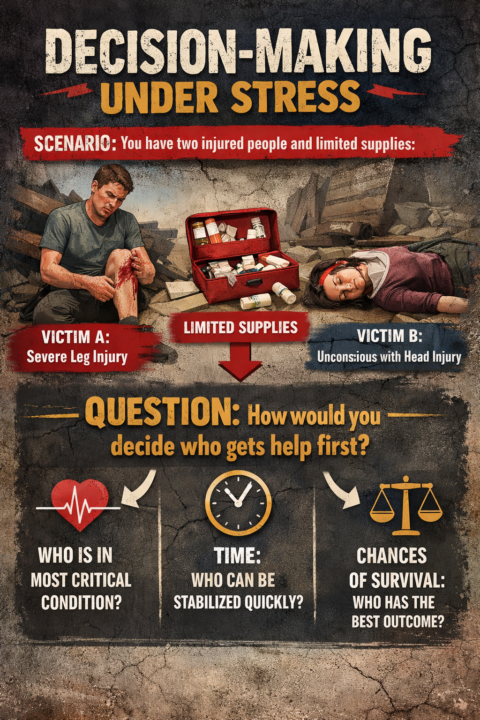
Decision-Making Under Stress
Scenario: You have two injured people and limited supplies. Question: How would you decide who gets help first? ➡️ This isn’t about perfection—this is about thinking clearly under stress.
1 like • Jan 23
Yikes! This is a tough one. Does it mean they are less critical if they can be stabilized quickly? I believe I would look for severity of bleeding first and go from there.
Jan 16 •
Would you intervene?
Scenario: You see a stranger collapse in a parking lot, but you’re not 100% sure what’s happening. Question: Would you step in or hesitate? What concerns would run through your head in that moment? ➡️ Let’s talk fear, liability myths, and real-world hesitation. Look forward to hearing your response. Going through these little scenarios is all it takes for your mind to grab onto what to do if and when an emergency situation happens!
1 like • Jan 18
I would want to step in, but I might hesitate depending on the scenario. Where am I? Am I alone? Is it dark? Are they alone? Could it be staged to get someone to help and then they attack? I would need to assess the surroundings first and then determine next steps.
Jan 14 •
Bystander Effect Breakdown
Scenario: You arrive at a scene where 5–6 people are standing around, but no one is helping. Question: What’s one specific thing you could say or do to break the bystander effect and get help moving? ➡️ Think leadership, not medical skill.
0 likes • Jan 18
Agree with all of the above.
Jan 13 •
M.A.R.C.H. - AIRWAY
A: Airway Why it matters: No airway = no oxygen = no life. What to Look For - Snoring, gurgling, choking - Blood, vomit, broken teeth - Inability to speak clearly What to Do 1. Position patient 2. Jaw thrust / head tilt–chin lift 3. Clear visible obstructions 4. NPA / OPA as appropriate (if trained) Tactical Considerations - Facial trauma = airway risk - Secure airway without losing scene awareness Note: Most airway failures are positioning failures.
0 likes • Jan 18
What is NPA/OPA?
1-8 of 8

@amy-logsdon-2943
I want to be prepared and confident if the need arises to act.
Active 114d ago
Joined Jan 7, 2026