Activity
Mon
Wed
Fri
Sun
Jul
Aug
Sep
Oct
Nov
Dec
Jan
Feb
Mar
Apr
May
Jun
What is this?
Less
More
Memberships
The AI Advantage
125.3k members • Free
AI Automation Society
406.4k members • Free
AI Automation Agency Hub
325.5k members • Free
AI Automation (A-Z)
159.3k members • Free
25 contributions to The AI Advantage

3h •
The task that bores you the most is probably the one costing you the most hours.
The task that bores you the most is probably the one costing you the most hours. Most business owners assume the expensive problems in their business are the complicated ones. They're not. The expensive problems are the boring ones nobody wants to look at. - The task you put off until Friday afternoon. - The report you build the same way every single week. - The follow-up you mean to send but keep forgetting. - The invoice that sits there because chasing it feels tedious. None of these feel urgent. That's exactly why they cost the most. A task that's exciting gets done quickly because you want to do it. A task that bores you gets delayed, rushed, or skipped entirely, and the cost of that compounds quietly in the background for months. Here's a simple way to find it. Think about the task you avoid the most. The one you'd rather do anything else than start. That feeling isn't laziness. That's your brain telling you this task has no real thinking in it. It's the same steps, every time, with nothing new to solve. That is precisely the work that should never need a person. The interesting part of your business will never feel boring enough to ignore. The boring part is hiding in plain sight, and it's usually the first thing worth fixing. What's the task you've been avoiding the longest?

1d •
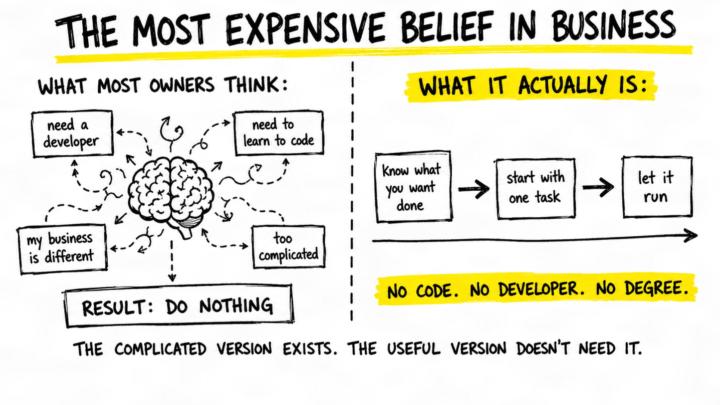
Most business owners think AI is too complicated for their business.
Most business owners think AI is too complicated for their business. That belief is the most expensive one they hold. Every week I speak to owners who say the same thing. "I'm not technical." "My business is different." "I wouldn't even know where to start." I understand why they feel that way. The internet is full of developers talking to developers. Jargon everywhere. Tools that look like they need a degree to operate. But here is what I actually see when we start working with someone. The business owner who said they were not technical is running 6 automations 90 days later and checking them less than once a week. The one who said their business was different has the same 3 types of manual work every other business has. The one who did not know where to start now has a Monday morning that looks nothing like it used to. You do not need to understand how any of it works. You just need to know what you want done. The owners getting the most back from AI are not the most technical people in the room. They are the ones who decided to start somewhere instead of waiting until they understood everything. The complicated version of AI exists. The version that saves you 20 hours a week does not require it. What is the one thing in your business you have been putting off because it felt too complicated?
3d •
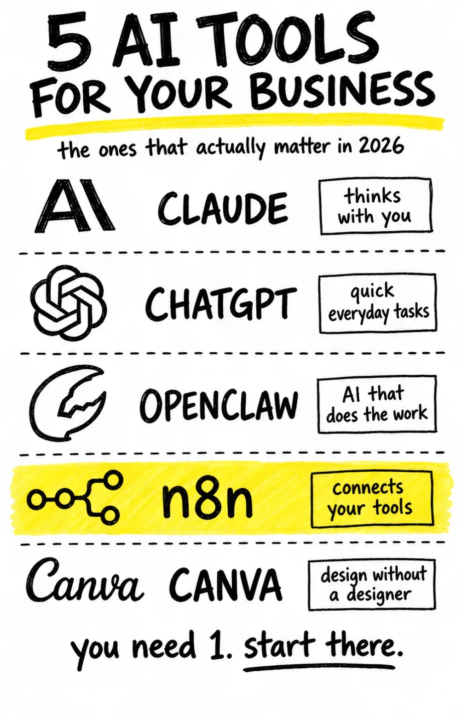
5 AI tools every small business owner should know about in 2026.
5 AI tools every small business owner should know about in 2026. Most people know ChatGPT. Very few know what to use it with. Here is the honest list. 1/ Claude The AI that actually thinks with you. Write, plan, analyse, solve problems. Start here before anything else. 2/ ChatGPT The one you've already heard of. Good for quick tasks, images, and everyday questions. Use it alongside Claude, not instead of it. 3/ OpenClaw This one most people haven't heard of yet. AI agents that handle tasks across your business automatically. The difference between asking AI and having AI do it. 4/ n8n Connects all your tools together. When a job closes in one system, the invoice goes out in another. No coding. No manual steps. Just connection. 5/ Canva AI Design anything without a designer. Social posts. Proposals. Presentations. Professional every time. You don't need all 5 right now. You need one. The one that solves the most painful thing in your business this week. Start there. Everything else follows. Which one would make the biggest difference for you right now?
4d •
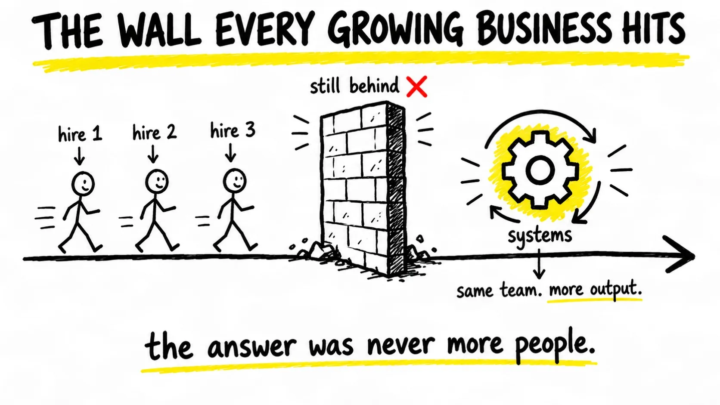
Every growing business hits the same wall.
Every growing business hits the same wall. More clients coming in. Not enough hours to handle them. So the obvious answer? Hire someone. And for a while, it works. - Then you need to manage that person. - Train them. - Brief them. - Check their work. - Deal with their problems. And suddenly you're busier than before you hired them. That's not a people problem. That's a systems problem. The businesses that figure this out stop asking "who do we need to hire?" And start asking "what should never need a human in the first place?" Because most of the work that feels like it needs a person? It doesn't. It needs a system. - The follow-ups. - The reports. - The invoices. - The reminders. - The data entry. None of that needs a person. It just never got fixed. The businesses growing without constantly hiring aren't lucky. They built the system before they needed the headcount. That's the difference.
5d •
Most business owners solve the wrong problem for years
Most business owners solve the wrong problem for years. (this is what figuring it out looks like) He'd been running his business for over a decade. - Always busy. - Always behind. - Always one more hire away from feeling in control. So he started hiring, again and again Then one day something ran on its own that he'd been doing manually for years. That's when it clicked. Every time he hired someone new, he also hired the management, the training, the briefings, the mistakes, and the cost that came with them. The business wasn't short on people. It was short on systems. Most businesses at this stage don't have a capacity problem. They have a process problem that looks like a capacity problem, and hiring is the most expensive way to paper over it. And people forget. Systems don't. 8 months later. 30% more clients. Same team. Zero new hires. Just a different system underneath.

1-10 of 25

@alex-naskidashvili-5764
Partner at @ Systems Dept. | Building AI Automations, Workflows and Systems
Active 51m ago
Joined Feb 7, 2026
Remote
Powered by