Activity
Mon
Wed
Fri
Sun
Mar
Apr
May
Jun
Jul
Aug
Sep
Oct
Nov
Dec
Jan
Feb
What is this?
Less
More
Memberships
AI Freedom Finders
721 members • Free
Creator Profits (Free)
17.5k members • Free
AI Automation Society
256.6k members • Free
3 contributions to AI Automation Society

6d •
Enquiries
Hi community, I’d like to get some enquiries on how to use AI automation to create better ads for my brother’s car wrapping business. I thought I’d ask the group and if anyone can connect we can discuss it. I’d be happy to get some help regarding this

8d •
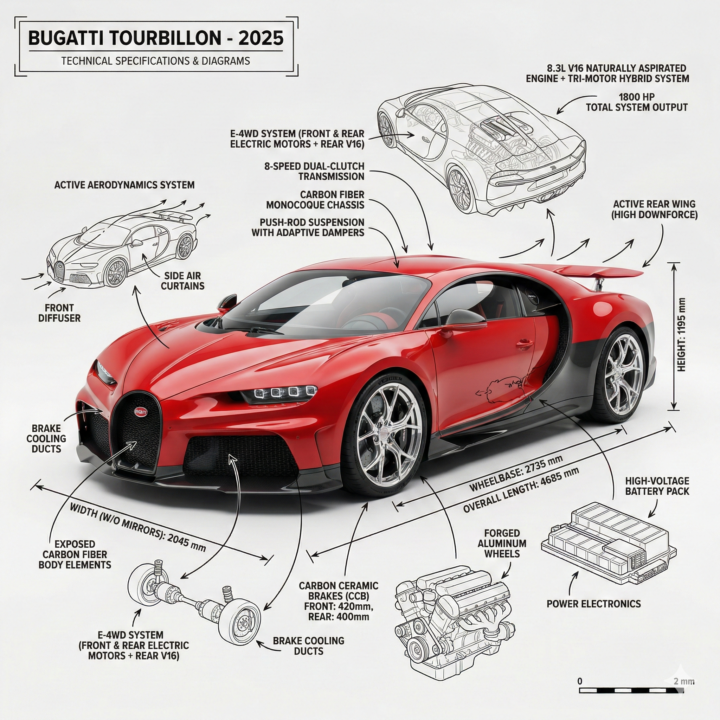
🚗 Engineering-Style Car Visuals
Technical car infographics done right This uses a structured prompt to turn a single studio car image into a clean engineering-style diagram — with real proportions, accurate components, and floating technical annotations Perfect for automotive content, brand visuals, or educational-style posts where realism matters more than effects Prompt 👇 Create a technical infographic-style image of a {Bugatti} {Tourbillon} in {Rosso Corsa Red} {2025} Use a single, ultra-realistic studio photograph or photorealistic render of the car as the base layer. The car must be fully intact, unmodified, and clearly visible from a clean 3/4 front or side studio angle. Base Image Requirements Pure white studio background (RGB white, no gradients) Neutral, even studio lighting Sharp focus, realistic reflections and materials Correct proportions and factory-accurate design No motion blur, no depth effects, no cinematic lighting Annotation Overlay (Critical) Overlay black, ink-style technical annotations on top of the image without covering or repainting the car. Annotations must include: Key component labels (engine, drivetrain, suspension, brakes, aerodynamics) Cutaway or exploded-view outlines (schematic only, not removing parts) Measurement lines, dimensions, and scale markers Material callouts (carbon fiber, aluminum, steel, etc.) Directional arrows showing airflow, cooling, force, or power transfer Simple sectional or schematic diagrams connected to the car with fine leader lines ⚠️ Annotations must float above the image, connected by thin lines. ⚠️ Do NOT redraw the vehicle itself. ⚠️ No annotations painted directly on body panels. Title Placement Place the title “{car_make} {car_model}” inside a realistic technical annotation box in one corner of the image (engineering blueprint style). Visual Style Minimal technical illustration aesthetic Black linework only Precise, architectural, slightly hand-drawn engineering feel Educational, museum-exhibit / engineering-manual tone
1 like • 8d
Hi community, I’d like to get some enquiries on how to use AI automation to create better ads for my brother’s car wrapping business. I thought I’d ask the group and if anyone can connect we can discuss it. I’d be happy to get some help regarding this

💎
⭐
Dec '25 •
🎉 Happy New Year, Everyone
It is always a good time to reflect on everything you accomplished this past year and to set some goals for what you want to achieve in the new one. Thank you for helping us build such an awesome community over the past year. I cannot wait to see how much more it grows by the end of 2026. Cheers, Nate

5 likes • Jan 3
Happy new year
1-3 of 3

Active 5d ago
Joined Jan 2, 2026
Powered by