Activity
Mon
Wed
Fri
Sun
Dec
Jan
Feb
Mar
Apr
May
Jun
Jul
Aug
Sep
Oct
Nov
What is this?
Less
More
144 contributions to Oasis Builders

4d •
Stop buying cut Christmas trees
Today I'm planting Christmas trees to be diverse, but Christmas tree monoculture and the whole industry of cut trees just for the festive season is not ecological.


1 like • 4d
@Phillip Greenwood Using conifers as pioneer trees is an interesting idea. I have some huge white pines on my property, and I’ve always viewed them as more of a burden than a benefit. They shade a large section of my hillside and compete for a lot of water, which may actually be why they were planted there in the first place. I think the Christmas tree concept could work, but from a business perspective, it gets complicated. It wouldn’t make much sense to brand yourself as a Christmas tree farm only to gradually phase that out and become a berry farm. Eventually, you’d have to transition away from one product and build a market for another. That’s part of why monoculture is so common in commercial agriculture. It’s simply easier to produce, market, and sell a consistent product at wholesale scale.
11d •
False sense of reality
There's fake news, deep fake images, false sentiment, artificial intelligence, protein substitute and lab grown meat, soilless growing and factory farms. Are we entering the matrix? I've seen that Kellogg's rice crispy cereal, a snap, crackle and Pop family favourite, will no longer contain rice, to reduce costs. It wasn't a healthy option to begin with, now it's another multi national counting pennies.
2 likes • 10d
The entire Internet is compromised to the point that you cannot believe any image, voice, or video online. Social media platforms, run rampant, false campaigns to confuse you.
2 likes • 10d
I’ll add even platforms like this. Bots are rampant.
20d •
87 days of anarchy
It seems likely we will have some catastrophic event between February and 2030, after three days under the kitchen table with only the light and warmth of a candle ,with perhaps a pack of playing cards for entertainment, having eaten all the tins of cold beans, and filled the toilet bucket, we will emerge to a new world order. The army and high rank civil servants are planning to stay in their bunkers for 90 days, so we will be on our own. If you're trapped in a prison, mental institution or hospital, or any area of high population density, the chances are not good. If you were trapped travelling out of urban areas you'll already be toast. I think this may be a planned population reset , like the first two world wars or COVID. World social engineering on this scale , comes from where, and who are these influencers and puppeteers? Sometimes it's enough to suggest a event will occur, to instigate a reaction, or change in public opinion. Especially if we were told to prepare and nothing happened. Believe it , or not, change is in the wind!
1 like • 18d
@Phillip Greenwood I agree I would just add that this a wide range of organizations, governments and individuals (including Elon) that have this idea (I call globalists)
1 like • 15d
@Jim Flach if they could they would do 100%. Goes back to the idea of owning the whole supply chain to control prices. The major price has always been labor. If we knew the actual cost of things we would riot. Companies are already creating factories to manufacture humanoid machines. There is one on the market already. I believe it is 30K. Can do all your chores
17d •
Getting into trouble with vegans(again)
Today I've been accused of incitement of hate, because I said I was "anti vegan" and apparently I should have said I was a non-vegan. Although my reasoning was justified and l explained why vegans are not accepted in the community where I live and why they ecologically don't make sense, I am still being told I set a bad example within the organic/ syntropic / permaculture movement. It makes me want to be more anti vegan because people who say they don't exploit animals think they are always right. Not all rural communities can make a living from plant based crops and stopping hunting would lead to an imbalance, because there's an abundance of arable crops and pastures,and no major predators for deer and boar . They Don't even start thinking about processing of vegan food, based on soya, or almond milk. I'm I really a demon for being "anti" -Something.
1 like • 17d
From my experience, this tactic appears to gain popularity in groups that abandon critical thinking. They resort to shouting or name-calling, hoping to silence your voice. You’re right; when someone uses forceful language, the usual response is to move away from their position. Discussions are beneficial when everyone agrees, but when someone stands up, they often face backlash. You can either avoid engaging in substantive conversations with them or become cynical and deliberately provoke them.
23d •
What Carbon and Nitrogen Do for the Compost Community
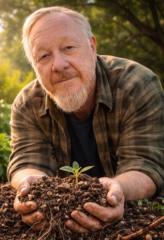
A fruit scrap and a woody twig both contain carbon. Yet they do not offer the compost community the same food, or release it at the same pace. That difference helps us look more closely at two words we hear often in composting: carbon and nitrogen. We have explored who does the work in compost and how those organisms interact. Now we can ask what they need from the materials they consume. Microorganisms need both energy and materials to grow. Carbon-containing compounds, including sugars and other carbohydrates, supply energy and carbon for building cells. Nitrogen helps them make proteins, build DNA, and form other essential cell components. With usable carbon, enough nitrogen, and suitable conditions to include moisture and air, microorganisms can grow and reproduce, expanding the community and stimulate decomposition. Plenty of carbon-rich food alone cannot support their growth if available nitrogen is limited. As microorganisms use the food, they release some of its energy as heat. Greater activity can generate more heat, although whether the pile warms also depends on how readily that heat escapes. Leaves, grass clippings, and food scraps contain both carbon and nitrogen. Calling them “carbon materials” or “nitrogen materials” is shorthand for the balance between those elements. That balance is expressed as a carbon-to-nitrogen ratio, written C. For example, 30:1 means thirty parts carbon for every one part nitrogen by weight. It does not mean thirty buckets of browns to one bucket of greens. A higher ratio means more carbon relative to nitrogen; a lower ratio means more nitrogen relative to carbon. This example explains how to read the ratio rather than prescribing one mixture for every compost system. The ratio helps us understand what materials contribute, but availability matters too. Some carbon compounds, such as sugars in fruit scraps, are relatively easy for microorganisms to use. Carbon held in woody material generally becomes available more slowly because of the material’s chemical structure. A pile can contain plenty of carbon without offering a large supply that organisms can use quickly.
Poll
3 members have voted
1 like • 23d
Carbon helps soil store more of what plants need: air, water, nutrients, and life. That’s one reason biochar is so interesting. It’s a highly carbon-rich material with a porous structure and surfaces that can hold water and nutrients. This is also why people recommend “charging” biochar with compost or nutrients before adding it to the soil. I like to think of soil as a battery. Adding carbon-rich organic matter can increase its capacity to store and cycle resources, while soil biology helps make those resources available to plants. Nitrogen plays an important role in that process, influencing microbial activity, decomposition, and how quickly organic matter cycles through the system. Carbon helps build the battery. Biology helps cycle the energy. Nitrogen helps regulate the process.
1 like • 22d
@Jim Flach Ironically, I would argue that biochar isn’t commonly produced through natural soil-building processes. It forms primarily through the incomplete combustion of organic matter, such as during wildfires. Soils without a history of fire may contain little or no fire-derived charcoal. Soil does, however, naturally develop humic substances through the decomposition and transformation of organic matter. These are another important form of carbon that contributes to nutrient retention, soil structure, and overall soil health.
1-10 of 144

@jon-shobe-2169
Have a small farm located in zone USDA 6b. Property is 5 acres creating a biodiversity food production homestead .
Active 2d ago
Joined Apr 13, 2026
INTP
Ohio, USA