Activity
Mon
Wed
Fri
Sun
Aug
Sep
Oct
Nov
Dec
Jan
Feb
Mar
Apr
May
Jun
What is this?
Less
More
Owned by Sterling
This group is designed for the discussion of the Vagus Nerve, techniques to stimulate it, and the benefits of doing so.
Ultra School is a repository for information published by Sterling Cooley, as an online training platform for using Ultrasound.
Memberships
Start My AI
157 members • Free
The Success Club
13.6k members • Free
The AI Advantage
126.1k members • Free
Biotech Career Accelerator
2 members • Free
Skoolers
169.8k members • Free
Synthesizer: Free Skool Growth
44.3k members • Free
Accelerator
9k members • Free
411 contributions to Vagus School

21h •
The Secret Link Between Your Vagus Nerve And Vocal Health
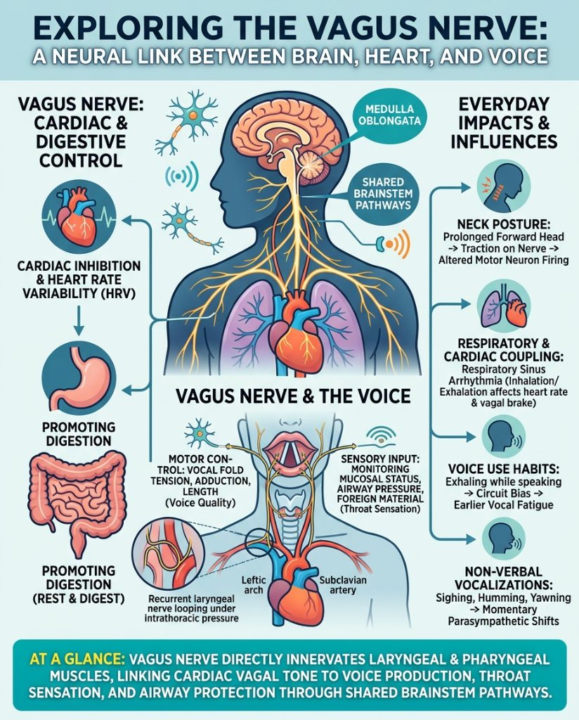
The vagus nerve is the tenth cranial nerve and originates in the medulla oblongata. It carries both efferent signals that slow heart rate and promote digestion and afferent signals from visceral organs to the brainstem. Its laryngeal branches arise from the nucleus ambiguus and supply the sole motor innervation to the intrinsic laryngeal muscles except the cricothyroid, as well as sensation above and below the vocal folds via the recurrent laryngeal nerve and superior laryngeal nerve. Motor fibers control vocal-fold tension, length, and adduction while sensory fibers monitor mucosal status, airway pressure, and foreign material. The recurrent laryngeal nerve loops under the aortic arch on the left and the subclavian artery on the right. Intrathoracic pressure changes can mechanically deform the nerve and alter vocal-fold closure pressure. Myelinated axons for laryngeal muscles travel alongside cardio-inhibitory fibers until they diverge in the neck. Everyday neck postures such as prolonged forward head position can create traction on vagal fibers and change baseline firing rates of laryngeal motor neurons. The same brainstem nuclei that govern cardiac slowing also coordinate glottic closure timing. Habitual speaking while exhaling can bias shared circuitry toward expiration and produce earlier vocal fatigue. Heart-rate variability and respiratory sinus arrhythmia index vagal tone. During inhalation the vagal brake is withdrawn and heart rate rises; exhalation restores the brake. Reduced variability may coincide with a narrower window of tolerance for physical and emotional demands. A paced-breathing task at six breaths per minute increased high-frequency heart-rate variability and reduced phonation threshold pressure during subsequent tone production. Anatomical tracing and neuroanatomy studies confirm unilateral or bilateral disruption alters vocal-fold position and sensation. Clinical observations from vagus-nerve stimulation document transient voice changes and swallowing effects. Cleveland Clinic summaries note that irritation can manifest as hoarseness or globus sensation without structural lesions. These associations remain non-causal for everyday fluctuations in healthy individuals.
2
0
2d •
I Was Wrong About AI And I Am Sorry
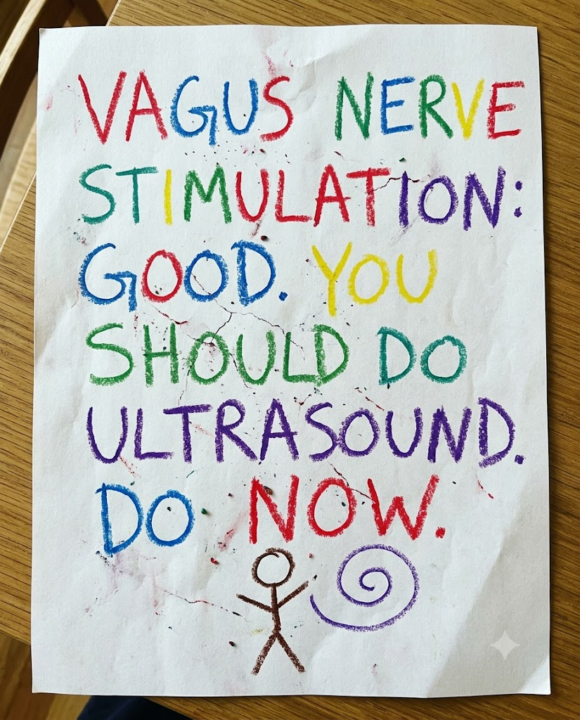
OK, OK, I've seen the errors of my way and have now decided from now on I'm going to make pictures only by hand. The only pictures you're going to see from me from now on are ones that only I have made with my own hands and whatever drawing materials I have on hand. Apologies in advance for the superior drop in quality, but this is what people have asked for, and people don't like AI. While the consistency and quality of my posts may drop substantially and it really won't convey too much information, I decided to make this one very clear piece of media so people can really get a sense of what's important in life. I hope this helps, and you guys were totally right. I'm so sorry about using AI to make pictures. What was I thinking? Crazy, I know! I have innate artistic abilities that I should have been tapping into this whole time! I feel like such an idiot. Please accept this picture as a sign of my apology.
1 like • 24h
@Mason Peck ha ha, right more funny too
2d •
How Vagus Nerve Stimulation Targets Subconscious Inner Child Patterns
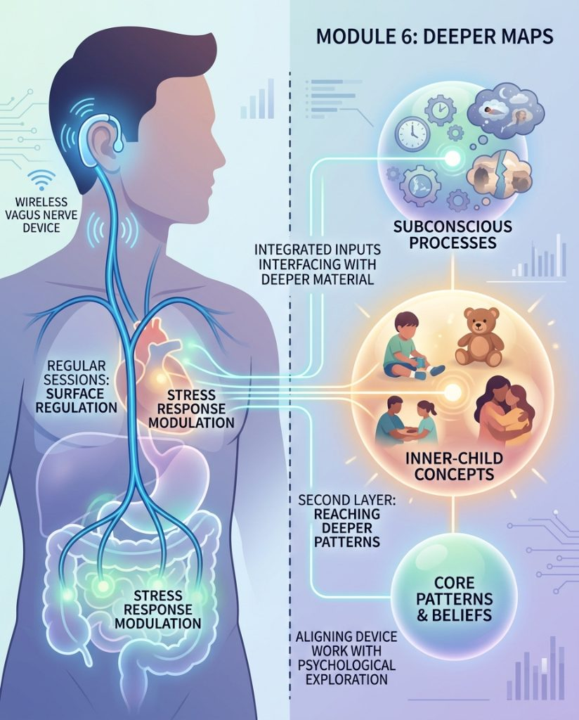
Vagus nerve stimulation acts as an interface with the neural architecture in Module 6, targeting zones where inner-child concepts and subconscious processes are seated. These signaling pathways extend into the symbolic territories governing rooted emotional frameworks. The stimulation activates a loop bridging the gap between physiological modulation and the subconscious landscape. Regular stimulation provides more than surface-level regulation of the parasympathetic system. While traditional approaches focus on vagal tone, this framework identifies a secondary layer of influence penetrating into long-standing behavioral patterns. This allows for a reorganization of materials beneath conscious awareness, showing the nerve as a conduit for systemic restructuring rather than simple maintenance. Illustrations of these pathways demonstrate an extension toward symbolic processing zones where the inner-child concept is anchored. Research examines how consistent inputs reach these subconscious zones to alter the scripts driving autonomic responses. This alignment provides technical validation for practitioners linking physical modulation to internal states and emotional archetypes. Integrating subconscious mappings into protocols shifts the focus from temporary relief toward the resolution of entrenched regulatory biases. Refining inputs to target the symbolic zones in Module 6 transforms the device into a precision instrument for accessing the biological substrates of early-life imprinting. This evolution moves practice toward a targeted update of core emotional regulation. https://www.skool.com/vagus/classroom/dad599f3?md=
2
0
Mar 12 •
🚨 The #1 Question I Get: "What's the Best Ultrasound Device to Buy?" (My Official Answer + Regional Guide)
Welcome to the group! I know the first few modules are in the Classroom: Skool.com/vagus/classroom available to read right now - but I always see the same question pop up immediately: "What device should I buy?" Instead of *I guess* hoping you will make use of the Classroom which already has the answer, or hoping you would use the Search feature at the top of the site, I wanted to put the answer front and center. This post will be pinned at the top, so you can reference it anytime. The goal is to get you started with the right tool for your region. Let's break it down: USA: If you are in the USA: The US-1000 is your go-to. It’s affordable, incredibly effective, and the perfect entry point for Vagus Nerve Stimulation. For around $54 USD, it’s one of the most accessible biohacks you can invest in. The benefits—from reduced inflammation and deeper sleep to a calmer nervous system—are tremendous for the price. - 👉 Click for Module 2: How to Buy an Ultrasound - 👉 Click for Module 3: How to Use & Place Ultrasound 🌍 If you are in Canada: Great news, the US-1000 is also easily available. - Canada Supplier: Link EU: If you are in the EU or UK: The Rules are a Little Different Due to regulations and availability, the US-1000 isn't sold here. You’ll be looking at the US-2000 Pro class of device. Don't let the "Pro" name intimidate you! It simply means these units produce a higher power output and offer more focused stimulation. You don't really have a choice in the matter, but honestly, you're getting a slightly more powerful unit out of the gate.

0 likes • 8d
@Abraham Turner sweet! I'm going to be opening up my calendar for calls this summer so I'll keep you in mind and keep an eye out for that.
0 likes • 3d
@Crystal Halloran of course you can actually get the US 2000 pro in Australia. It’s called the revive so you actually already have it there.
4d •
New Research Reveals The True Primary Cause Of Alzheimer's Disease
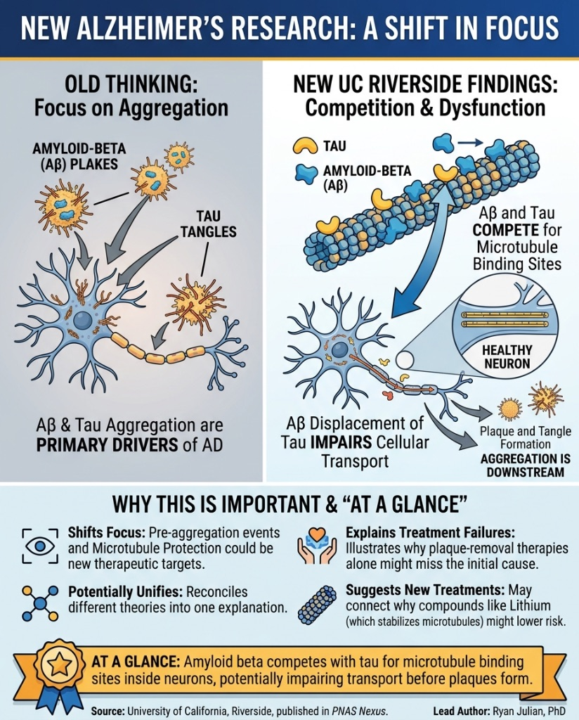
New research from investigators at University of California, Riverside suggests that amyloid beta (Aβ) and tau compete with each other for binding sites on microtubules inside neurons, disrupting cellular transport and possibly initiating disease development. The study, published in Proceedings of the National Academy of Sciences, Nexus, focuses on microtubules as a central point of interaction between the proteins and proposes that displacement of tau by Aβ may impair neuronal function before protein aggregation occurs. The new research runs counter to current thinking that has focused on amyloid beta aggregation as the primary driver of Alzheimer’s disease. Instead, the UC Riverside team found that amyloid beta binds to microtubules with similar affinity to tau, a protein responsible for stabilizing these structures. Using fluorescent labeling, the team tracked amyloid beta interactions and observed that it attaches to microtubules and can displace tau when present at sufficient levels. This displacement may compromise the microtubule network that neurons rely on for intracellular transport. “Our work shows amyloid beta and tau compete for the same binding sites on microtubules, and that a-beta can prevent tau from functioning correctly,” said first author Ryan Julian, PhD, a professor of chemistry at UC Riverside. Microtubules are a transport pathway within neurons that provide for the movement of essential molecules. Tau’s role in maintaining these structures has been well established, but the interaction between amyloid beta and microtubules has not been researched extensively. The researchers sought to better understand this relationship after they identified structural similarities between regions of tau that bind microtubules and Aβ peptides. To do this, the investigators labeled Aβ peptides and monitored them for changes in movement and light emission, indicating attachment to microtubules. Additional experiments demonstrated that amyloid beta and tau bind with comparable strength, which gave weight to the team’s hypothesis that Aβ accumulation could displace tau.
1-10 of 411

@sterling-cooley
Vagus Nerve Stimulation Specialist
Admin of Ultra School
Active 20h ago
Joined Oct 15, 2020
ENTP
Seattle, Washington
Powered by