Activity
Mon
Wed
Fri
Sun
Jun
Jul
Aug
Sep
Oct
Nov
Dec
Jan
Feb
Mar
Apr
May
What is this?
Less
More
Memberships
Chase AI Community
60.9k members • Free
Automatable Free
9.9k members • Free
AI Bits and Pieces
716 members • Free
Business Builders Club
8k members • Free
The Build Room
2.4k members • $97/month
AI Automation Society Plus
3.6k members • $99/month
AE
Automate Everything
143 members • $1/year
The Upwork Playbook (Free)
239 members • Free
Ai Titus
911 members • Free
16 contributions to AI Bits and Pieces

🔥
2d •
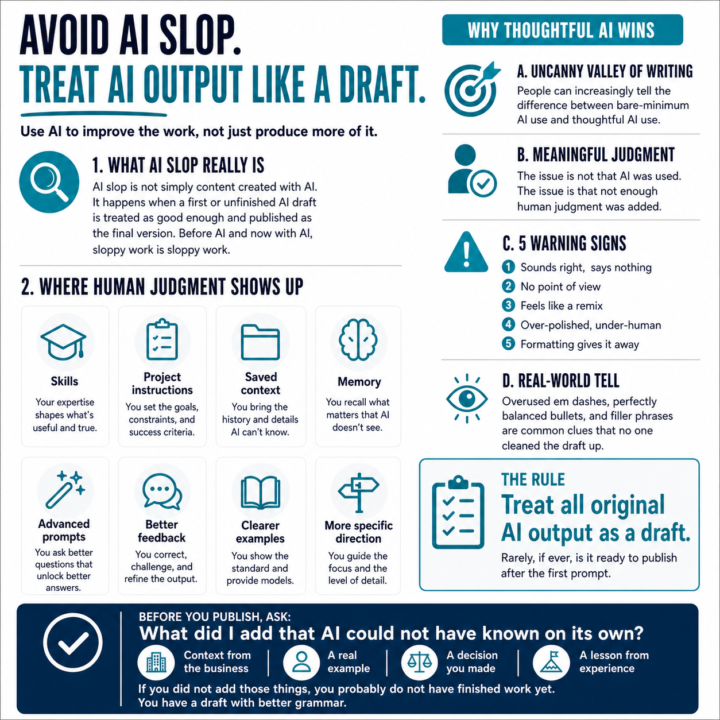
⚠️ AI Slop: Uncanny Valley of Writing
The latest buzzword is “AI slop.” And honestly, I think it is a useful one. But AI slop is not simply “content created with AI.” That misses the point. AI slop is what happens when someone treats the first or unfinished AI drafts as “good enough” and publishes it as the final version. Decent but unfinished content is not the antidote to procrastination. Before AI, and now with AI, sloppy work is sloppy work. We are quickly approaching a time where, in a professional environment, people can tell the difference between bare-minimum AI use and thoughtful AI use. You have probably heard of the uncanny valley problem with AI images, where something looks almost right, but still feels off. I believe something similar is starting to happen with AI writing. That same intuitive sense that tells people an image was generated by AI also starts to work against the person who presents unedited AI output as their own thinking. Not because they used AI. Because they did not add enough meaningful human judgment. And that judgment can show up in a lot of ways: - Skills. - Project instructions. - Saved context. - Memory. - Advanced prompts. - Better feedback to the LLM. - Clearer examples. - More specific direction. Thoughtful AI use creates better content, deeper meaning, and a sharper perspective. My rule is pretty simple: 👉 Treat all original AI output as a draft, and accept that it will rarely, if ever, be ready to publish after the first prompt. Always a draft. Here are five warning signs I look for: 1. It sounds right, but says nothing If you can delete the sentence and the meaning does not change, cut it. 2. There is no point of view If anyone could have written it, no one will remember it. 3. It feels like a remix AI is very good at summarizing what already exists. Your job is to add the experience, the example, or the opinion. 4. It is over-polished, but under-human Perfect grammar does not equal trust. Sometimes the post needs a shorter sentence.A rougher line.A little more of you.

3 likes • 1d
This is a spot-on reminder that AI should be a tool, not a shortcut. True value comes from the human touch-context, judgment, and unique insight- that transforms AI drafts into meaningful content.
🔥
2d •
AI Bits & Pieces is now 700 members strong!
We just crossed 700 members in AI Bits & Pieces, and I want to take a moment to say thank you. When this community started, the idea was simple: AI is becoming a life skill. For the AI Curious. For the AI Beginner. For the AI Enthusiast. For the AI Practitioner. For the business owner. For the person simply trying to keep up. For everyone. AI is becoming part of how we think, write, plan, research, learn, create, and make decisions. And for many people, the hardest part is not understanding every technical detail. The hardest part is knowing where to start. That is what AI Bits & Pieces is here for. A place to learn without feeling behind. A place to ask basic questions without judgment. A place to see real examples, practical workflows, and honest tool testing. A place where curiosity matters more than credentials. As the community grows, the goal remains the same: help people build practical AI fluency one step at a time. You don't need to learn everything by tomorrow. Just steady progress. Some members are brand new to AI. Some are using it every day. Some are building workflows, automations, content systems, or businesses. And some are simply trying to understand how this technology fits into their work and life. All of that belongs here. I also want to recognize and acknowledge everyone on the leaderboard! You are the people who continue to show up, comment, ask questions, share examples, and make this feel like a real learning community. That participation matters more than most people realize. Content helps. Tools help. But people make the community useful. So thank you for being here, whether you joined at member 7, member 70, or member 700. We are still early. And we are building AI fluency together, one bit and piece at a time.

1 like • 1d
@Michael Wacht Congratulations and thank you for the teaching you are publishing! Also, congratulations to all of us for being a part of this community.
🔥
9d •
📦 Out of The Box in 90: Suno Turns My Poem Into AI Song for Daughter
Welcome to the Out of The Box Series — where I test how far curiosity and AI can take you in 30, 60, or 90 minutes using today’s best no-code and low-code tools. No studio. No production team. No advance training. Just exploration to see what we can do — right out of the box. 🎧 Finished Song*: I Got Your Six Little Girl 🎬 This Episode: Suno.com – AI Song Creation 🕒 Time Limit: 90 Minutes 📂 Category: AI Music & Personal Creativity 🎶 What Is Suno? Suno is an AI music generation tool that can create songs from prompts, lyrics, and style direction. In this case, Suno did the musical composition. I uploaded my original lyrics. 🎧 Finished Song*: I Got Your Six Little Girl Because rights and ownership matter, I started with lyrics I had written myself and kept the words original. With Suno Pro, you can publish what you create, so I wanted to be thoughtful about what I uploaded and refined. 📝 Backstory In February 2020, I wrote a poem for my daughter called I Got Your Six Little Girl. It was written from the perspective of a father looking back on all the firsts: - first heartbeat - first breath - first steps - first bike ride and moments in between The poem was already written. But I cannot sing. I cannot play instruments very well. I was never in the band. So I wanted to see if I could use AI to help turn the poem into a song to give her as a graduation present. ⏳ What I Built in 90 Minutes: Within one focused session, I: 🎼 Uploaded my original lyrics into Suno 📝 Converted the poem format into a song lyric format 🎚️ Used Suno’s interface presets to guide the style 🔁 Generated multiple versions 🎧 Listened for tempo, transitions, hooks, and continuity 🎵 Created a strong working version of the song 🎧 Finished Song*: I Got Your Six Little Girl The prompt was less of a traditional instruction and more of a music style descriptor.

2 likes • 6d
@Michael Wacht This is truly touching - turning your heartfelt poem into a beautiful song for your daughter is such a meaningful gift. The blend of personal words with AI music brings a new depth to your message. Awesome!!
2 likes • 6d
@Michael Wacht Yeah. I also have a son and I know what it means.
🔥
7d •
🩺 AI in Real Life: Proud Parent Edition
Sometimes AI helps with productivity. Sometimes it helps with workflows. And sometimes… it helps two very proud parents create the perfect swag gift for their daughter’s first job as a nurse. In this case, Mommy was the art director — with the vision, the eye, and the “nope, that’s not quite right” authority. ❤️ And Daddy was prompting his heart out, trying to get every detail just right for a one-of-a-kind gift to celebrate a huge milestone. Not just any gift. A first job gift. A you worked for this gift. A we are so incredibly proud of you gift. That’s one of the things I love about AI. It is not always about big business use cases or fancy automation. Sometimes it is simply about helping you bring an idea to life faster… more creatively… and with a little more heart. A custom gift. A meaningful moment. A daughter stepping into her calling. And two parents smiling behind the scenes, trying to make it special. Here is the full prompt trail — images, typos, revisions, “almost there” moments, and all: https://chatgpt.com/share/69f202f5-7a30-83ea-a591-cb97fd8246b2 That is AI in real life. Because sometimes the best use of AI is not just getting something done. It is helping you show someone you love just how much they mean to you.

3 likes • 6d
@Michael Wacht Excellent, Wonderful!!
🔥
12d •
🔨 AI Terms Daily Dose: Models
Day: 127 Level: Intermediate Edition: Claude Code Category: Costs & Usage AI Learning Path: Real-World Usage AI Terms in Series: Tokens → Models → Subscription Level → API Use → Extra Usage Models are the different versions of Claude AI available through Claude Code, each with different capabilities, speeds, and costs. Understanding which model you’re using is foundational — it affects everything from what you can accomplish to how much you’ll pay. 🪄 Simple Definition: Claude AI engines available through Claude Code, each with unique capabilities and costs.→ “Understanding how Choosing the right Claude model for the job selecting or moving between the models will help you control token usage and cost” 🌟 Expanded Definition: Models are different Claude AI engines, each trained and optimized for specific capabilities. Think of them as different specialists on your team — some are fast and efficient for simple tasks, others are powerful for complex work, and each comes with different costs. Claude Sonnet 4.6 (Daily Driver) • Best balance of capability and cost • Preferred by 70% of developers • Great for most coding tasks • $3 input / $15 output per million tokens Claude Opus 4.7 (Most Capable) • Newest and most advanced mode • Best for complex, multi-step projects and agentic workflows • Superior software engineering and vision capabilities • $5 input / $25 output per million tokens Claude Haiku 3.5 (Fastest & Cheapest) • Quick, simple tasks • Ultra-fast responses • Lowest cost option • Best for repetitive or basic tasks Model choice affects both your experience and budget. Models are essential for: • Managing your Claude Code costs effectively • Getting appropriate capability for your task complexity • Balancing speed vs. thoroughness • Optimizing your workflow and budget • Understanding why some interactions cost more than others ⚡ In Action: “Building a simple app and training? Use Haiku for fast, cheap results. Architecting a complex API integration with multiple files and error handling? Opus 4.7 justifies the higher cost. Daily coding tasks? Sonnet 4.6 hits the sweet spot — it’s why 70% of developers prefer it.”

2 likes • 10d
Keep going and explore the new issues. Very useful for beginners like me.
1-10 of 16

@md-abdullah-al-mafi-6512
QuickBooks Online Expert | AI Bookkeeping Automation (n8n) | Helping Founders Turn Accounting Data into Profit Decisions | Finance Consultant
Active 9h ago
Joined Jan 20, 2026
Bangladesh
Powered by