Activity
Mon
Wed
Fri
Sun
Oct
Nov
Dec
Jan
Feb
Mar
Apr
May
Jun
Jul
Aug
Sep
What is this?
Less
More
Owned by Nadene
Learn with like minded global practitioners and professionals bringing regenerative & emotionally mature leadership into real organizational contexts.
The RoboNuggets Network (free)
76.7k members • Free
The JOY Project
532 members • Free
Skoolers
157.2k members • Free
432 contributions to InnerDevelopment@Work

20d •
Fall Listening to What is Changing
I’m offering a special fall edition of Listening to What Is Changing on September 17, in recognition of the Global Day of Listening. It’s a 75-minute pause to listen to what may be changing in our lives—and, inspired in part by the Pachamama Alliance’s Earth Listening Circles, to widen that listening to include the living world and the season we’re part of. If you’re navigating a transition, sensing something shifting, or simply longing for a little space to listen, you’re warmly welcome. September 17 · 11am PT · Zoom · Complimentary https://goldenthreadcoach.com/events
1 like • 3d
Thank you @Julie Gefroh for hosting this session you provided a wonderful space to slow down and listen to what life is telling me. ✨
1 like • 1d
@Julie Gefroh I am still mulling over the question “What would it mean to stay in relationship with what you touched?” In relation to life unfolding 🙏
3d •
Happening next week ✨Inner development and regenerative economics
@Sarah Santacroce and I will be attending to listen and learn about the connection between inner development and regenerative economics. What have you got planned next week? Hope to see you there too! Kate Raworth, creator of Doughnut Economics, collaborates with the Plum Village community to connect Zen mindfulness and inner transformation with systemic economic change. Upcoming Live Event - Event Name: Inner Change for Systems Change - Date & Time: Thursday, September 24, 2026, from 7:30 to 8:30 pm CEST - Hosts: Kate Raworth and Plum Village monk Brother Phap Linh - Cost: Free to attend (online registration available via the Plum Village Event Page) - FOCUS: Exploring how inner personal transformation helps build regenerative economic systems rooted in interdependence

1 like • 1d
@Marise Hyman congratulations that sounds like a terrific new challenge. Please do share your policy paper when it’s available 🙏
11d •
The 81st session of the UN General Assembly and Climate Change week
Since yesterday "world leaders are gathering in New York for the 81st session of the United Nations General Assembly (September 8–28, 2026) and Climate Week NYC (September 20–27, 2026) at a pivotal moment. Amidst rising geopolitical tensions, the looming 2030 deadline, and the escalating climate crisis, a new UN Secretary-General will soon be elected ahead of next year's 2027 SDG Summit. Against this backdrop, the UN Sustainable Development Solutions Network (SDSN) will host a series of high-impact events bringing together civil society, academics, policymakers, and youth to address today's rapidly evolving global challenges and identify solutions for sustainable development through 2030 and beyond." Two suggestions that may be of interest: Science Across Generations: From Regional to Global Connectivity 🗓️ When: September 16, 2026, 10:15 to 11:45 AM EDT 🌎 Where: Virtual REGISTER HERE OR The Future of Multilateralism: Leadership for a Changing World September 24, 2026, 10:00 AM to 12:00 PM EDT | Online & New York, NY | Watch the Livestream This is with Geoffrey Sachs the President of SDSN The discussion will examine the leadership, partnerships, and governance approaches needed to renew international cooperation and respond to the growing complexity of global challenges ID@Work follows the SDSN on LinkedIn, and X (Twitter), to stay up-to-date on their activities throughout UNGA 81 and Climate Week NYC.

0 likes • 3d
One of the events I'll be attending online is the The UN Sustainable Development Solutions Network (SDSN), led by President Professor Jeffrey Sachs He will host a high-level side event titled "The Future of Multilateralism: Leadership for a Changing World" on September 24, 2026, from 10:00 AM to 12:00 PM EDT during the 81st United Nations General Assembly high-level week. Event Details - Date & Time: September 24, 2026, 10:00 AM – 12:00 PM EDT - Location: Hybrid format (New York, NY and online livestream via the SDSN Official Site) - Host: UN Sustainable Development Solutions Network (SDSN) - Key Speaker: Professor Jeffrey Sachs (President, SDSN) Core Focus - Multilateral Cooperation: Examining how international collaboration and governance can evolve to meet complex 21st-century crises. - Leadership & Partnerships: Identifying new approaches in policy and science to build a more responsive global system. I belileve that I saw you there the last time the SDSN had an event @Maria do Céu Bastos and look forward to seeing you there!
Jun 18 •
WELCOME TO THE MESSY IN-BETWEEN!
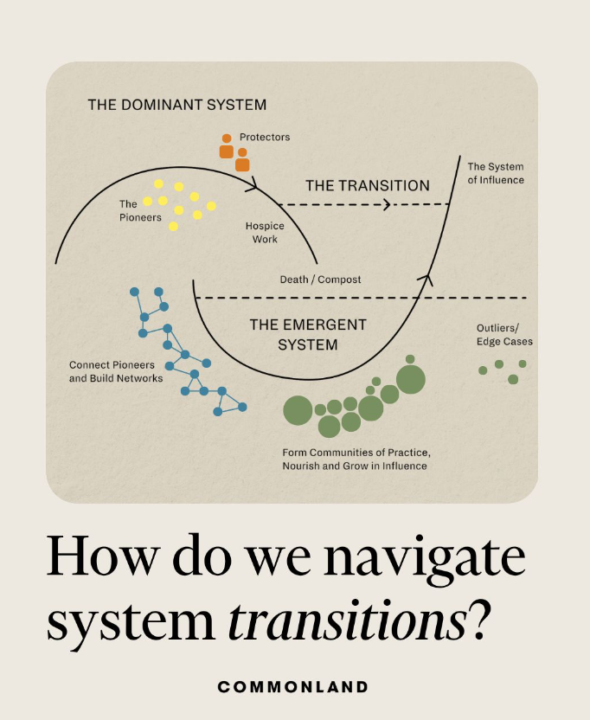
Where do you find yourself in this moment of systems transition? Are you pioneering the new? Hospicing the old? Supporting the in-between? Systems change happens in an uneasy space—between what’s fading and what’s yet to fully emerge. While we see glimpses of a regenerative future, extractive systems still dominate. So, how do we navigate this transition? 👉 Enter the Berkana Two Loops Model Developed by The Berkana Institute, Margaret Wheatley and Deborah Frieze, in the '90s this model maps out how systems change. As one system declines, another slowly emerges—not through sudden transformation, but through intentional transition. But here’s the uncomfortable truth: the old system doesn’t go quietly. So, who drives the transition? 🚀 Pioneers emerge first, those brave enough to experiment with new ways of thinking and doing. Without connection and support, those pioneering voices can easily be drowned out by the dominant system. THIS is why community matters. Pioneers need networks—to share, to connect, to recognise they’re not alone. 🤲🏽 Protectors, meanwhile, are those working within the current system—they nurture the new ideas, they carve out space for them to grow. But it's not only about innovation. Some fulfil the role of hospice workers for the old system—gently guiding it to a close while composting what’s worth keeping. 🌱 It’s about holding onto the best of the old, while gracefully letting the rest go. Where do you find yourself in this moment of transition? What would your role be within the Berkhana Two Loops Model? Let us know in the comments! 🌍✨ Thank you commonland for the reminder!
0 likes • 11d
@Marvin Maneve In my consulting, facilitation and coaching work within teams, departments, UN agencies and organisations in different states of a change processes the Berkana is one good visual of what it can look like.
0 likes • 5d
@Marvin Maneve it is definitely my vécu
5d •
Reawakening Humanity’s Sacred Connection with Earth
Encounters to co-create a future with greater love, courage, and action - this IS Inner Development at Work The Fetzer Institute Environment Collaborative has extended an open invitation for each of us to honor our sacred relationship with the Earth, uniting perspectives for bold climate solutions to address the climate crisis through spiritual and Indigenous worldviews. Together, we will enter a current of spirit that begins from within and flows and grows among us in shared ceremony and dialogue, reflection, encounter and purpose throughout the day. We will celebrate and explore the sacred spirit that connects us to each other, all living beings, and our Earth while honoring the grief and joy, struggle and courage that accompany our work. Through meditation and dialogue, music and movement, and evidence-based stories of transformation, we will discover how spirituality and ancient wisdom are vital forces for meaningful climate action. Together, we will deepen our relationships, chart practical pathways of change, and generate authentic collaborations that emanate from spirit and manifest into effective climate solutions that are necessary for a just, loving and compassionate future. WHEN | September 20, 2026, 8:30 am – 5:30 pm EST WHERE | Columbia University, The Lee Bollinger Forum Attend the event via livestream Register here https://www.eventbrite.com/e/virtual-reawakening-humanitys-sacred-connection-with-earth-tickets-1996170289070
4
0

1-10 of 432
@nadene-canning-5753
Listening, learning, leaning in.
Supporting practitioners weave purpose & inner development into their work.
Design, Curate, Facilitate & Coach.
Active 10h ago
Joined Oct 8, 2024
Earth
Powered by