
4h •
🧬 There's a Molecule Hiding in Your Mitochondria That May Be the Key to Why Some People Live Past 100
Most people have never heard of Humanin. It's a tiny signaling molecule made by your mitochondria, the little power plants inside your cells. Scientists discovered it in 2001 while hunting for things that protect brain cells from Alzheimer's damage. What they found was something way more interesting than expected. Humanin doesn't just protect neurons. It improves insulin sensitivity, shields the heart from damage, and acts like a survival signal that tells your cells "don't give up yet" when they're under stress. Here's the part that gets really fascinating. Researchers studied centenarians, people who live past 100, and found they have significantly higher levels of Humanin circulating in their blood compared to average people. Their children do too. Meanwhile, in the rest of us, Humanin levels drop steadily as we age. That decline tracks almost perfectly with the rise of age-related diseases like diabetes, heart disease, and neurodegeneration. Here's what the research has found so far 👇 ✅ Humanin blocks a specific protein called BAX that triggers cell death, essentially acting as a cellular bodyguard ✅ A synthetic version called HNG is about 1,000 times more potent than the natural form and is being used in advanced preclinical studies ✅ It belongs to a brand new class of molecules called mitochondria-derived peptides, which is rewriting what scientists thought mitochondria actually do The big picture shift here is that your mitochondria aren't just making energy. They're sending signals that may determine how fast you age. That's a completely different way of thinking about longevity. What's the one thing about aging that you think mainstream medicine is still getting wrong? Would love to hear your take. For research purposes only.
0
0
8h •
💬 What's the One Health Goal That Made You Start Looking Beyond the Basics?
Everyone here landed in the peptide research world for a reason. Maybe it was a nagging injury that wouldn't heal. Maybe it was watching your energy slowly decline year after year and knowing there had to be more to the story than "just getting older." Maybe it was skin changes, brain fog, gut issues, or just a deep curiosity about what your body is actually capable of when you give it the right signals. For a lot of people, the turning point comes when conventional answers stop being satisfying. You start reading studies instead of headlines. You realize there are entire categories of compounds your body already produces that most people have never heard of. And suddenly you're down a rabbit hole at midnight learning about growth hormone pathways, tissue repair peptides, and mitochondrial signaling molecules. So here's what I want to know 👇 What's the specific goal or problem that first pulled you into researching peptides? Was it recovery, aging, body composition, cognitive performance, gut health, something else entirely? And now that you're here, what's the one thing you wish you had understood sooner? Drop your answer below. Genuinely curious where everyone's at and what topics would be most useful to break down next. For research purposes only.
0
0
13h •
🧬 There's a Peptide That Works Like Your Body's Own Antibiotic — And It's Controlled by Vitamin D
Your immune system has a first responder that most people have never heard of. It's called LL-37, and it's the only cathelicidin antimicrobial peptide humans produce. Think of it as your body's built-in antibiotic. Instead of targeting one specific type of bacteria the way traditional antibiotics do, LL-37 physically punches holes in bacterial membranes. That's a much harder defense for bacteria to outsmart, which is why researchers are paying close attention to it in the age of antibiotic resistance. But here's where it gets really interesting. LL-37 doesn't just kill bacteria. Studies show it can break apart biofilms, which are those stubborn, shield-like colonies bacteria build to protect themselves from treatment. It also neutralizes endotoxins, which are the inflammatory molecules bacteria release that make you feel terrible during an infection. On top of that, research has found it promotes wound healing by stimulating new blood vessel formation and helping skin cells migrate to close up injuries faster. A small clinical trial on chronic leg ulcers found that patients receiving the highest dose of topical LL-37 saw complete wound healing, while none in the placebo group did. Here's the part that connects it all 👇 ✅ Your body's production of LL-37 is directly controlled by vitamin D levels ✅ The cathelicidin gene has a vitamin D response element built right into it ✅ Research suggests keeping vitamin D above 30 ng/mL supports optimal LL-37 production That means one of the most practical takeaways from peptide science is something surprisingly simple — your vitamin D status may be quietly dictating how well your innate immune system actually functions. Have you ever looked into the connection between vitamin D and immune defense? For research purposes only.
0
0
1d •
🧬 Your Body Has a Built-In Wound Healer That Also Protects Your Heart — And It's in Almost Every Cell You Have
There's a naturally occurring peptide called Thymosin Beta-4 that exists in virtually every cell in your body. Its main job is managing something called actin, which is basically the scaffolding that gives your cells their shape and lets them move. When tissue gets damaged, Thymosin Beta-4 helps repair cells migrate to the injury site, builds new blood vessels to deliver nutrients, and calms down inflammation so healing can actually happen. Think of it as your body's internal project manager for tissue repair. The synthetic version used in research is called TB-500, and the studies on this compound are genuinely fascinating. In 2004, a study published in Nature showed that TB-500 helped heart cells survive after blood flow was cut off, reducing damage by roughly 50%. Then in 2007, another Nature study found it could actually reactivate special progenitor cells in the heart that can grow into brand new heart muscle cells. That's not just repair, that's regeneration. Researchers have also seen accelerated wound closure rates of about 40% in skin injury models, plus promising results in traumatic brain injury recovery. One of the most unique things about TB-500 is that it doesn't need to be applied directly to an injury site to work there. Its low molecular weight lets it travel systemically through the body and find where the damage is. That's pretty rare for a compound like this. Here's what the research highlights 👇 ✅ Reduced cardiac tissue damage by approximately 50% in ischemia models ✅ Promoted new blood vessel growth and cell migration to injury sites ✅ Showed improved neurological recovery in traumatic brain injury studies What area of tissue repair research interests you most — heart, brain, or musculoskeletal? For research purposes only.
1d •
💬 What's the Health Problem You Googled at 2AM That Eventually Led You Here?
We all have that moment. Maybe it was joint pain that wouldn't quit, brain fog that made you feel like a different person, or watching your energy disappear year after year while being told "everything looks normal." Something made you stop waiting for answers and start looking for them yourself. That curiosity is honestly what builds communities like this one. Most people don't stumble into peptide research because everything is going great. They find it because they hit a wall with conventional options and started asking better questions. Whether it was gut issues, stubborn body composition, skin aging faster than it should, or cognitive decline that felt way too early, there's usually a specific frustration that lit the spark. So here's what I'm curious about 👇 What was the thing that made you start digging into this world? Was it a specific health goal you couldn't crack? A compound someone mentioned that made you think "wait, why haven't I heard of this before"? Or maybe something you learned along the way that completely changed how you think about your own biology? Drop it below. Not because I'm collecting data, but because every time someone shares their story here, someone else reads it and realizes they're not the only one looking for something better. For research purposes only.
0
0
1-30 of 58
skool.com/thecompoundlab
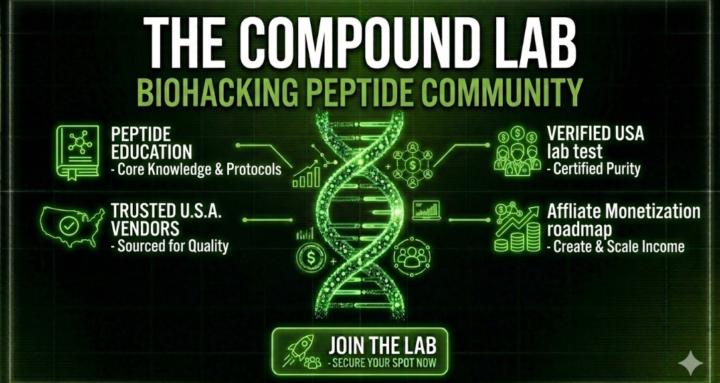
Private biohacking community for peptide education, trusted sourcing, and ethical affiliate monetization. Education-first.
Leaderboard (30-day)
1

+6
2
+4
3

+4
4

+4
5

+3
Powered by