
Pinned
Mar 27 •
START HERE
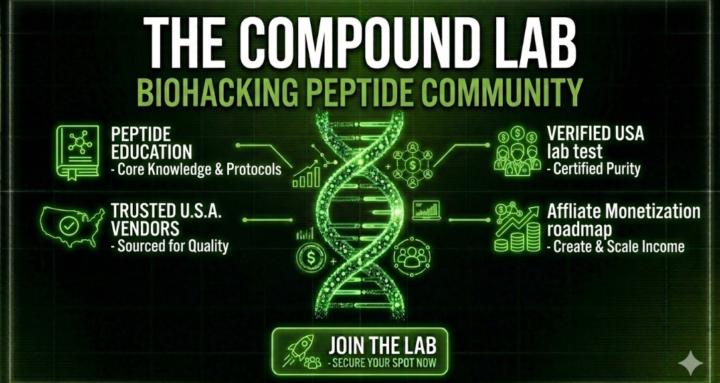
🧬 Welcome to The Compound Lab Your Research Starts Here. We're glad you're here. Follow these 4 steps to get plugged in: ✅ STEP 1: Introduce Yourself Drop a comment below — tell us who you are, what brought you here, and what your goals are as a Compound Researcher. Ask any questions you have. We're all here to help. 📚 STEP 2: Head to the Classroom Tab This is where your education begins. Start with Module 1 and work your way through our in-depth research compound breakdowns, biohacking science, and compliance training. 🔬 STEP 3: Check Out Our Verified Vendors Every vendor in our network is COA certified and fully research compliant. No guesswork — just trusted sources for serious researchers. For research purposes only. Not for human consumption. 💰 STEP 4: Get Your Affiliate Link Ready to earn? Once you're a verified researcher, our vendors will assign you a personal affiliate link so you can earn recurring commissions sharing what you already know. "Learn it. Source it. Share it. Earn from it." 🧬 Welcome to the family — now let's get to work.
8d •
🧬 Your Body Has a Built-In Healing Signal That Declines as You Age — And Scientists Are Studying How to Bring It Back
Here's something wild. Inside your mitochondria (the tiny power plants in every cell), there's a hidden code that produces a protective molecule called Humanin. It was discovered in 2001 by researchers looking for something that could shield brain cells from Alzheimer's damage. Turns out, your mitochondria aren't just making energy — they're sending survival signals to the rest of your body. What makes Humanin fascinating is how it works. When your cells are under stress, Humanin essentially blocks the self-destruct sequence. It stops a protein called BAX from triggering cell death, which is a big deal for your brain, your heart, and your metabolism. It also improves insulin sensitivity and reduces oxidative stress. Think of it as your body's built-in "don't give up" message from your mitochondria to your cells. Here's what researchers have found so far 👇 ✅ People who live past 100 have naturally higher levels of Humanin in their blood compared to everyone else ✅ Humanin levels drop significantly as you age, which tracks with the rise in age-related diseases ✅ A synthetic version called HNG is roughly 1,000 times more potent than the natural form and has shown cardioprotective and neuroprotective effects in preclinical models The idea that your mitochondria are doing more than just making energy — that they're actually broadcasting protective peptide signals — is still a relatively new concept in science. And it raises a big question worth thinking about. What if slowing down aging isn't just about what you put into your body, but about restoring signals your body already makes? For research purposes only.
0
0
8d •
💬 What's the One Thing You Wish Your Body Did Better?
Everybody has that one thing. Maybe it's recovering faster after a workout. Maybe it's finally sleeping through the night without waking up at 3am. Maybe your joints remind you of your age every single morning, or your brain just doesn't feel as sharp as it used to. For a lot of people, that one frustration is actually what leads them down the rabbit hole of peptide research. You start Googling why your knee still hurts after six months, or why your energy crashed in your 40s, and suddenly you're reading about signaling molecules and growth factors at midnight. So here's what I'm curious about 👇 What's the thing you're trying to improve right now? And what's one thing you wish you had known sooner about how your body actually works? Whether you've been researching peptides for years or you just found this community last week, drop your answer below. Chances are someone else here is dealing with the exact same thing. For research purposes only.
0
0
9d •
🧠 There's a Peptide Your Brain Makes for Bonding — And Researchers Think It Could Help Rewire How We Handle Stress
Oxytocin gets called the "love hormone" but that nickname barely scratches the surface. It's a tiny molecule made deep in your brain's hypothalamus, and it does way more than make you feel warm and fuzzy when you hug someone. Researchers have been studying it for decades and what they're finding goes far beyond bonding. Here's what makes oxytocin fascinating. It actually dials down the volume on your brain's fear center, the amygdala. When oxytocin receptors get activated, your stress response literally quiets down. Cortisol output drops. Your brain shifts from threat detection mode into something closer to social connection mode. This isn't just feel-good theory either, brain imaging studies have shown measurable changes in amygdala reactivity after oxytocin exposure. Here's what research has found 👇 ✅ A landmark 2005 study published in Nature showed oxytocin increased interpersonal trust in participants during decision-making tasks ✅ Research on PTSD found that oxytocin reduced trauma-related symptoms when studied shortly after stressful events in emergency settings ✅ A 2013 study on alcohol dependence showed it reduced cravings and withdrawal symptoms in subjects being evaluated ✅ Levels naturally decline with chronic stress and isolation, which may explain why loneliness compounds over time The part that really stands out is that oxytocin doesn't just affect emotions. It influences your gut, your heart, your immune signaling, and even wound healing. It's one of the clearest examples of how a single molecule can bridge your brain and your entire body. Researchers are still mapping out exactly how far its influence reaches, and the picture keeps getting bigger. What surprises you more, that a "bonding" peptide can calm your stress response or that it also talks to your gut and immune system? For research purposes only.
0
0
11d •
💬 If You Could Hand Your Body a To-Do List, What Would Be on It?
I talk to a lot of people who are researching peptides and the one thing that always stands out is how different everyone's starting point is. Some people are here because they want to think sharper at work. Others because they're tired of waking up stiff and sore. Some are chasing better sleep, others want to feel like themselves again after years of running on empty. The interesting thing is, most people don't start by searching for a specific compound. They start with a feeling. Something that's been off for a while. Maybe it's energy that disappeared in your 30s, or recovery that used to take a day and now takes a week, or skin that aged faster than you expected. And then one day you stumble across research on GLP-1 receptor agonists or tissue repair peptides or mitochondrial signaling and suddenly there's a whole world of science you didn't know existed. So here's what I'm curious about 👇 What's the thing you're most trying to improve right now? And what's one thing you wish you had known sooner about how your body actually works? Drop it below because I guarantee someone else in here is dealing with the exact same thing. For research purposes only.
1-30 of 132
skool.com/thecompoundlab
Private biohacking community for peptide education, trusted sourcing, and ethical affiliate monetization. Education-first.
Leaderboard (30-day)
1

+1
Powered by