
Jan 1 (edited) • Course 1: Seeing with Intent
Phase 1 - Introduction - Seeing with Intent (Weeks 1-4)
Seeing with intent is the disciplined practice of making photographs deliberately rather than reactively. It’s not just about noticing what’s in front of you, but about choosing why, how, and when to photograph it. Below is an in-depth, step-by-step breakdown of that process, framed for a photographer who values visual storytelling and critique—not just technical execution.
1. Intent Before the Camera Is Raised
Seeing with intent begins before you look through the viewfinder.
Ask yourself:
- Why does this scene matter?
- What am I responding to—light, gesture, emotion, form, metaphor?
- What do I want the viewer to feel or notice first?
This step separates photographers from image collectors. Intent might be narrative (“a moment of isolation”), formal (“repeating geometry”), or emotional (“quiet tension”). Without this, the camera defaults to recording rather than interpreting.
2. Perceptual Awareness (Seeing vs. Looking)
Looking is passive. Seeing is active.
At this stage, you slow down and scan the scene intentionally:
- Foreground, midground, background
- Edges of the frame
- Light direction, quality, and falloff
- Movement vs. stillness
You’re training yourself to notice relationships: how subjects interact with space, how light shapes meaning, how elements compete or harmonize. This is where distractions are identified before they enter the frame.
3. Defining the Subject (What Is the Photograph About?)
Intent sharpens when the subject becomes specific.
Not:
- “A street scene”
- “A building”
But:
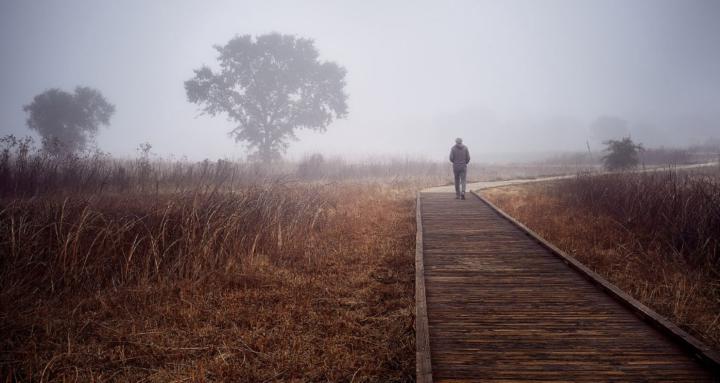
- “A solitary figure swallowed by architecture”
- “A storefront that feels closed off despite daylight”
At this point, you’re deciding what is essential—and what must be excluded. Seeing with intent is as much about removal as inclusion.
4. Compositional Decision-Making
Composition becomes a tool, not a rule set.
You deliberately choose:
- Framing (tight vs. expansive)
- Perspective (eye-level, elevated, compressed)
- Balance or imbalance
- Negative space usage
Rather than asking “Does this follow the rule of thirds?”, you ask:
- Does this composition reinforce my intent—or weaken it?
If the intent is tension, symmetry may dilute it. If the intent is calm, chaos may undermine it.
5. Light as Meaning, Not Illumination
Seeing with intent means understanding light emotionally, not just technically.
You assess:
- Hard vs. soft light
- Direction and shadow behavior
- Color temperature
- Time-based changes
Light becomes narrative. Backlight may suggest fragility or anonymity. Flat light may emphasize form over drama. You wait—or return—if the light doesn’t align with the intent.
6. Timing and Anticipation
Intent sharpens your sense of when.
You’re no longer reacting to moments—you’re anticipating them:
- Waiting for a gesture to complete the frame
- Allowing space for a subject to enter
- Letting stillness settle before pressing the shutter
This patience is critical. Seeing with intent often means not taking the photo until the scene aligns with the internal vision.
7. Technical Choices in Service of Intent
Settings are no longer neutral.
You choose:
- Depth of field to isolate or contextualize
- Shutter speed to freeze or imply motion
- Focal length to compress, distort, or observe
Every technical choice supports meaning. If it doesn’t, it’s arbitrary.
8. The Moment of Commitment
Pressing the shutter is an act of commitment.
You’re saying:
This frame, at this moment, communicates what I saw and felt.
Seeing with intent doesn’t guarantee a “successful” image—but it guarantees a considered one.
9. Reflection and Critique
The process continues after the photograph is made.
You ask:
- Did the image communicate my intent?
- What elements helped—or distracted?
- What would I refine next time?
This reflection trains future perception. Over time, intent becomes faster, clearer, and more instinctive.
In Short
Seeing with intent is the shift from:
- Recording → Interpreting
- Reacting → Choosing
- Shooting → Communicating
It’s the foundation of meaningful photography—and the skill that allows style, voice, and storytelling to emerge naturally rather than be forced.
4
3 comments
Phase 1 - Introduction - Seeing with Intent (Weeks 1-4)
powered by
skool.com/the-visual-storytelling-lab-4609
A photography learning community where art has intent. A community for photographers who want their images to have meaning, not just look good.
Suggested communities
Powered by