
Write something

🍀
🔥
Jul 16 •
Staying Calm as a Preschool Teacher When Behaviors Escalate
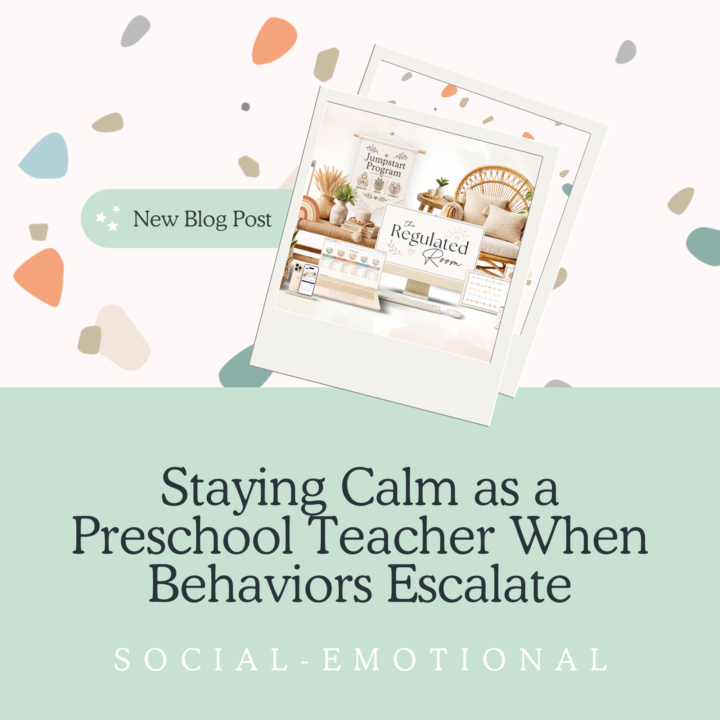
Nobody tells the teacher what to do in that split second. When teachers ask me how to manage big feelings in a preschool classroom, what they usually describe is the children. The behaviors. The meltdowns. The child who will not come to the carpet. Almost never what it costs us to absorb it. I understand why. We are trained to look outward. So we have language for a child's hard moment and almost none for the thing happening in our own body at the same time. The shoulders. The voice we did not choose. The guilt at nap time that follows us all the way to the car. Here is what I have come to believe: You are not losing your patience. You are absorbing a room full of big feelings all day with nowhere to put your own. That is not a character flaw. That is a body doing what bodies do. Think of the last time a child swept the blocks off the shelf, or tore down your bulletin board. Your shoulders were probably up before you decided anything. That reaction was faster than thought. It was already underway before you had a chance to choose it. Which is exactly why "be more patient" has never once worked, for you or for anyone. You cannot decide your way out of something that already happened. There are a hundred resources out there for calming the children. There are almost none for the teacher standing in the middle of it. Jennifer said it better than I could: "I've been seeking this in so many places but it's always about regulating the kids. Everything says, the teacher will feel this way too. But they never tell the teacher what to do for yourself in that split second." So I made something that does. The Regulated Room is 90 minutes of audio, broken into five themes, built for the teacher and not the child. 90 minutes. That is one summer afternoon. Do it in a single sitting, or take one theme at a time over five mornings. Whatever way works for you. More than 117 teachers have already gone through it. I asked them for their honest feedback at the end, and I would rather they tell you than me.
🍀
🔥
Jul 11 •
The Power Of Process Skills In Early Childhood Education
How The Creative Curriculum Empowers Preschoolers for Success As preschool teachers, we often wonder how to prepare our young students for future academic success. The Creative Curriculum's inquiry-based, play-based approach to learning may seem less academic. However, did you know it emphasizes developing essential process skills that predict academic achievement? Let's talk about how these skills are developed through hands-on learning experiences. The Creative Curriculum's emphasis on developing process skills is essential to preparing our young students for future academic success. The curriculum's Foundation Volume 1 outlines five key process skills vital in promoting children's learning and development. In this blog post, we'll closely examine these skills and how they are developed through various Creative Curriculum studies. 1.Observing and exploring This skill involves using our senses to gather information and explore the world. For example, during a Clothes study, children can observe different types of clothing and explore how they feel, how they are made, and who wears them. This skill is essential for developing children's curiosity and interest in learning. 2.Connecting This skill involves making connections between different concepts and ideas. For example, during a Balls study, children can connect different types of balls with their uses and features and learn how to categorize them based on size and shape. This skill is essential for developing children's critical thinking and problem-solving skills. 3.Problem-solving This skill involves using critical thinking to solve problems and find solutions. For example, during an Insects study, children can problem-solve how to create a safe and comfortable environment for insects to live in and learn how to identify different types of insects based on their characteristics. This skill is essential for developing children's problem-solving and decision-making skills. 4.Organizing information This skill involves categorizing and organizing information meaningfully. For example, during a Buildings study, children can organize different types of buildings based on their uses and functions and learn to identify different parts of a building. This skill is essential for developing children's language and cognitive development.
1-2 of 2

skool.com/teachers
The go-to hub for preschool & Pre-K teachers on Skool! Play-based learning, Creative Curriculum + free samples from the $7 Pre-K Prep Club library
Leaderboard (30-day)
1

+13
2

+13
3

+12
4

+10
5

+9
Powered by