
Write something
Pinned

5d •
This Blew My Mind
🦎 Did You Know? The First GLP-1 Drug Came From a Lizard! 💉 Okay, I HAVE to share this because it's one of the most fascinating stories I've come across while learning about GLP-1 medications! 😂 Did you know that a discovery involving a venomous lizard helped lead to the very first FDA-approved GLP-1 receptor agonist for treating type 2 diabetes? And yes... This is a TRUE story! 🦎 Let's talk about how a lizard called the Gila monster helped change diabetes treatment forever! 🦎 Meet the Gila Monster The Gila monster (pronounced HEE-luh) is a venomous lizard native to the southwestern United States and northwestern Mexico. It's known for its: 🦎 Large body 🟠 Orange, pink, and black patterned skin 🌵 Desert habitat 🍽️ Ability to go long periods between meals But what makes this lizard REALLY interesting isn't just its appearance. It's something scientists discovered in its venomous saliva! 🔬 The Discovery That Changed Everything In 1990, a scientist named Dr. John Eng was studying substances found in Gila monster venom. He discovered a peptide called: Exendin-4 And here's where things got interesting... Exendin-4 behaved a LOT like a hormone researchers were already studying in humans. That hormone? GLP-1! Yes, the SAME GLP-1 receptor system we talk about in our community today! But there was something special about the lizard's peptide. It lasted much longer in the body than natural human GLP-1. And that caught researchers' attention! 💉 Why Was This Such a Big Deal? Scientists already knew that GLP-1 could help regulate blood sugar. One of the ways it does this is by signaling the pancreas to release insulin when blood sugar is elevated. But there was a problem. Natural human GLP-1 breaks down VERY quickly! We're talking just a few minutes. That made it challenging to use natural GLP-1 directly as a practical medication. But Exendin-4? It was much more resistant to the enzyme that breaks down GLP-1. Which meant its effects could last much longer!

Pinned
Jul 9 •
📌 Welcome Thread
Welcome! 👋 Introduce yourself! • Where are you from? • How did you find Subject To Change Academy? • What are you hoping to learn?
Pinned
Jul 9 •
🧪 Beginner Questions
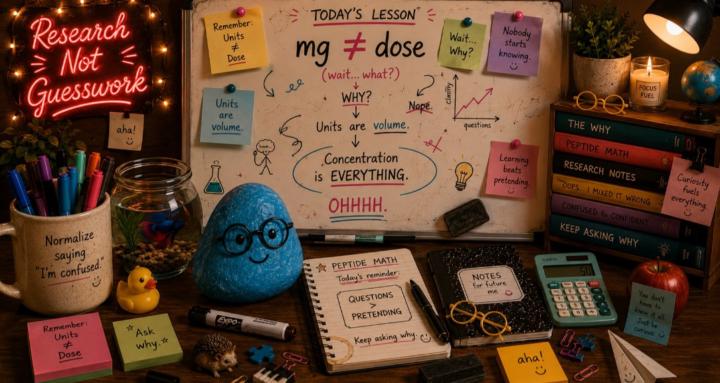
🧪 Beginner Questions "Every expert started by asking a beginner question." 🤔 Ever Thought... "Everyone else seems to understand this except me." Maybe you've watched five different videos. Read twenty comments. Even searched Google... And somehow you're more confused than when you started. If that's you... You're exactly where you're supposed to be. 📚 Let's Break It Down This category exists for one reason: To ask questions. Not perfect questions. Not advanced questions. Just honest questions. Whether you're wondering: • What does concentration mean? • What's the difference between mg and units? • Why do people mix the same vial differently? • How do I read a COA? • Where should I start? Ask it. Because chances are... Someone else is wondering the exact same thing. 💛 Remember... Nobody is born knowing peptide math. Nobody starts out understanding concentration. Nobody reads a research paper for the first time and thinks, "Well that was easy." Learning takes time. And questions are part of the process. 📝 Ashley's Take One of the biggest reasons I created this community was to normalize saying: "I'm confused." Because pretending to understand doesn't help anyone. Asking questions does. 🧠 Let's Check Your Understanding True or False: Asking beginner questions means you're behind. ❌ False. It means you're learning. 🎯 Before You Post... One thing to remember: 👉 Every question is welcome here. One question to think about: 🤔 What's one thing you've been afraid to ask because you thought everyone else already knew the answer? 💬 Join the Conversation Go ahead... Ask your question below. Whether it's something you've been wondering for five minutes... Or five months... You're in the right place. 🤍 Research, Not Guesswork.

16h •
Well, TikTok Put Me in Timeout Again! 🙄😂
If you’ve been following me on TikTok, you might want to follow my backup account too! My main account, Subject to Change, is currently frozen for 30 days. It’s not gone, at least not yet, but I’m not taking any chances. I’ve spent a lot of time building that account, answering questions, sharing information, and connecting with people who are genuinely interested in learning. I’d hate to lose those connections because TikTok decided it didn’t like something I posted. Thankfully, we have this Skool community, so you can always find me here! ❤️ But if you enjoy my TikTok content, I’d really appreciate you following my backup account while we see what happens with the original. 👉 @thesubjecttochange.2 https://www.tiktok.com/@thesubjecttochange.2?_r=1&_t=ZT-9AaliU7TT9Z And if you know anyone who follows my original account, feel free to pass this along. Apparently, having a backup plan for your backup plan is just part of being on TikTok these days. 🤦♀️😂
3d •
🔬 Peptide Spotlight: Humanin (HN)
We've talked about quite a few interesting peptides in our spotlights, but today's peptide is a little different! ⠀ What if I told you that our mitochondria, the tiny energy factories inside our cells, are connected to a peptide that researchers are investigating for its possible role in protecting cells from stress? 🤯 Meet Humanin! 🧬 ⠀ Researchers have been studying Humanin in areas involving: 🧠 Brain health and neuroprotection ⚡ Mitochondrial function 🛡️ Cellular stress responses 🧬 Aging and longevity biology ❤️ Cardiovascular and metabolic health ⠀ Sounds interesting, right? ⠀ Let's break it down! 💛 ⠀ 🧬 What Is Humanin? ⠀ Humanin is a small, naturally occurring peptide first reported in 2001. ⠀ It's considered a mitochondrial-derived peptide, meaning its genetic origin is associated with mitochondrial DNA. ⠀ Remember our mitochondria lesson? ⠀ We learned that mitochondria help our cells produce usable energy. ⠀ But scientists have also discovered that mitochondria are involved in much more than energy production! ⠀ They participate in cell signaling, stress responses, and decisions about cell survival. ⠀ Humanin is one of the peptides researchers are studying to better understand those processes. ⠀ And here's something interesting... ⠀ Humanin is typically described as a peptide containing 21 or 24 amino acids, depending on how its genetic sequence is translated. ⠀ So when you see slightly different descriptions of Humanin in scientific articles, that doesn't necessarily mean one is wrong. ⠀ ⚡ Why Is Humanin So Interesting? ⠀ One of the reasons researchers became interested in Humanin was its apparent ability to influence how certain cells respond to stressful conditions. ⠀ Think of a cell like a little factory. ⠀ That factory needs energy, supplies, communication, and functioning equipment. ⠀ But sometimes things go wrong: ⚡ Oxidative stress increases. 🧬 Proteins become damaged or misfolded. 🔥 Inflammatory signals change. 🛑 Cells receive signals that may lead to cell death.
1-30 of 101
powered by
skool.com/subject-to-change-academy-4743
Pull up a chair. Ask why. Stay curious. Research instead of guess. Normalize saying, "I'm confused."
Suggested communities
Powered by