
Write something

Apr 3 •
I Used to Think Asking for Help Made Me Weak. My Custody Battle Changed That.
Growing up, I was taught — the way a lot of men are taught — that handling your problems alone was strength. That needing help was a sign of weakness. That you put your head down, figured it out, and didn't talk about it. Then my custody battle started. And I tried to do it the only way I knew how. Head down. Alone. Grinding through it. What I didn't realize was that I was making it harder. I was missing things my attorney would have caught if I'd talked to them sooner. I was making emotional decisions I would have avoided if I'd had support. I was isolating myself at the exact moment I needed people most. The turning point for me wasn't a court win. It was the first time I sat across from someone who had been through it — who looked at me and said: 'I know exactly where you are right now.' That moment cracked something open. Asking for help isn't weakness. In a custody battle, it might literally be the thing that changes the outcome for you and your kids. That's part of why this community exists. Not to give legal advice. Not to tell you everything's going to be fine. But to make sure no parent has to navigate this alone. You don't have to be that tough right now. You just have to keep going. 💬 Was there a moment where asking for help changed something for you? You don't have to share details — just let us know we're not alone in this.
0
0
Mar 29 •
Community Question: What Do You Wish You'd Known at the Start?
If you could go back to day one of your custody battle and give yourself one piece of advice, what would it be? We're asking because the wisdom in this community is REAL. Many of you have been through stages that someone else is just entering. Your answer could be the thing that saves someone months of pain, thousands of dollars, or a critical mistake. This community is stronger when we share what we've learned — the hard way or otherwise. So drop it below. What do you wish someone had told you? 👇 Let's fill this thread with real, hard-earned wisdom.
0
0
Mar 23 •
Stop Reacting. Start Responding. Your Kids' Future Depends on It.
Here's a hard truth no one told me early enough in my custody battle: The parent who keeps their composure usually wins. Not because the court rewards niceness. Because a parent who reacts — who sends the angry text, who argues at drop-off in front of the children, who lets emotion drive their decisions — gives the other side exactly what they need to paint a picture of instability. Reacting is emotional. Responding is strategic. When you're provoked — and you WILL be provoked — here's what responding looks like: • You pause before you reply (or don't reply at all) • You run your message by a trusted person before you send it • You ask yourself: "If a judge saw this, what would they think?" • You document the provocation instead of escalating it This is not weakness. This is the highest form of strength — doing the hard thing for the people who need you most. Your kids aren't watching your court case. They're watching YOU. Every day. Choose who you want them to see. 💬 What's one situation where you chose to respond instead of react? Share it below — your story might help someone else.
0
0
Mar 19 •
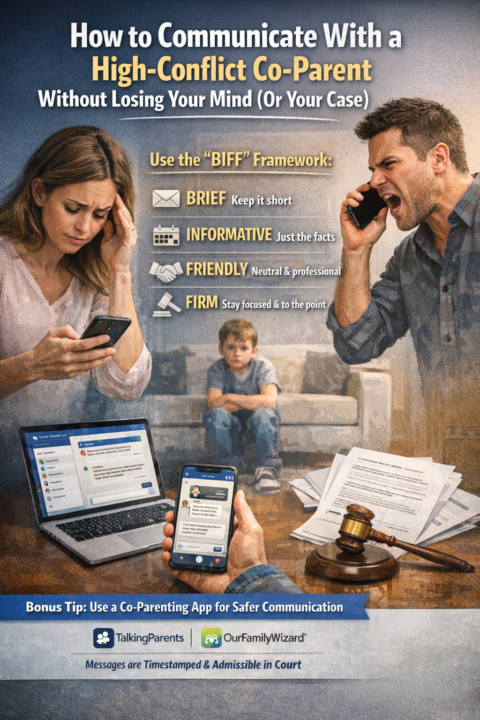
How to Communicate With a High-Conflict Co-Parent Without Losing Your Mind (Or Your Case)
One of the most damaging things a parent can do during a custody battle is communicate poorly with the other parent. I'm not talking about being mean. I'm talking about the emotional texts sent at 1am. The long, rambling emails. The phone call that turns into an argument your child hears from the other room. Every single communication with your co-parent during this process is potential evidence — for or against you. Here's a framework that changed everything for me: BIFF. BRIEF — Keep it short. The longer your message, the more ammunition you hand to the other side. INFORMATIVE — Stick to facts. Logistics. Schedules. Medical appointments. Nothing emotional. FRIENDLY — Neutral in tone. Not warm, not cold. Just professional. FIRM — Say what you need to say once. You don't have to JADE (Justify, Argue, Defend, or Explain). Bonus tip: Use a co-parenting app like TalkingParents or OurFamilyWizard. Everything is timestamped and admissible in court. It removes the "he said/she said" problem entirely. Your communications during this battle can either build your case or blow it up. Choose wisely. 💬 Have you tried any co-parenting apps? Drop your experience in the comments.
1
0
Mar 16 •
Welcome to Child Custody Coaches — Here's What We've Built for You
If you're new here, welcome. If you've been here since day one — thank you for trusting us with this chapter of your life. Child Custody Coaches was built because we couldn't find a place that truly supported parents — especially fathers — through the storm of a custody battle. So we built it. Here's what you have access to inside this community: 📚 Courses — Step-by-step education on the custody process, from filing to final orders 📋 Templates — Custody journals, communication logs, parenting plan templates, and more 📞 Group Coaching Calls — Live sessions where you can ask questions and get real answers 🤝 1-on-1 Coaching — Private support tailored to YOUR specific situation 💬 Community Forum — A judgment-free space to share, vent, celebrate, and connect with parents who get it You don't have to navigate this alone. That's the whole point. This week, we'd love for you to introduce yourself below. Tell us where you're at in your journey — just a sentence or two is enough. 👇 Introduce yourself below. We're glad you're here.
2
0
1-8 of 8
powered by

skool.com/stevens-group-1839
Fighting for custody of your child? You don’t have to do it alone. Join parents getting real tools, real support & real results.
Suggested communities
Powered by