
Write something
Pinned

Nov '25 •
Second Classroom has opened!
Our second Classroom “Course” has opened, have a peek - let me know what you think. Let’s bring our voices home 🏴
0
0

Pinned
Oct '25 •
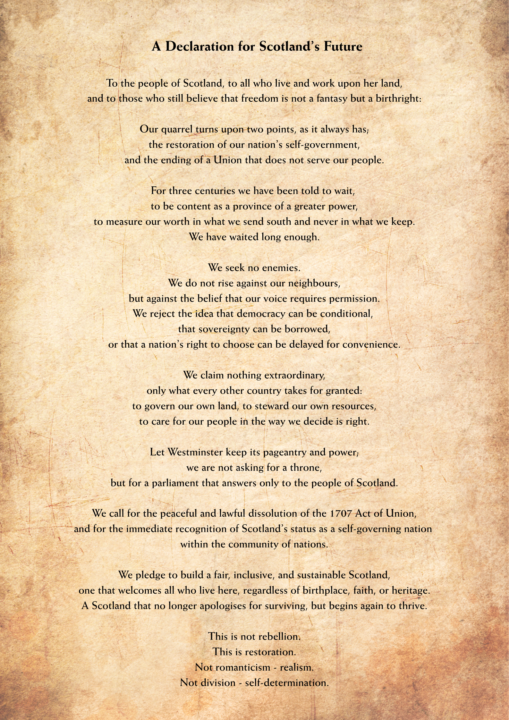
A Declaration For Scotlands Future
Three hundred years ago, Scots stood against the loss of their nation. They silenced our ancestors for daring to ask for what every other country now takes for granted. Today, we stand for its return. This is their voice reborn This isn’t rebellion - it’s restoration.
Pinned
Sep '25 •
Welcome To The Scottish Indy Exchange!
The Indy Exchange is Scotland’s space to dig into the who, what, when, where and why of independence. 🔹 A hub for facts, resources, and myth-busting. 🔹 Open to supporters, critics, and the undecided because strong debate builds strong ideas. 🔹 Focused on Scotland’s future: history, law, economy, resources, defence, democracy. Whether you’re here to sharpen your arguments, challenge your assumptions, or just learn, you’re welcome at the table. Please Do: Introduce yourself 👋🏻 Please Don’t: Use insults/argue for the sake of arguing. We see enough of that in parliament. Above all: We aim to have healthy, productive discussions about and for our country’s independence 🏴
5
0
Jan 27 •
So when did the Union become illegitimate?
There are three defensible answers, depending on how strict you want to be. Let’s have a look at all three, from hard legal to modern democratic. 1. It was born illegitimate This is the uncomfortable one Westminster never wants examined. Why? Because in 1707: - There was no popular consent - No referendum - No mandate - Widespread public opposition in Scotland - MPs were bribed, pressured, or financially dependent - Protests were suppressed, not heeded By any modern definition of legitimacy: - The people were never asked - The decision was elite-driven - Consent was assumed, not given So strictly speaking: The Union did not become illegitimate. It never was legitimate in the first place. It was legal under elite-controlled law, but illegitimate by democratic standards. 2. It became illegitimate when democracy arrived This is the argument even moderates can’t dodge. Once democracy becomes the basis of authority, ongoing consent becomes mandatory. Key shift: - The UK evolves into a parliamentary democracy - The moral basis of rule changes from “Crown + Parliament” to “people” At that moment, something critical happens: An agreement made without the people now requires their consent to continue. But Scotland was never re-asked. No ratification. No renewal. No mechanism to withdraw. From that point onward, the Union survives not on consent — but on inertia. That’s when legitimacy starts decaying. 3. It became illegitimate the moment Scotland voted to leave and was told “no” This is the cleanest, most devastating argument. You don’t even need history for this one. In a modern democracy: - If a people express a sustained, majority desire to leave - And are blocked from doing so - The governing structure loses legitimacy immediately Why? Because consent has been explicitly withdrawn. At that point, the Union stops being a union and becomes: - A constraint - A containment - A control structure Legality may continue.
Jan 27 •
The Doctrine of Democratic Legitimacy and the Union
Foundational Principle All political authority derives from the ongoing consent of the governed. Consent is not permanent. It must be renewable, withdrawable, and respected. Definition of a Union A union is legitimate only while all constituent peoples: - Entered freely - Continue freely - Can leave freely If exit is denied, the union ceases to be voluntary. Failure of Origin The 1707 Union was formed without popular consent. It was an agreement between elites, enacted through financial pressure and parliamentary control, not democratic will. Failure of Renewal As democracy replaced crown sovereignty, the moral basis of authority shifted to the people. The Union was never re-ratified by Scotland under democratic standards. Failure of Continuance When a people express a sustained desire to reconsider or withdraw from a political arrangement and are blocked from doing so, consent is withdrawn. Authority persists only through force of law and institutional inertia. Illegitimacy by Inertia A system that survives only because it is difficult to dismantle, rather than because it is actively chosen, has lost democratic legitimacy. The Union lacks: - Democratic origin - Democratic renewal - Democratic continuance Therefore, whatever its legal status, it no longer possesses moral or democratic authority.
0
0
1-30 of 41
powered by

skool.com/scottish-indy-exchange-2628
Debate it. Learn it. Shape it.
The Indy Exchange is Scotland’s space to dig into the who, what, when, where and why of independence.
Suggested communities
Powered by