
Feb 21 (edited) • 🩹💬 First Aid Corner
🧠⏱️Brain stroke
📋 FAST test: How to spot a stroke in 60 seconds and save a life 🧠⏱️
I'm standing next to a woman who's having a stroke right now. Would you recognize it? 🧠⏱️
She's smiling, but her smile is crooked – the left corner of her mouth is drooping. She raises her arm, but her right arm hangs like a rag doll. She tries to say something, but only nonsense sounds come out.
This woman could be your grandmother, your neighbor, or maybe your mom.
----------------------------------------------------------------------------------------------
Why I'm sharing this:
----------------------------------------------------------------------------------------------
👨⚕️ I work in the Stroke Center at Motol and Homolka Hospital in Prague. Every day I see what stroke does to patients and their families. I started this Skool community to spread awareness and save lives together.
----------------------------------------------------------------------------------------------
Two stories, two endings:
----------------------------------------------------------------------------------------------
👨 Josef, 68 – His wife recognized the FAST test from a Facebook article. She called emergency within 5 minutes of the first symptoms. Today, Josef is home, walking, talking, and watching his grandkids.
👵 Eva, 72 – Her family waited to see if it would "pass." The ambulance arrived 3 hours later. Today, Eva is in a long-term care facility, dependent on others for help. She'll never hug her grandkids the way she'd want to.
❓ The difference? Time. And knowing the FAST test.
----------------------------------------------------------------------------------------------
📋 THE FAST TEST
----------------------------------------------------------------------------------------------
🧠 F – Face
- What to do: Ask them to smile
- What to look for: Is the smile symmetrical? Is one corner drooping?
- ⚠️ Even slight asymmetry can be a sign
💪 A – Arms
- What to do: Ask them to raise both arms in front of them
- What to look for: Does one arm drift down? Do they struggle to hold it up?
- ⚠️ Test each arm separately
🗣️ S – Speech
- What to do: Ask them to repeat a simple sentence like "The sky is blue"
- What to look for: Is speech slurred? Are they struggling to find words? Can you understand them?
- ⚠️ Try simple questions too
⏱️ T – Time
- What to do: If you see ANY sign
- What to look for: CALL EMERGENCY IMMEDIATELY
- ⚠️ Every minute counts
----------------------------------------------------------------------------------------------
🧪 Quick quiz: Would you recognize a stroke?
----------------------------------------------------------------------------------------------
👀 Scenario 1: Grandma feels dizzy – She complains of dizziness and wants to lie down. She says, "It's nothing, I'm just tired." She smiles normally, raises both arms fine. What do you do?
🔍 Answer: Keep watching her. If ANY other symptom appears, call emergency. Dizziness alone might not be a stroke, but it can be a warning sign.
👀 Scenario 2: Dad suddenly slurs his speech – He's suddenly speaking poorly, mixing up words. He smiles normally, raises both arms fine. What do you do?
🔍 Answer: CALL EMERGENCY NOW! Speech problems are one of the three main signs. Don't wait for other symptoms to show up.
----------------------------------------------------------------------------------------------
🚨 Other symptoms the FAST test might miss
----------------------------------------------------------------------------------------------
FAST is great, but it's not perfect. Watch out for:
- Vision problems – sudden double vision, loss of part of your visual field
- Severe dizziness with inability to stand – often with nausea
- The worst headache of your life – could signal bleeding in the brain
- Sudden confusion – someone suddenly doesn't know where they are or what's happening
----------------------------------------------------------------------------------------------
⏳ What to do while waiting for the ambulance
----------------------------------------------------------------------------------------------
- LAY the person in the recovery position – on their side if they're unconscious
- LOOSEN tight clothing – unbutton their collar, loosen their belt
- NO food or drink – risk of choking
- NOTE when symptoms started – the ambulance crew will ask
- DON'T give any medications – aspirin can make bleeding worse
----------------------------------------------------------------------------------------------
🧪 Why is time so critical? The concept of thrombolysis
----------------------------------------------------------------------------------------------
The brain depends on oxygen. Every minute without blood flow, 1.9 million neurons die.
Thrombolysis = a drug that dissolves blood clots. It can save lives and restore patients to normal. But there's a catch: it must be given within 4.5 hours of symptom onset. The sooner, the better.
That's why: Every minute = a chance at a normal life.
----------------------------------------------------------------------------------------------
Two types of stroke – explained simply
----------------------------------------------------------------------------------------------
🧠 Ischemic stroke (80% of cases) – A blood vessel gets blocked by a clot. The brain doesn't get blood. Solution: thrombolysis or a stent-retriever procedure.
🩸 Hemorrhagic stroke (20% of cases) – A blood vessel bursts, bleeding into the brain. Solution: surgery to stop the bleeding.
📋 The FAST test works for both. The type is determined by a CT scan at the hospital.
----------------------------------------------------------------------------------------------
🔁 Your turn – pay it forward
----------------------------------------------------------------------------------------------
Now you know 📋 the FAST test. Your loved ones might not.
Do these 3 things:
👇 Comment "GOT IT" – confirm you've read the article
📤 Send this article to 3 people you care about (parents, grandparents, friends)
📌 Share it on your profile with the hashtag #IKnowFAST #StrokeDoesntWait
----------------------------------------------------------------------------------------------
Maybe because of you, someone will recognize in time that their loved one needs help.
Did you know the FAST test before? Have you ever used it with someone close to you? Or are you afraid you'd hesitate in a crisis?
Drop your story or thought in the comments below. I read every single one and love responding! 👇
----------------------------------------------------------------------------------------------
📚 Sources
----------------------------------------------------------------------------------------------
- European Stroke Organisation (ESO) Guidelines 2024: Acute Stroke Management. https://eso-stroke.org/guidelines/
- American Heart Association / American Stroke Association (AHA/ASA) Guidelines 2023: Early Management of Patients with Acute Ischemic Stroke. Stroke. 2023;54(7):e314-e370.
- European Resuscitation Council Guidelines 2021: First Aid. Resuscitation. 2021;161:270-290. https://cprguidelines.eu/
- Powers WJ, Rabinstein AA, Ackerson T, et al. Guidelines for the Early Management of Patients With Acute Ischemic Stroke: 2023 Update. Stroke. 2023;54(7):e314-e370. doi:10.1161/STR.0000000000000431
These guidelines form the basis for all information provided in this article. For the full guidelines, visit www.eso-stroke.org and www.cprguidelines.eu.
1
0 comments
🧠⏱️Brain stroke
powered by
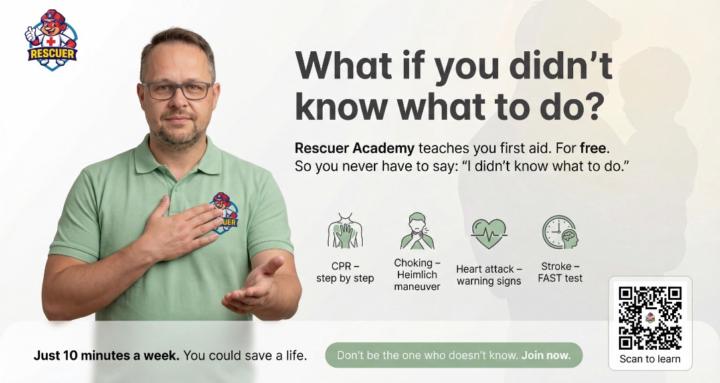
skool.com/rescuer-academy-1418
🎯Realistic first aid training 🛡️without fear. 🧠 ICU nurse teaches CPR, bleeding, AED & more. 👨🚒 Real stories, community, it's free! 🫵 Join now!
Suggested communities
Powered by