
Write something

2h •
Buying an auction property for $25k (here's how)
Most people think you need six figures sitting in the bank to buy investment properties. You don't. Here's the exact five-step process I used to acquire a deal at auction — and walk away with 90% of it financed. Step 1: Find the property on auction sites Start by browsing dedicated auction platforms — sites like Auction.com, Hubzu, or Xome. Step 2: Run your comp research before you bid Pull comps in the area and calculate your max bid based on the ARV (after repair value), factoring in rehab costs and your profit margin. Step 3: Show up every single week The investors winning deals are the ones who are there every week — building familiarity with the process, learning how other bidders behave, and staying ready when the right deal comes up. Step 4: Get pre-approved with a hard money lender Before auction day, line up your financing. A hard money lender like Kiavi https://try.kiavi.com/sczxcel2n5pp can move fast — which is exactly what auction deals require. Step 5: Finance 90% — pay only 10% down With a hard money lender financing 90% of the deal, your out-of-pocket is limited to the 10% down payment plus closing costs. Want me to walk you through this step by step? Inside my mentorship, I show you exactly how to find, analyze, and close auction deals — including how to build lender relationships, run comps the right way, and never overpay at auction. If you're serious about building your portfolio this year, this is the fastest path there. 👉 https://calendly.com/tiiffxny/new-meeting?month=2025-08
0
0
6d •
🔍 The FREE tool I run on every single deal before making an offer
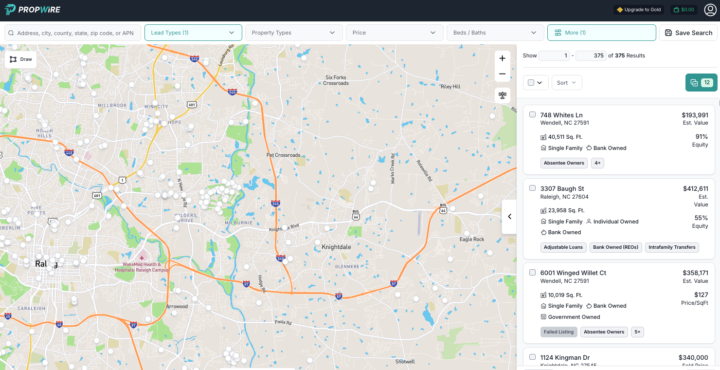
Most investors are still paying $100+/month for data tools they could be getting for free. I use Propwire — and it's become a non-negotiable step in my deal analysis process. Here's exactly how I use it 👇 What Propwire gives you (for free): ✅ Access to 157M+ property records nationwide ✅ MLS + off-market data in one place ✅ Comparable sales to validate your ARV ✅ Motivated seller filters — pre-foreclosures, absentee owners, vacant properties ✅ A keyword tool to surface hidden deals other investors scroll right past My actual workflow: Property comes in → I pull it up on Propwire immediately I run comps within a tight radius to confirm ARV I use that context to position my offer and negotiate smarter Takes me under 5 minutes. And it costs me $0. Why this matters: You don't make money when you sell. You make money when you buy. That means your offer has to be based on real data — not vibes, not hope, not what a wholesaler told you the ARV was. Propwire gives you an objective lens on every deal so you're not overpaying and killing your margins. Get your free account here (my referral link): 👉 https://propwire.com/s/284b2429-r Want me to walk you through how I analyze a deal from start to finish — comps, numbers, offer structure, everything? That's exactly what we do inside the mentorship. If you're serious about closing your first (or next) deal with confidence, drop a comment below or book a free call with me here → https://calendly.com/tiiffxny/new-meeting?month=2025-08 We'll look at where you are, what's holding you back, and whether the program is the right fit. No pressure. Just clarity. 🎯
8d •
The Exact Framework I Use to Analyze Every Deal in 10 Minutes
Most investors don't lose money because of bad luck. They lose because they never ran the numbers before making an offer. In this week's video, I'm breaking down the exact framework I use to analyze any deal in under 10 minutes — so you can make confident offers without second-guessing yourself. You'll walk away knowing how to pull accurate comps to find your ARV, how to estimate rehab costs based on what you actually see at the property, how to apply the 60% rule to set your maximum offer, and why your exit strategy — flip, BRRRR, or wholesale — changes the numbers entirely. This isn't theory. This is a repeatable process you can use on your very next deal. Whether you're brand new and trying to understand how investors evaluate properties, or you've been in the game and want a faster, cleaner system — this video is for you. 👉 Watch the full video and then drop your deal in the comments. https://youtu.be/L0ToA94hAtE I'll personally tell you whether it passes the 60% rule. If the numbers don't work on paper, they won't work in real life. Let's make sure yours do.
1
0
20d •
How I Spot Profitable Deals in Minutes (Xome Breakdown)
Just dropped a walkthrough on another one of my go-to auction platforms — Xome.com 👀 In this video, I’m not just scrolling listings… I’m showing you how to actually spot deals with real margin. We go through: - Properties currently for sale - How to quickly analyze if the numbers make sense - Comparing comps to see true value - And identifying where the profit is (before you ever place a bid) A lot of people say they “can’t find deals”… but the reality is, they’re not looking at the data the right way. This is exactly how I approach new markets and start narrowing down opportunities. 🎥 Watch through, take notes, and try analyzing one property on your own after: https://youtu.be/faU5izvUbLQ
1
0
Apr 6 •
Ever Wondered How Much You Need to Invest In Auction Properties?
Most people think you need a ton of cash to start buying auction properties—but that’s not actually the case. In this video, I break down a real example showing exactly how much you really need to get started, and it’s a lot more doable than you might think. We walk through a full deal—from purchase price to estimated rehab costs—and then layer in fix-and-flip financing to show how you can potentially secure a deal with as little as 10% down. Instead of coming out of pocket for the full purchase and renovation, many investors leverage short-term financing options that cover a large portion of the project. This allows you to stretch your capital further and take on bigger opportunities without needing six figures sitting in your bank account. The key is understanding your numbers: knowing your all-in cost, after repair value (ARV), and having a solid plan for execution. When you combine that with the right financing strategy, deals that once felt out of reach can quickly become realistic. Action Step: After you watch the video, drop a comment with your estimated entry price based on your market—I want to see what you’re finding 👀 And if you’re serious about getting your first deal (or your next one), book a strategy call with me. We’ll map out a game plan and see if working together is the right fit to get you there 🚀 https://calendly.com/tiiffxny/new-meeting?month=2025-08
1-26 of 26
powered by

skool.com/real-estate-investing-101-7860
Welcome to Auction Property Academy — a community of real estate investors mastering the art of finding, analyzing, and landing off-market deals.
Suggested communities
Powered by