
Write something
Pinned

Mar 15 •
Welcome to Clief Notes. Here's where to start.
1. Watch the intro video and introduce yourself in the intro post here 2. Start with The Foundation (free course). Concepts, folder architecture, prompting framework. Everything else builds on this. 3. Check in at the bottom of each lesson. Polls, discussion posts, other members working through the same stuff. Use them. 4. When you're ready to build real things, move to Implementation Playbooks (Level 2). When you're ready to build your own tools, Building Your Stack (Level 3). 5. Post your work. Ask questions. Help others when you can. What are you here to build?
Poll
4155 members have voted
Pinned
3d •
🏆 Weekly Comp #2: The Artifact Sprint 🏆
💰 Week 1 winner @Ian Barriopedro took home $200 cash. 🎟️ This week the prize gets bigger. ✨ Winner gets a FREE seat in The Lyceum. ✨ https://www.skool.com/quantum-quill-lyceum-1116/12-weeks-real-projects-250k-in-prizes-lets-talk?p=e850567b 🎯 Pick your cohort: Technical, Business, or Creator. Your call. 📋 THE CHALLENGE: "The Returning Client" You just got hired again. Different client this time. Meet Marcus. 👋 📎 Download the full client brief attached to this post. 🛠️ YOUR DELIVERABLE An interactive artifact built in Claude that does what Marcus asked for. ✍️ Plus a 100 word writeup covering: - 👤 Who it's for - ⚙️ What it does - 🎨 One design choice you made and why 📐 THE RULES ✅ It has to work ✅ It has to sound like Marcus, not a bank ✅ The writeup matters ⚖️ Judging: Myself, Jake, and the mods. 🎟️ Who can enter: Premium and VIP members only. Free members, this is your sign. Upgrade and you're in the running for a Lyceum seat. 🚀 📨 How to submit: Drop a screen recording or screenshot of your artifact, the link if you've got one, and your writeup in the comments below. 📅 Deadline: Saturday, May 2nd at 12:00 PM EST 🎉 Winner announced: Monday, May 4th at 12:00 PM EST 💡 A note before you start. This isn't a finance challenge. It's a design and voice challenge. You don't need to be a CFP to win this. Read the brief. Marcus tells you exactly what he wants and how he thinks. Your job is to build something that solves his problem and sounds like him. 🆕 If you've never built an artifact in Claude before, this is a great first one. The brief is clear, the scope is reasonable, and the bar is "would Marcus actually send this to a prospect?" 🔥 @Ian Barriopedro set the standard last week. Your turn. LFG 🚀

13h •
Claude Went Down. I Opened Codex. Zero Downtime.
The setup Yesterday I posted about rebuilding my workspace to be agent-agnostic. Plain markdown, plain YAML, env-var paths, no Claude-specific lock-in. The thesis: when the tooling layer churns, the workspace outlasts it. I did not expect to test that thesis the next day. What happened Claude went down mid-task. I opened Codex CLI in the same workspace. Same skills loaded. Same memory. Same briefs. Same manifests. Codex read the workspace exactly the way Claude reads it, because the workspace is just files. The task done. Faster, actually. Zero downtime. Zero re-plumbing. Zero "let me port my setup." Why it worked Three properties carried the swap. The orchestration layer is plain text. Briefs, manifests, memory, voice rules. All markdown and YAML. Any agent that reads files reads my workspace. The agent-specific bits are isolated. Hooks, slash commands, settings live behind one entry point. Codex doesn't need them. The rest of the system functions without them. The skills are portable. My skill definitions aren't Claude-shaped, they're task-shaped. Codex picked them up and ran. The lesson When you build your stack around one tool, an outage is a stop. When you build your stack around your workspace, an outage is a tool swap. The agent is a worker. The workspace is the contract. Workers are interchangeable. This is the whole point of decoupling. What I'd do differently Nothing. Yesterday's migration was the work. Today's outage was the dividend. If you're still running everything inside one agent's surface, that's a single point of failure dressed up as convenience. Pull your config, briefs, and memory into plain files. Put the agent-specific layer in a sidecar. Test the swap before you need it. You will need it. // A<3
Mar 15 •
🏁 Foundations 1.2 Check-In
You built your first folder. Vote below, then drop a screenshot in the comments so we can see what you came up with.
Poll
1310 members have voted

3h •
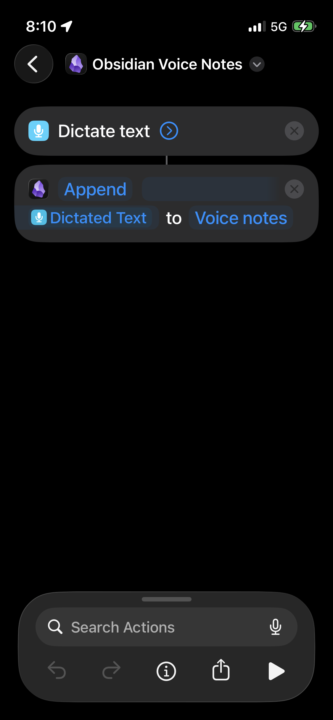
iOS Shortcut for Obsidian Users
I’ve been using obsidian for notes for years and I am currently working through building out an ecosystem for Claude to work with to help me manage my notes and make plans. I wanted a way for me to quickly record voice notes and have them available to Claude so that it can act on my voice notes and turn them into more tangible notes while I’m out and about. The simple solution I came up with was to create a voice note markdown file in my Obsidian vault, and then create this iOS shortcut. I tap a button on my home screen and dictate the notes I want to take and it dumps them into the voice notes markdown file where Claude or your favorite AI can scrape on a scheduled basis and really do anything you want from there. I’m sure there are other methods and apps to accomplish this especially with openclaw and dispatch being an option but the thing I like here is there is no new process or app for me to play with. Everything works with my existing folders and processes.
1-30 of 882

skool.com/quantum-quill-lyceum-1116
Jake Van Clief, giving you the Cliff notes on the new AI age.
Leaderboard (30-day)
1

+764
2
+632
3

+468
4

+391
5

+388
Powered by