
Write something
Pinned

Oct '25 •
Start Here
To make sure you get the most out of the community 1️⃣ Download the Skool app on your phone 2️⃣ Introduce yourself! Tell us who you are, where you’re from, and what brought you to the Portuguese real estate market. 📲 Android: https://play.google.com/store/apps/details?id=com.skool.skoolcommunities&hl=en 🍎 iOS: https://apps.apple.com/us/app/skool-communities/id6447270545 👉 Comment on our welcome post 3️⃣ Explore the categories: - 💬 General Discussion – Educational content, news, and market insights. - 🏗️ Our Deals – Our exclusive real estate investment opportunities. - 🤝 Members Deals – Deals and opportunities shared by community members.
3
0
Pinned
Oct '25 •
👋 Welcome to the Portugal REI Club!
You’re officially part of the first English-speaking real estate investment community in Portugal, a place where investors, developers, and specialists connect, share insights, and access real opportunities. This thread is where it all starts.We’d love for you to introduce yourself and get to know the other members of the community. You can share things like: 💼 What brought you to the Portuguese real estate market 🌍 Where you’re currently based 🏠 The type of investments or projects you’re most interested in 🤝 What you’re hoping to learn or connect on here 👇 Don’t overthink it, if you feel comfortable, just say hi and tell us a bit about your journey!
4d •
I Live in a Magical Place
Lisbon is my home now, but every time I arrive in Caparica, it feels like I enter another dimension. The noise gets quieter. One day by the ocean can reset everything. The sea, the sunsets, the food, the people, the rhythm of life here — it all brings me back to myself. And maybe this is why I understand Portugal differently now. Not only as a market. Not only as a place for real estate, development, or investment. But as a place with its own culture, rhythm, and relationship with land, family, nature, and time. That matters. Because when you build here, you are not only building projects. You are building inside a place that needs to be understood and respected. Portugal is imperfect. But for me, it is perfectly imperfect. And it reminds me that building well requires more than ambition. It requires respect.
3
0

4d •
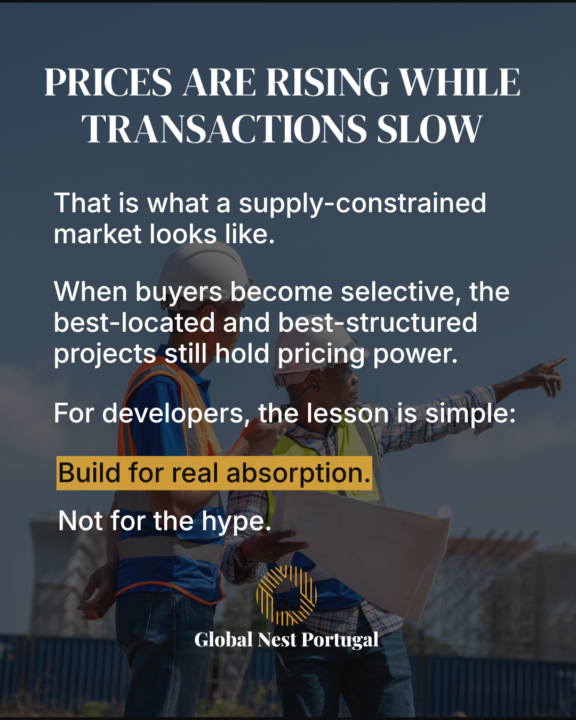
Why Prices Can Rise Even When Transactions Slow
A slower transaction market does not always mean weaker demand. In Portugal, we are seeing something important: transaction volumes can cool while prices continue to rise in many areas. That usually points to a supply-constrained market. There are fewer good homes available, buyers are more selective, and weak projects struggle to move. But well-located, well-structured projects can still hold pricing power. For developers, the lesson is simple: Do not build for hype. Build for real absorption. That means understanding the buyer, the location, the product, the pricing, and the exit before construction begins. The market does not reward every project equally. It rewards the projects that solve a real demand problem.
0
0
9d •
Portugal Changed It's Construction Rules
Portugal’s construction framework has changed. That creates opportunity, but it also raises the standard for execution. The developers who benefit will not be the ones who move fastest on paper. They will be the ones who understand licensing, technical constraints, construction timelines, and delivery risk before committing to a project. At GlobalNest Portugal, we do not treat regulation as background noise. It is part of the underwriting.
0
0
1-30 of 77
powered by

skool.com/portugal-rei-club-2051
Vetted development deals for passive real estate investors. No noise.
Suggested communities
Powered by