
20d • General discussion
Baryon Asymmetry: A Theoretical Solution
Abstract: This short note outlines the philosophical reasoning that the perceived imbalance between matter and antimatter is a conceptual problem for which there exists a theoretical solution. The current definition of matter automatically excludes the possibility for particles and antiparticles to form matter despite the fact that antiparticles (positrons) can be produced in the decay of matter. The assumption that particles and antiparticles always annihilate each other does not reflect an initial condition in which elementary particles and antiparticles are relativistically rotating around each other as pairs in a rotating universe. With this initial condition, matter is necessarily made up of electrons and positrons, thereby accounting for all the antiparticles and explaining why there is matter rather than antimatter.
1. The Big Bang was accompanied with an equal number of particles and antiparticles, but contrary to common assumption, this doesn’t automatically mean that there was an equal amount of matter and antimatter at that time. To assume this would be to miss the critical step involved for these particles and antiparticles to form matter or antimatter.
2. Composite particles such as protons and neutrons, due to their composite nature, can be treated as matter since they must contain elementary particles. In other words, before the emergence of composite particles or antiparticles and other more complex forms of matter or antimatter, there was a time when there must be only elementary particles and antiparticles.
3. Elementary particles, being elementary, cannot interact with other types of elementary particles if they are fundamentally different in nature – that fundamental difference would make such interaction impossible. This means that fundamentally there can only be one type of elementary particle or antiparticle in the universe. This contradicts the current conceptual framework that demands a bewildering variety of unrelated elementary particles and antiparticles. It also explains why an elementary particle can interact with its antiparticle – they are fundamentally the same.
4. As well, elementary particles, being elementary, must be present in any composite particles or matter – any absence would negate their status as elementary. Therefore, if electrons are elementary particles, they must play an essential role in the constitution of protons and neutrons. This also contradicts the current conceptual framework that treats quarks as the elementary particles making up protons and neutrons without any reference to electrons.
5. Between electrons and quarks, the former rather than the latter must be the elementary ones. It is not incidental that while the elementary nature of electrons has long been clearly established, quarks have never been isolated or observed directly. Almost all we know about quarks are drawn from observations of hadrons. They are also the only “known” particles whose electric charges are not integer multiples of the 1 elementary charge. The term “quark” thus only describes the moving shadows one can barely see through a thick curtain; it does not reveal the true identities of those inside a nuclear room.
6. The Big Bang, therefore, must have been accompanied by an equal number of electrons and positrons as elementary particles and antiparticles. Since we see electrons everywhere in matter today, notwithstanding their peculiar absence in protons and neutrons, the burning question is not about the missing antimatter, but about the missing elementary antiparticles – where are all the positrons?
7. To answer this question, we need to examine the current definitions of matter and antimatter. If we define matter simply as something consisting of matter particles, and antimatter that of antiparticles, we are making the same huge assumption mentioned in paragraph #1. This would essentially equate matter with electrons, the only elementary particles, and antimatter with positrons, the only elementary antiparticles.
8. This definitional assumption immediately runs into two problems. First, without any investigation, it automatically excludes the possibility for particles and antiparticles to form matter. Second, it can’t logically explain the phenomenon of positron emission in the decay of matter (e.g. isotopes). If, according to its definition, matter is made up of only matter particles, only matter particles should be emitted.
9. On the other hand, the phenomenon of positron emission from matter can be readily understood if elementary particles and antiparticles indeed interacted to form matter. This scenario has been dismissed out of hand due to the assumption that whenever a particle and its antiparticle collide, they always annihilate each other, as has been repeatedly observed in laboratories. However, nature is larger than any laboratory. This assumption overlooks the scenario in which particles and antiparticles do not freely collide head to head, but are in a natural high mass state of relativistically rotating around each other as pairs. In other words, if all the particles and antiparticles in the Big Bang initially existed as rotating pairs of electrons and positrons, no annihilation would take place and the universe should exist as it does today. This high mass state of relativistically rotating electron-positron pairs exists on the scale of nuclear particles, different from the short-lived, hydrogen atom-like low energy state known as “positroniums”.
10. One of the fundamental quests in physics is exactly to identify which initial condition to begin with. Depending on whether we get the initial condition right or wrong, the resulting theories will differ fundamentally and lead to either a coherent view consistent with all observations or one with many dark mysteries and unresolved puzzles. Between an overall rotating universe with internal rotating pairs of particles and antiparticles and a non-rotating universe with non-rotating particles and antiparticles, the energy difference is enormous, large enough to account for any dark energy and dark matter.
11. The next question to explore is how these rotating pairs of electrons and positrons formed matter particles such as neutrons and protons instead of antineutrons and antiprotons. For this, we need not look for any special symmetry violation – the rotation of the whole symmetric universe has a natural directional preference that determines why electrons are orbiting around protons, rather than positrons orbiting around antiprotons.
12. An internal structure for protons and neutrons with nothing but electrons and positrons is not beyond imagination. More than two decades ago, Dr. Ernest J. Sternglass discovered that the observed properties of a proton can be fully explained if a positron is moving in a figure “8” orbit in the middle of two sets of electron-positron pairs when they rotate in opposite directions in a synchronized fashion. The central positron always moves in the opposite direction to the four electrons, producing the largest possible relative velocity and thus the strongest possible attractive force between these charges. The initial rotating electron-positron pairs underwent a phase transition to form such a crystalline structure, accounting for a proton’s stability, spin, magnetic moment, size, as well as the spatial distribution of the positive and negative charge. Neighboring protons in the nucleus of atoms can constantly exchange an electron between them, with the electron briefly attaching itself to a proton by powerful electromagnetic forces in an orbit of spin ħ/2, thus giving rise to the neutron.
13. An electron-positron composition of all matter particles is consistent with the fact that all unstable mesons and baryons ultimately decay into electrons, positrons, protons and radiation quanta such as photons and neutrinos in a spontaneous process. Since photons can turn into electron-positron pairs and vice versa, the nature of light and matter is reconciled. As per Sternglass’ rotating electron-positron pair model, the four fundamental forces of nature can all be accounted for in purely electromagnetic terms.
14. In final analysis, two elementary charges associated with internal opposite rotations are all nature needs to undergo and manifest myriad transformations. The elementary charges are the only thing that matters.
15. To conclude, there is no large scale naturally existing antimatter. Matter, by necessity, involves electrons and positrons with their equal but opposite charges serving as bonding mechanisms. All the positrons are inside protons and neutrons under the guise of quarks, along with electrons. There was no mutual destruction of particles and antiparticles in an initially rotating universe with internal rotating electron-positron pairs.
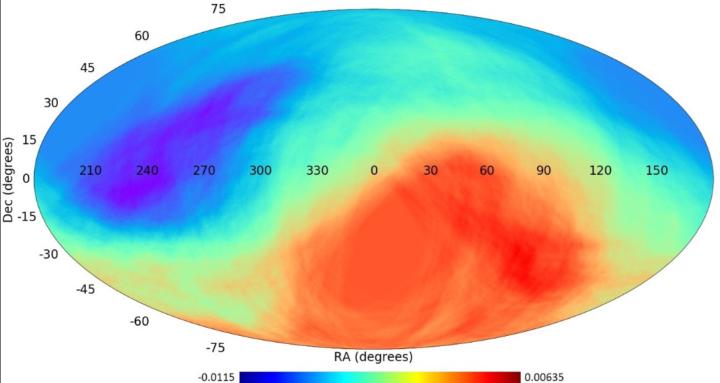
16. The validity of this initial condition is attested by its everlasting beauty: as all forms of energy conserve, logically it must also be the current as well as future condition – rotation never stops. All empirical evidences, from the so-called “dark energy” to the so-called “dark matter”, from the presence of universal gravity to that of large scale cosmic anisotropies, indeed demonstrate that the finite universe is rotating as a whole with internal hierarchical rotating systems that ultimately consist of electrons and positrons. The only variable is the total number of internal rotating systems as the universe expands and contracts in turn as a result of the dynamic interaction between the overall rotation and the internal ones – from one to many, and from many to one, cyclically. On the cosmic level, the arrow of time is circular.
17. By contrast, all other initial conditions assumed by prevalent theories, including the standard model, take a non-rotating universe for granted without any physical evidence. Such a universe cannot exist because matter is ultimately localized rotational energy, be it on the macroscopic scale of stars, galaxies, and the universe as a whole, or on the microscopic scale of electrons, positrons, and all other composite particles or antiparticles.
1
0 comments
Baryon Asymmetry: A Theoretical Solution
powered by
skool.com/physicscosmologyspirituality-5660
Free for first 1024 members. For those who seek absolute truth: atheists, nonbelievers, questioners, poets; who follow reason; who dare to know.
Suggested communities
Powered by