
Write something
Pinned

Jan 11 •
📌 What Is Aquaponics — and Why PH Farm Quest Starts Here
If you’re new here and wondering:“What is PH Farm Quest, and why does everything start with aquaponics?”this post is your entry point. 🌍 First: What Is PH Farm Quest? PH Farm Quest is a long-term, real-life farming journey. It is not: - a course - a theory-based education platform - or a “perfect system” showcase It is: - a step-by-step documentation of learning agriculture from scratch - focused on small-scale, practical systems in Europe - as preparation for future full-time farming in the Philippines Everything shared here is based on real builds, real mistakes, and real results. 🌱 So, What Is Aquaponics? Aquaponics is a food production system where: - Fish produce waste - Beneficial bacteria convert that waste into nutrients - Plants absorb those nutrients - Cleaned water returns to the fish All inside a closed-loop system. No soil. No synthetic fertilizers.Just biology, balance, and management. ❓ Why Start PH Farm Quest With Aquaponics? Aquaponics is not chosen because it’s easy. Its chosen because it’s an ideal learning system. It teaches: - water management - nutrient balance - biology - system thinking - problem-solving under real conditions In a small space, with visible consequences. For PH Farm Quest, aquaponics is: a training ground, not a final destination. ✅ Advantages - Very low water usage - Fast plant growth - Compact systems - Immediate feedback when something goes wrong - Excellent for learning and documentation ⚠️ Disadvantages - Systems are sensitive - Fully dependent on electricity - Not “set and forget” - Small mistakes can escalate quickly That’s exactly why it’s valuable. Here, mistakes are shared, not hidden. 🔧 How Aquaponics Is Used in This Community In PH Farm Quest: - Systems don’t need to be perfect - Results don’t need to be impressive - Progress matters more than polish You’ll see: - basic setups - failures - adjustments - improvements over time
Jan 11 •
PH Farm Quest – Challenge #1
Building a 3–4 IBC Aquaponics System on a Budget 💧🌱 Cheb, Czech Republic 🇨🇿 Outside: -6 to -15°C ❄️ Building: not yet Planning: full speed ✅ Since winter won’t allow construction yet, I’m using this time to prepare everything properly for my spring aquaponics pilot. The goal: A small but scalable system that I can later adapt for Mindanao conditions. Local sourcing (Cheb / Karlovarský kraj): • 3× IBC tanks (1000L): $70–75 each → $210–225 • 2× 200L barrels (filter + sump): $15–20 each → $30–40 • Water pump: $70–75 (BOYU FP-4000) • Air pump: $95–100 (Resun LP-40 / Hiblow HP-40 / Aquaking Q2007) • Grow media: $200–220 → 600kg basalt 8–16mm (lava rock is too expensive here) • Fittings & plumbing: $25–50 (hopefully 😅) Estimated total: 👉 $630–710 for a complete pilot system Sources: Bazoš.cz, Facebook Marketplace, local garden shops. 🔎 Important note: Always check what the IBCs were used for – food-grade only. Why I like this setup: • cheap to build • easy to expand • realistic to copy later in the Philippines 👉 Your turn: • What aquaponics budget are you aiming for? • Any hacks or cheaper alternatives you’ve found? Let’s compare and learn together.
Jan 15 •
Reality Check – Planning Saves More Money Than Cheap Materials
At the beginning, I assumed that finding cheaper materials would automatically keep the system budget under control. On paper, it made sense. But once logistics, availability, transport, and compatibility entered the picture, the “cheap option” started getting expensive — fast. What I’m learning is this: • Planning beats improvisation • Access matters more than price • And “low cost” depends heavily on your local reality I’m building here to learn what actually works — before scaling this mindset further down the road.
1
0
Jan 14 •
Discussion: Beginner Guide (PDF)
I’ve added a beginner guide PDF to the Classroom under Start Here: Aquaponics for Beginners (EU Reality). If you’ve read it, comment READ below. If you have questions or disagree with something in the guide, ask here — it helps everyone.
Jan 13 •
📐 Aquaponics System Design – Planned Before Building
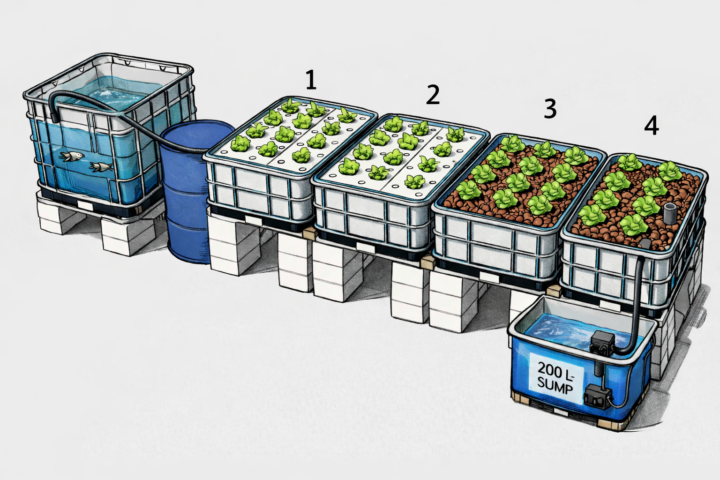
Before buying more parts, I mapped out the entire system flow based on the materials I plan to use and the type of crops I want to grow. This post is not about results yet — it’s about design logic. _________________________________________________________ 🔁 Water Flow Overview 1️⃣ Fish Tank - 1× IBC tank - Dedicated only to fish Water exits the fish tank by gravity. _________________________________________________________ 2️⃣ Mechanical Filter Tank (200L) First stop after the fish tank. Designed to: - capture solid waste - reduce debris before water reaches the grow beds This keeps the grow beds cleaner and easier to manage. _________________________________________________________ 3️⃣ Grow Beds (4 units, single row) Built from 2× IBC tanks, cut horizontally. Each IBC provides two grow beds (top + bottom). Grow bed configuration: 🟩 Grow Beds 1 & 2 - Styrofoam raft system - Used for lettuce - Lightweight roots, minimal clogging 🟫 Grow Beds 3 & 4 - Lava rock media - Bell siphon system - Suitable for heavier crops (cabbage, kale, etc.) Water flows sequentially through all four beds. _________________________________________________________ 4️⃣ Sump Tank (200L) - Final collection point for all returning water - Positioned at the lowest level - Ensures stable water level in the fish tank _________________________________________________________ 5️⃣ Pump Return - Water is pumped from the sump tank back to the fish tank - System runs in a continuous loop _________________________________________________________ 🧠 Why This Design Makes Sense (for me) - Efficient use of IBC tanks - Clear separation between: - Simple gravity flow - Easy to adjust or scale later Nothing is built yet — this is the thinking stage documented honestly, before spending money or locking myself into mistakes. _________________________________________________________ Does this layout make sense to you, or would you approach it another way?
1
0
1-7 of 7
powered by

skool.com/ph-farm-quest-1644
A real path from Europe to a farming life in Mindanao.
Small systems, real numbers, mistakes, and step-by-step learning — documented as it happens.
Suggested communities
Powered by