
Pinned

10d •
World Mental Health Day: Why “I’m Fine” Is Not Always the End of the Conversation
As World Mental Health Day approaches on 10 October, this year’s theme; “Lived experiences heard: real voices, real change”, offers an important challenge for every leader, manager, coach and colleague: Are we really listening? In workplaces, professional networks and even among friends, “I’m fine” is one of the most common answers we hear. Sometimes it means exactly that. But sometimes it can mean: “I don’t know how to explain what is going on.” “I don’t want to burden anyone.” “I’m worried about how this will be received.” “I don’t think anyone can help.” “I’m trying to hold it together.” The issue is not that people are being dishonest. Often, they are protecting themselves in environments where openness may not yet feel safe. That is where communication matters. The role of NLP: More choice, not quick fixes For those of us who use NLP in coaching, leadership, learning or communication, mental health is an area that calls for humility and responsibility. NLP can help people become more aware of their language, assumptions, emotional states and patterns of attention. It can support better conversations and help people access choices that may feel unavailable when they are under pressure. But NLP is not therapy… It is not a replacement for counselling, psychotherapy, medical support, crisis intervention or clinical mental-health care. Nor should it ever be used to persuade someone that their distress is simply “a mindset issue.” There is a vital difference between helping someone explore their thinking and trying to talk them out of their experience. A useful principle is this: ‘We can help people explore the meaning they are making, without denying the reality of what they are facing.’ “The map is not the territory” in real conversations One of the best-known NLP ideas is that ‘The map is not the territory’. In simple terms: each of us experiences life through our own internal map, shaped by our beliefs, memories, values, circumstances and current emotional state.
2
0

Pinned
Jul 9 •
NLP Master Practitioner and Turkey Retreat
Hey all! Summer chaos and sizzling temperatures might be keeping everyone on the move, but if you missed the call — you’re in luck. We recorded it, and it’s bursting with everything you need to know about stepping into the NLP Master Practitioner and our unforgettable NLP Retreat in Turkey next May. Hit play, get inspired, and when you’re ready to secure your spot, email us at [email protected] or WhatsApp us on +44 (0)7920 836 439. Your next big breakthrough could start right here. Watch the video: https://netorgft1513539-my.sharepoint.com/:v:/g/personal/toby_macrebur_com/IQBMi5w0QPEFQJk43iMmbAfjAf_SZrtF18YelyNp2KgnG1s
May 30 •
Does NLP work?
Before I answer that, let me explain why every NLP intervention needs a “control”, and what science teaches us about measuring change… In science, nothing is taken at face value. If you want to know whether something works, you don’t just test it — you compare it. You measure it against a control. A control is the baseline, the “normal,” the standard set of conditions you already understand. Without it, an experiment becomes guesswork. You might get a result, but you have no idea whether that result is meaningful. And this principle applies far beyond laboratories and test tubes. It applies directly to NLP, personal change work, and the question people love to ask: “Does NLP actually work?” Let’s break this down. The Science Analogy: Why Controls Matter Imagine I’m testing a new polymer additive in asphalt in my business (MacRebur Limited). I want to know whether a new additive improves strength, flexibility, durability — whatever my goal is. So I create two samples: • Control asphalt — the standard mix that’s always used • Experimental asphalt — the same mix, but with my polymer additive included I test both to a set of criteria and standard. I compare the results. If the polymer works, my experimental asphalt should outperform the control. If I didn’t have the control asphalt, I’d have no idea whether the polymer made any difference at all. Maybe the asphalt was always that strong. Maybe it was always that weak. Without comparison, the experiment is pointless. NLP Works the Same Way… When we use NLP tools — anchoring, reframing, submodalities, timeline work, language patterns — we are essentially running an experiment on human experience. But here’s the key: You cannot measure change unless you know what the experience was before the intervention. This is why NLP questions often presuppose comparison: • “How do you feel differently now, compared to before?” • “What’s different?” • “What’s changed?” • “What’s shifted?” These questions aren’t fluffy. They’re the NLP version of a scientific control.
Aug 16 •
To India with love.
Eighteen years ago, Kate and I travelled to Kerala, India for a course that changed far more than our professional lives… One afternoon, we visited the SOS Children’s Village to model the excellence of the team running it. While we were having tea, a young girl - 9 years old, sweeping the courtyard - walked over, smiled, and said: “Hello auntie, hello uncle.” In that moment, Sughandy walked straight into our hearts. We decided that day to sponsor her, support her education, and make sure she had everything she needed. Letters turned into phone calls, phone calls turned into video chats, and every year I travelled back to India to visit her. She worked hard, qualified as a nurse, and a few years ago moved to Galway, Ireland to work as a carer. There, she met a young man who she’ll be marrying this Saturday. This week, Kate, India, Keira and I will travel to India to give her away, the only four members of her family among 200 guests from her new husband’s side. I’ll share our journey here, on Instagram and Facebook. This is more than a trip. It’s the continuation of a promise we made 18 years ago.
3
0


Jul 28 •
Question of the day
What if the opposite of my most negative thoughts or assumptions is actually true? What would change in my current mood?
1-30 of 47
powered by
skool.com/nlp-1250
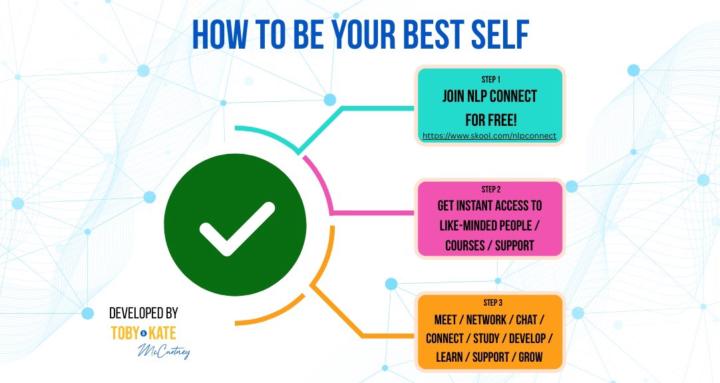
Join NLP Connect! Access free trainings, tutorials, and podcasts for personal and professional growth in a lively community of NLP enthusiasts!
Suggested communities
Powered by