
Write something

3d •
Affirmations
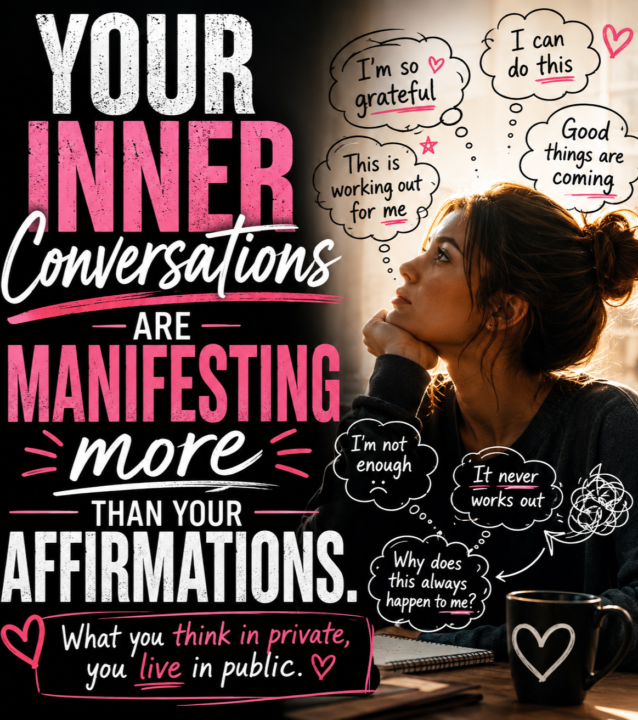
Stop wasting your time repeating affirmations if your inner conversations never change. Read that again. You can say, "I am loved" a thousand times a day. But if, five minutes later, you're imagining someone rejecting you, ignoring you, betraying you, or thinking you're not enough... that's the conversation your mind accepts as real. Affirmations are what you practice. Inner conversations are what you believe. One is an exercise. The other is your identity. This is why so many people say manifestation doesn't work. They spend a few minutes speaking the words they want, then spend the rest of the day mentally rehearsing the life they don't. Pay attention to the conversations no one hears. The ones you have in the shower. The ones you have before you fall asleep. The imaginary arguments. The imaginary apologies. The imaginary failures. The imaginary victories. Those conversations are quietly writing tomorrow. Change the conversation, and you'll eventually change the person having it. Change the person, and your world has no choice but to reflect it.
0
0
5d •
Fear
Fear is a state that organizes perception around uncertainty and potential threat. It does not depend on actual danger being present. It activates when the mind anticipates negative outcomes, loss, rejection, failure, or instability. When fear is active, attention becomes selective. The mind focuses on what could go wrong, what is not secure, and what might be lost. Neutral information can be ignored or reinterpreted in a negative direction. This creates a perception of reduced safety even in situations that are objectively stable. Fear also affects thinking patterns. It increases prediction, scanning, and mental rehearsal of future scenarios. These thoughts feel useful because they create a sense of preparation, but they often maintain the emotional state that generated them. In the body, fear is often experienced as tension, restlessness, shallow breathing, or a general sense of urgency. These physical signals then reinforce the mental interpretation that something is wrong or needs attention. Over time, fear can become a default way of processing uncertainty. Instead of responding only to real threats, the system begins reacting to possibilities. This can lead to avoidance, hesitation, over-preparation, or difficulty making decisions without reassurance. Fear also influences identity. When it is frequently active, people may begin to describe themselves as anxious, cautious, or not confident. These descriptions often reflect repeated states rather than fixed traits. How fear maintains itself Fear is reinforced through attention and interpretation. When fearful thoughts are believed and followed, the state strengthens. When bodily sensations of fear are interpreted as confirmation of danger, the cycle continues. Common patterns include: • imagining negative outcomes and treating them as likely • avoiding situations that create uncertainty • seeking reassurance before acting • over-analyzing decisions to reduce discomfort • interpreting uncertainty as a sign to stop or delay Each of these responses reduces short-term discomfort but strengthens the long-term pattern.
1
0

6d •
Stand still
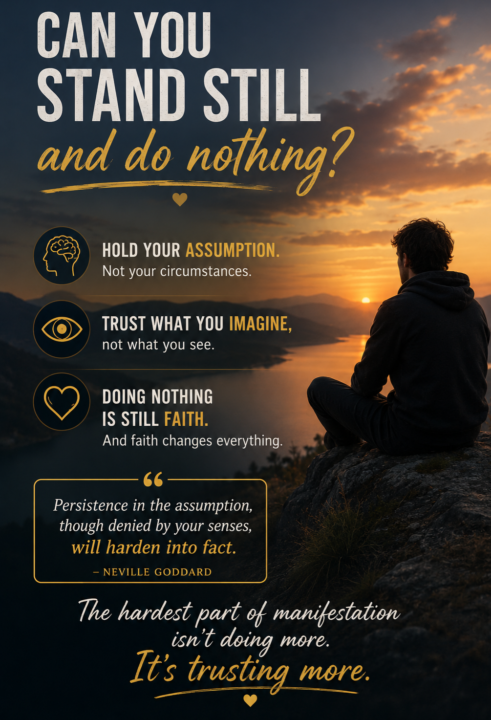
Can you stand still and do nothing? Everyone says it's easy to do nothing. But can you actually do nothing when everything around you seems to be falling apart? When life looks nothing like what you've been imagining? When every part of you wants to react, fix, control, or force an outcome? That's the real test. Yes, there are moments when action is necessary. But there are also moments when the greatest act of faith is to remain faithful to your assumption. Neville Goddard taught that persistence in the assumption, though denied by your senses, will harden into fact. That means your eyes may show you one thing while your imagination knows another. Which one will you believe? Most people abandon their desire the moment the outside world disagrees with them. They let appearances become their truth. But the person who manifests isn't the one who never faces challenges. It's the one who refuses to let circumstances decide who they are. Can you sit with uncertainty without changing your story? Can you watch the old reality crumble without trying to save it? Can you remain the person who already has what they desire, even when nothing on the outside confirms it yet? Because sometimes doing nothing isn't weakness. Sometimes it's the strongest declaration of faith you can make. You are saying, "I trust what I have accepted in imagination more than what I currently see with my eyes." And according to Neville, that's exactly how reality changes. The hardest part of manifestation isn't imagining your wish fulfilled. It's having the courage to stay there until the world has no choice but to reflect it. What if your breakthrough isn't waiting for you to do more... What if it's waiting for you to trust more?
0
0
7d •
I AM
I remember the day I was told I was lucky to have one child because my condition meant I would probably never have another. Those words broke me. I cried. I questioned everything. For a while, I believed them. Then something shifted. I realized I had a choice. I could accept someone else's prediction as my future, or I could decide that the final word belonged to me. That was the day I truly began to understand the power of "I AM." Not as empty affirmations. Not as wishful thinking. But as an identity. I stopped asking the outside world to tell me what was possible and started finding my answers within. I challenged every limiting belief I had inherited. I rebuilt the story I told myself, one assumption at a time. And today, I have two beautiful children. That experience didn't just change my circumstances. It changed me. Looking back, I'm grateful for the pain because it led me to discover a version of myself I never knew existed. The woman who no longer lets fear, statistics, or other people's opinions define what is possible. This is why I believe so deeply in the power of "I AM." Because the moment you stop identifying with your limitations and start identifying with the person you choose to be, your entire life begins to change. What's one label you've been given that you're no longer willing to accept?

10d •
Checking
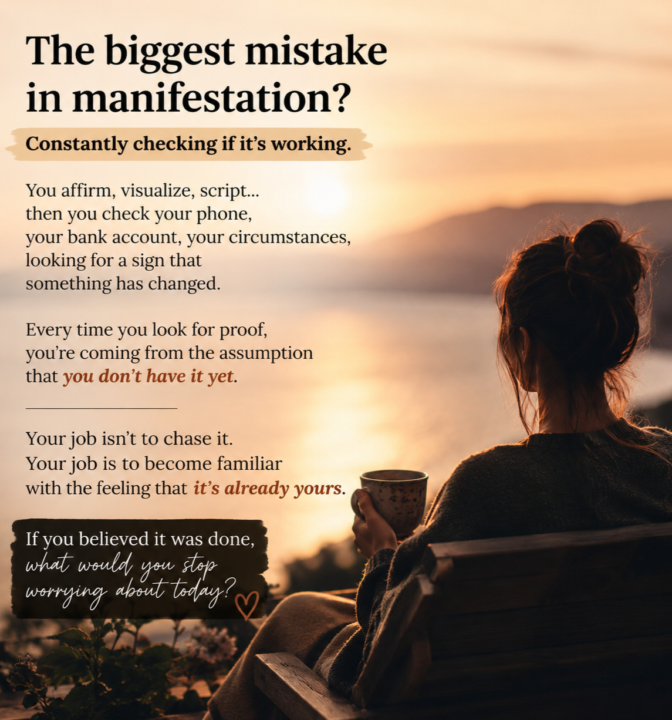
One of the biggest mistakes I see in manifestation is constantly checking if it's working. You affirm, visualize, script, then 10 minutes later you're checking your phone, your bank account, your circumstances, looking for a sign that something has changed. I've done it too. The problem is that every time you go looking for proof, you're coming from the assumption that you don't have it yet. If you ordered something online and knew it was on the way, you wouldn't spend all day wondering if it exists. You'd simply expect it. Manifestation works the same way. Your job isn't to force it, chase it, or keep checking on it. Your job is to become familiar with the feeling that it's already yours. The question is: if you truly believed it was done, what would you stop worrying about today?
0
0
1-10 of 10
powered by

skool.com/neville-goddard-mastermind-4394
A place to explore Neville Goddard’s teachings. Understand your states, shift your identity, and move from knowing to living the life you imagine.
Suggested communities
Powered by