
Write something

May '25 •
Best Practices for Secure, Per-User Data Access in a Chatbot (N8n & Airtable)
Hi everyone, I'm developing a chatbot using N8n for the backend logic, which needs to retrieve client-specific information from our Airtable base. My core requirement is to ensure that when a client interacts with the chatbot, they can only access their own data, and absolutely no one else's. This access will be determined by a unique client identifier (similar to a business registration number or SIRET) which will be used to filter all data queries in Airtable. I'm looking for advice on the most secure and robust strategies or architectural patterns to implement this kind of granular, per-user data segregation. Specifically, with N8n and Airtable in mind, what are the recommended best practices for: - Securely authenticating the client via the chatbot interface? - Ensuring that all N8n workflows making calls to Airtable strictly filter data based on the authenticated client's unique ID? - Effectively handling authorization within N8n to prevent any unauthorized data access to Airtable records? Thanks!
0
0

Apr '25 •
on PDF parsing
Hey everyone, looking for the best and most flexible (as per diff text structures) way to parse pdf files in n8n. Felt like the cloud nodes weren't super fit for parsing some 'complex' text format and structures (like multiple columns and areas of text). Was wondering if there would be better options with community nodes using the self-hosted version, or maybe I'm missing something in the cloud version. Any recommendation?
Mar '25 •
n8n & Supabase/pgvector: Date Range Filter on Metadata for Vector Search?
Hi all, I'm working within an n8n workflow, using the "Supabase Vector Store" node to perform semantic searches against a Supabase/pgvector database. My vector store setup follows the standard SQL provided in the Supabase documentation – the basic documents table (with a metadata JSONB column) and the match_documents function that uses the pgvector extension. Document dates are stored within the metadata column (e.g., {"date": "YYYY-MM-DD", ...}). The challenge I'm facing is filtering results by a date range (e.g., documents from the last 7 days). The n8n "Supabase Vector Store" node calls the standard match_documents function, which filters metadata using the metadata @> filter operator. While this works perfectly for exact key-value matches entered in the node's "Metadata Filter" options, it seems unsuitable for range comparisons on values (like dates) stored inside the JSONB. Given these constraints with the standard function and the n8n node, has anyone found an effective alternative or workaround? I need to combine the vector similarity search with filtering by a date range stored in the metadata, preferably within the n8n context. Looking for suggestions – perhaps SQL function modifications that are compatible, or different n8n approaches beyond the basic Supabase node? Thanks for any insights!

Mar '25 •
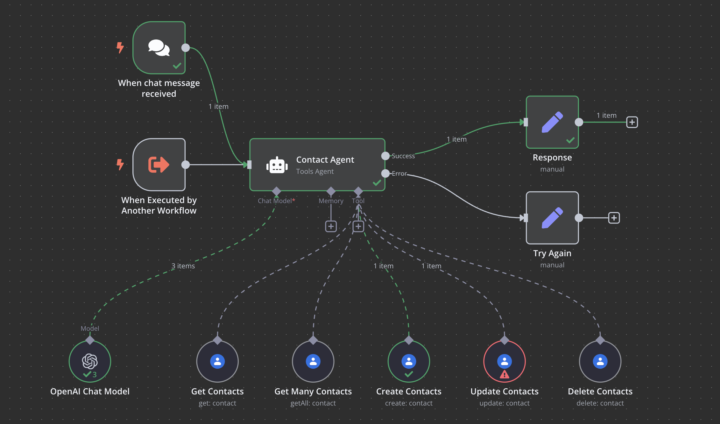
Has any one used the Google contacts nodes?
Hi all, So instead of offloading my google contacts to a sheet and then have the agent manage those there I decided to use the Google Contacts node and for lookup, creation of name it works well but when I want it to add an email things go wrong, not sure what I'm missing here. Any suggestions? I tried to make it as simple as possible. Error msg: The error message "The resource you are requesting could not be found" indicates that the contact ID specified in your request does not match any existing contact in your Google Contacts. This could be due to an incorrect contact ID, missing permissions, or a formatting issue with the ID.
Mar '25 •
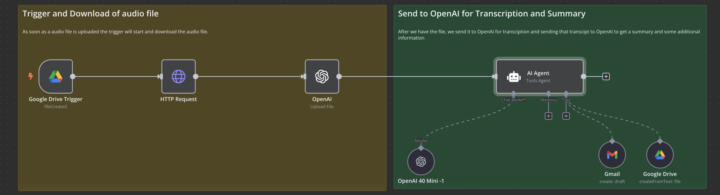
Question: Transcribe audio files
Hi all, Your insights is appreciated, does anyone have a working workflow example that his able to effectively grab an audio file from google drive (when a new one is added) and is able to transscribe it from any given language? Thank you.
1-10 of 10
powered by
skool.com/n8n-ai-automations-5459
Build practical AI automations, agents, and workflows that save time, improve operations, and create leverage.
Suggested communities
Powered by