
Write something

6d •
Debunking Rescue Myths
By S Hughes Myths busted by actual current up to date science: "80% of rabbit does get cancer". This was based on the findings of the Greene study performed in 1947 and published in the 1950s. It's 79yrs old. Studies done within the last 5 to 10yrs have extremely reduced that down to 14% or lower... that's less than humans. "Wire cages hurt rabbits". This was from studies performed in the 1970s, 56yrs old. The study used cages no bigger than the travel carriers breeders currently use for transport to different locations/brief trips... no longer what we use for permanent housing and haven't in decades. Current science from the past five yrs has given rabbits the choice of wire cages vs different housing, the rabbits themselves choose the cages, even if they're born in a group/colony and have never seen one. When European countries began requiring group housing and no wire, rabbits started getting sick and injured. Upon further scientific studies, correct wire caging is the superior housing format. It is cleaner, rabbits have their own space, their feet can sit in a natural position and stay dry. Sore hocks are a disqualification on the show table, yet multiple thousands of breeder rabbits are shown every year, that are housed overwhelmingly on wire. Because correct wire flooring doesn't cause sore hocks... it actually heals them. There is a difference in the type and spacing of wire that is appropriate. Chicken wire and hardware cloth are not correct. 14 or 16 gauge GAW 1/2in x 1in spacing is correct for flooring. This acts like bed springs to give some, while still supporting. Every time the rabbit moves, the pressure on the foot changes...unlike household flooring which pushes the toes up and puts constant pressure on the hock. Unless you're changing the litter box every time the rabbit goes, then they'll be touching the poop and pee with their feet. In wire cages, that all falls completely away from the rabbit and they never contact it. Rabbits do not need friends, in fact they dislike it. "Bonding" should be re-named "Forced co-habitation". All our domesticated rabbits descend from the wild European rabbit. The warrens of wild European rabbits are not one large hole in the ground where everyone lives in peace. The rabbit Warren is individual apartments underground where wild rabbits live singly for 20hrs a day. They maintain space from each other. They're violently territorial. They want to see other rabbits, but not interact. In every group housing study from 10yrs ago to current year, the stress hormones in group housed rabbits skyrocket. The housing method with the least stress is a stacked wire caging system where rabbits can see each other, but do not have to defend territories. (Please read "The Social Nature of the European Rabbit").
0
0
11d •
Heat stress
Rabbits are holding up pretty well considering it is close to 100 degrees. So far, so good. The fans are holding, rabbits are getting electrolytes, and I am putting ice in their water. Everyone is being checked every hour or two throughout the day. I also have Lactated Ringer’s solution from my vet on hand for sub-q fluids in case of emergency. That is not something to just wing. I am trained in emergency care and was a special-needs foster for years, so I learned these interventions decades ago. If you keep livestock or rabbits in extreme heat, talk to your vet before you need them and build that relationship. Phill and Peter both got 35cc today because they were showing early dehydration signs. The main warning signs we are watching for are drooling, skin tenting, hot ears, weakness, and acting “off.” The farm hand has been told exactly what to watch for and to move any rabbit showing signs closer to the cages directly in front of the fans. This is the part of summer rabbit keeping people do not always see. It is not just “give them shade.” It is constant monitoring, airflow, water management, and knowing when a rabbit is starting to crash before it becomes an emergency.
1
0
12d •
Lets talk poop
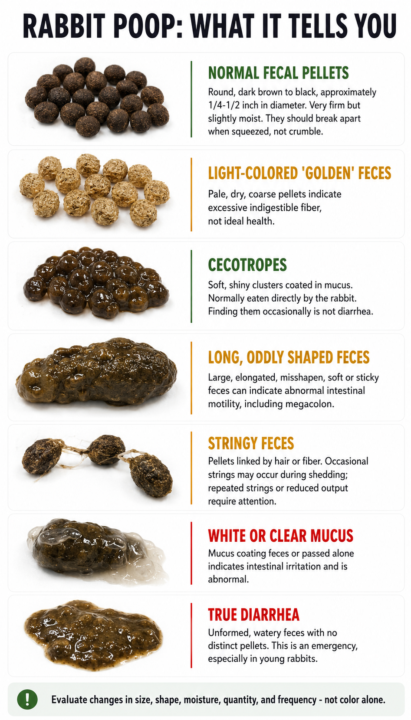
Fecal Abnormalities in Rabbits A rabbit’s fecal output provides important information about its diet and digestive health. You should evaluate the size, shape, texture, moisture, quantity, and frequency of the feces, not color alone. Normal Fecal Pellets: Normal rabbit feces should be round, dark brown to black, and approximately ¼–½ inch in diameter, depending on the rabbit’s size. The pellets should be very firm but slightly moist. When squeezed, they should break apart without crumbling into dry powder. Light-Colored “Golden” Feces: Pale, dry, coarse feces are not proof of perfect digestive health. “Golden poo” generally indicates that the rabbit is consuming excessive amounts of indigestible fiber. More fiber is not always better. Long, Oddly Shaped, Soft or Sticky Feces: Large, elongated, misshapen, soft, or sticky feces indicate abnormal digestive function. Persistent irregular feces may be associated with altered intestinal motility or conditions such as megacolon and should not be dismissed as normal variation. Stringy Feces: Pellets may occasionally become connected by swallowed hair, particularly during a heavy molt. Repeated strings, smaller pellets, reduced fecal output, loss of appetite, or abdominal discomfort require closer attention. White or Clear Mucus: Mucus coating the feces or passed without fecal material indicates intestinal irritation. This is abnormal, especially when it is persistent or accompanied by reduced appetite, pain, bloating, or changes in fecal output. Diarrhea: True diarrhea is unformed, watery fecal material without distinct pellets. It is not the same as uneaten cecotropes. True diarrhea is an emergency, particularly in young rabbits, because dehydration and systemic illness can develop rapidly.
0
0

24d •
Quarantine hutch
Today I put together a quarantine pen. It’s 20 feet away from other rabbits. I wanted it to be in view of the other rabbits. I often have others feeding the rabbits and didn’t want a rabbit in quarantine to get missed. I left space above for a fan for summer heat, as pictured on the other hutch. Come cold weather I’ll store bagged mixed grass over the rabbits to keep the grass dry and insulate the rabbits from cold and wind. Last winter I lost 1/3 of my dried grass when it got wet and molded.

Jun 10 •
Summer heat and rabbits
This time of year, rabbit breeders are in crunch mode trying to prevent the inevitable heat losses. And I am going to say the hard part out loud: The best long-term way to fight heat deaths is to breed for heat resistance. That means watching which rabbits handle heat well and which ones do not. Rabbits that pant hard, get nosebleeds in high heat, crash early, or generally struggle in summer should not be the animals carrying the next generation forward. That does not mean we do nothing to help them. We absolutely take precautions: metal water bowls filled with ice, extra fans, better airflow, rearranging cages, shade roofs to take the worst of the sun, blocking or shading windows to redirect direct light, changing water , adding Electrolytes, cool water three or four times a day, ceramic tiles, cement patio blocks, and other cool surfaces in cages. Heat management matters. But so does selection. If every summer the same type of rabbit is barely surviving, that is not just a weather problem. That is a breeding decision showing up in July. Also, climate matters. In dry desert climates, swamp coolers or misters can help. In humid climates, do not use misters. Adding moisture to already humid air can make things worse, not better. Airflow and shade are your friends. Humidity is the swamp monster. ::: “What heat-management setup has worked best in your barn, and what did you try that absolutely did not work?”
1
0
1-30 of 36
powered by

skool.com/mmcbunclub-6215
Bun Club: science-based rabbit education promoting data-driven care, accurate nutrition, and verified research.
Suggested communities
Powered by