
Write something
Pinned

Jul 2 •
Welcome to Mesh Stuff!
We're here to learn all about Meshtastic and Meshcore devices and use. Everyone is welcome to share ideas, your setups and how you use the Mesh. Traveling? Organizing? Security? Let us know! Share your ideas!
0
0
Jul 26 •
How Messages Travel Through the Mesh
Part One explained what mesh networking is: devices talk directly, messages hop between nodes, and no cell towers or internet are required. Part Two should answer the next question beginners naturally have: “What actually happens after I press Send?” Cover these points: • Client nodes are the devices people carry and use. • Router/repeater nodes help pass messages farther. • A message may travel through several nodes before reaching its destination. • Hops are the number of relays used along the way. • The system chooses a route automatically; users normally do not select the path. • A message can fail because of distance, terrain, metal buildings, poor antenna placement, incompatible settings, or too few nodes. • More nodes do not always mean better performance—badly configured repeaters can create unnecessary traffic. • Meshtastic and MeshCore devices must be using the same firmware ecosystem to communicate. A simple Pantera example would make it clear: Eric sends a message from his T-Deck inside Pantera. Pantera’s roof node hears it and relays it. Another node near the campground passes it onward. Diane’s handheld receives the message farther down the trail. A strong title would be: Mesh Part Two: How Your Message Finds Its Way And the closing line could be: You press Send once. The mesh figures out the journey. I’d save channels, encryption, public versus private messaging, and mesh etiquette for Part Three.
0
0
Jul 2 •
Mesh Basics
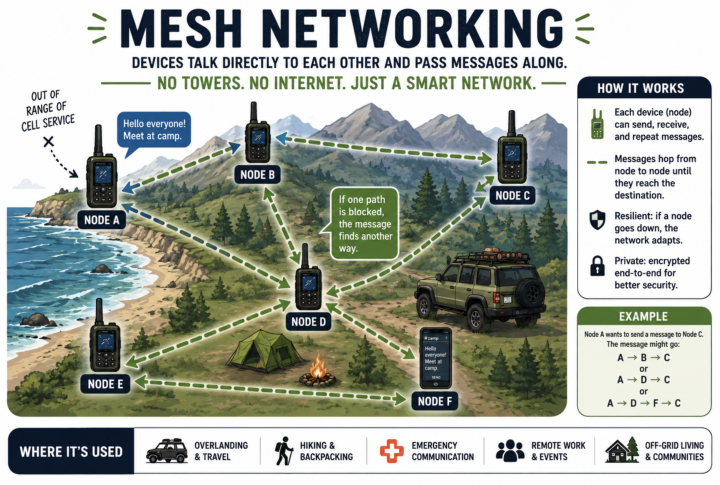
This is how it works. There are two different Mesh Networks running right now; Meshcore and Meshtastic. Both work as it shows in the image. Meshtastic is the older network, Meshcore is a newer upstart. Both are pretty easy to set up but most people see Meshcore are a rising upstart. Next post will be about devices.
0
0
1-3 of 3
Suggested communities
Powered by