
Write something
1d •
Who Is the Person Behind a Book?
Here, with you, I have found readers, curious minds, and writers. But the most important thing, the thing that actually leaves a mark, is the stories some of you have told in this space, in one or more of these chats. This is the heart of a community. Not the trick to make more money, not the technique for writing sharper dialogue. Of course, we will talk about those things too. But the stories, the real stories of each of you, those are better. They tell us something deeper. And we learn to write from them as well. Because otherwise, what would we even be talking about? We learn from stories. So let me go first. I was born and raised in Italy. I lived there for over thirty years, and in 2018 I moved to the UK. I wanted to become an international writer. I only started writing in English in 2020, and it was not easy to begin. No AI, that's right. Google Translate was garbage back then. My first steps were an early grammar app called Grammarly, and a dictionary I bought from Waterstones. That was my whole toolkit. In 2021, I published a science fiction romance novel called Echoes of Eurydice, a title I still struggle to pronounce to this day. But I did it. I got there. It did not matter to the literary agents that I had essentially written an entire book by hand, in a language that was not my own. I collected over a hundred rejections. A hundred. I remember when the number stopped feeling like a wound and started feeling like a strange kind of badge. Every no was proof that I had tried, that I had put the thing out into the world instead of leaving it safe in a drawer. So here is a piece of me, so that when you read my words, you know there is not just an icon with someone vague behind it. There is a real story. One of the ones that struggled, that had to fight against rejection, against prejudice, against racism. One that kept going when going made no logical sense. I had faith. I still have faith in my path. Now it is your turn. Take a moment and share it. It does not have to be long. It does not have to be polished. Just true. Let's see what happens. 👇
5d •
Advice from a Penguin editor: You don’t need a platform. You need…
I want to know your thoughts about this. I know, it's Sunday, but Netflix doesn't make anyone rich, information does. Right? I watched an interview the other day with Alyssa Matesic, a developmental editor who spent years inside Penguin Random House and now runs a YouTube channel followed by over 150,000 writers. She said one thing that I think every person in this community needs to hear. You do not need to be famous to get published. Wow, I said it. So many writers give up before they even start, convinced that without a platform, a following, a personal brand, no agent will ever look at them. Alyssa has watched the opposite happen, again and again. Authors with nothing but a strong story and real craft, getting deals. A following opens doors, yes. But it has never been the thing that gets a book bought. The book gets the book bought. Her advice for standing out was blunt, and I loved it. - Write the best freaking book you can. - Give the agent no reason to say no. - Make the pages impossible to put down from the very first one, because an agent is sitting at a desk with hundreds of queries, and the old excuse of "my story really picks up around page fifty" is a death sentence. They will never reach page fifty. Well, I know, nothing new under the sun. Almost boring. A few other things worth knowing, since this world is kept unnecessarily mysterious. - On money. A traditional advance is not a gift. It is an advance against your future royalties. If they pay you fifty thousand, your book has to earn that back in royalties before you see another cent. And the advance arrives in installments, often spread across one or two years. The upside is that a book that keeps selling can pay you for years. And we all hope for. - On editors. Take your manuscript as far as you possibly can on your own first. Do several passes. Let it sit. The story keeps teaching you things after you have written it, and some of the best fixes arrive in your sleep. You bring in an editor when you hit the wall where you can feel something is wrong, but cannot name it. That is the moment the investment pays off.
10d •
The Tortured Writer. Is It Real, or Is It a Story We Tell Ourselves?
There is an old idea that follows writers everywhere. To create something true, you have to suffer. That the pain is the price of the work. We half believe it. Sometimes we even romanticize it. Months ago I watched a series of episodes on YouTube interviewing famous screenwriters from the film world. I was going through a hard time myself, and hearing them say that it wasn't true, that writers don't have to suffer or be depressed in order to write, that they were happy, I thought: well, I'd be happy too if I had the right connections. We all know that in cinema, like in music, there is a handful of people who write and get paid well. The others, well, peanuts, as we say in Italian. What is the truth? So a psychiatrist decided to actually test it. In the 1980s, Nancy Andreasen, a neuroscientist at the University of Iowa, ran the first rigorous scientific study on the question. She had access to one of the most prestigious creative writing programs in the world, the Iowa Writers' Workshop, whose faculty over the years included Kurt Vonnegut, John Cheever, and Richard Yates. She studied 30 writers, compared them with a matched control group of people in non-creative professions, and used proper diagnostic criteria rather than anecdotes. Her hypothesis going in was that the writers would be mostly healthy. She was wrong. She found that 80 per cent of the writers had experienced some form of mood disturbance in their lives, compared with 30 per cent in the control group. The result was published in 1987, and it still echoes today. There was also something else, the same traits appeared in the writers' close relatives, which suggested that creativity and mood disturbance might run together in families. So the tortured writer is real. Case closed. Except it isn't, and this is the part I find most important. Andreasen herself resisted the romantic reading of her own data. Her conclusion was not that the suffering created the writers. It was almost the opposite. These people became writers not because of their pain, but in spite of it.
8d •
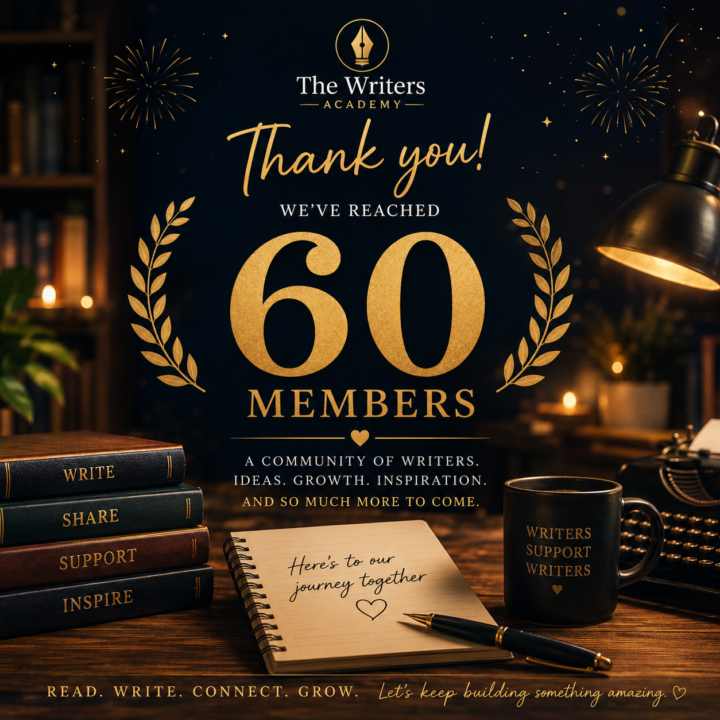
Today, we reached 60 members.
wow. I wanted to share a few thoughts. This group started as a school for copywriters, but over time it evolved into a space for creative writing. As many of you know, there are already two masterclasses available here, and I’ll be adding more in the future. The goal is simple: a free community where writers can read one another’s work and be read in return. From experience, I know that not everyone who joins will participate in good faith. Some people won’t read, engage, or contribute—they’ll simply try to use the community to promote themselves. Promotion is perfectly fine; there’s a dedicated section for it. But I’ll always ask for mutual respect and genuine participation. I’ve seen writing communities descend into chaos before. That’s not what we want here. I’d like this place to feel like an online retreat for writers. If you have doubts, ask. If you’ve written something you’re proud of, share it. If you’ve had a success worth celebrating, tell us. Someone will read it. Just remember to return the favour. Let me give you an example. For eight months, my growth on Substack was almost nonexistent. I just kept writing and publishing. Then, over the last couple of weeks, I started reading other people’s work, leaving thoughtful comments, and restacking articles and Notes. The result? I now gain new followers or subscribers every day (5, sometimes 7), without spending a penny. That’s the real secret to being noticed: invest time in getting to know people genuinely. A writer’s intelligence is reflected not only in what they write, but also in how they respond to the work of others. Every great writer has, at some point, engaged with another great writer. A community like this—full of ideas, ambition, and hope—deserves to be protected, enriched, and supported. Some of you are already doing exactly that. You write. You reply. You encourage others. Some even leave prayers and kind words. In many ways, it mirrors life outside these walls. Thank you for being here.
14d •
Why does this matter to you?
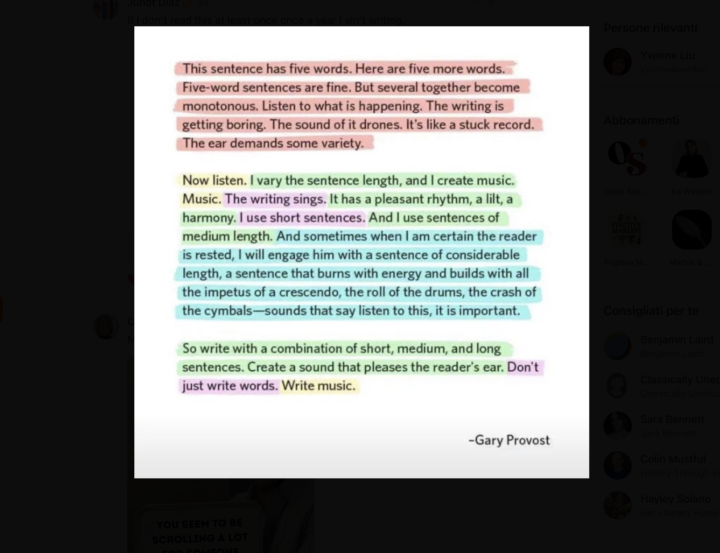
I was a musician back in high school, in Italy. From around fifteen to twenty-two, and then the band slowly died, the way bands do, not all at once but gradually, until the sound just stopped. And while I was writing music, I was writing my stories too. That is why this technique feels like mine in a way no other does. That is why I am a little obsessed with it. Which is strange, because I am not really friends with techniques. I have studied them, yes, but I have never been comfortable thinking of writing as a set of rules to follow. I believe, though, that to be truly free you first have to know. Otherwise, the freedom is blind. And blind freedom is just another word for chaos. There is a piece of writing advice, four short paragraphs by a writing teacher named Gary Provost. It has been shared so many times online that most writers have seen it. And most writers nod, think yes, of course, and then go back to writing the way they always have. The idea is almost embarrassingly simple. Sentences have length. And length creates rhythm. And rhythm, when handled with intention, becomes music. When every sentence runs to the same length, the prose becomes monotonous, the way a drumbeat without variation stops being music and becomes noise. When you vary the length, something happens to the writing. It starts to breathe. Cormac McCarthy understood this at a cellular level. In The Road, short staccato sentences create urgency and tension, and then, without warning, a long sentence arrives and carries the reader somewhere vast and slow and devastating, before a short one lands again like a door closing. "The cold relentless circling of the intestate earth. Darkness implacable. The blind dogs of the sun in their running. The crushing black vacuum of the universe. And somewhere two hunted animals trembling like ground-foxes in their cover." Cormac McCarthy Here is what the same moment sounds like without the technique, and then with it. Without: - The man looked at the fire. It was dying slowly. He didn't have enough wood to keep it going. The boy was asleep nearby. He watched him breathe. He thought about the morning.
1-30 of 73
powered by
skool.com/marcello-iori-7056
A home for storytellers who want to write and share their best work and build a career through writing. Best Creative Writing Masterclass lives HERE
Suggested communities
Powered by