

Apr 16 •
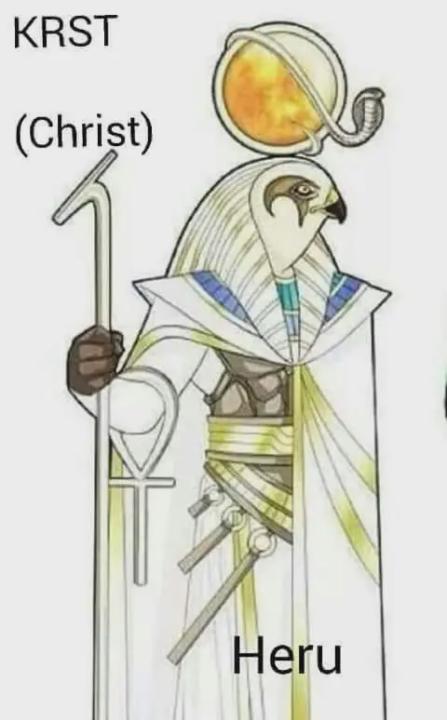
Christ/KRST
According to Egyptian scholar and spiritualist, Gerald Massey, the original ancient Egyptian (Kemetic) meaning of the term, “Christ” (originally spelled, “KRST”) is “mummy.” It’s important to note that the original ancient Egyptian written language (Medu Netcher) did not have vowels in its writing system, so the sounds were to be inferred by the speaker. The word “KRST,” can be broken into the following two syllables: “K” and “RST.” The “K” sound is pronounced “ka” and it means “spirit.” “RST” is pronounced “rest,” and it means “rise.” Thus, KRST means the “rising spirit.” The ancient Egyptians believed that it was the spirit that rises upward after a literal or psychologically transformative death. Consequently, Massey translated KRST into mummy - an enwrapped and preserved dead body whose spirit is believed to transcend corporeal death. The ancient Egyptians were astute observers of nature, and they often referred to natural phenomena for metaphorical purposes. For example, when they observed a caterpillar transform into a butterfly, they noticed that it entered into a chrysalis (etymologically related to Christ), underwent a metamorphosis, and then emerged from its dormant state as a butterfly. When the caterpillar entered into the chrysalis, it appeared as if it was a dead body that was mummified. However, after a period of dormancy, it transformed into a butterfly. The ancient Egyptians represented spiritual elevation with creatures that fly, hence the butterfly represented spiritual ascension. The ancient Egyptians believed that everyone could achieve KRST-consciousness, so this analysis is relevant to all of us. With this understanding, it means that embodying Christ (KRST) signifies undergoing a spiritual metamorphosis and achieving spiritual elevation. This is the allegorical meaning behind Christ being born in a lowly status (caterpillar), realizing his divinity, undergoing tribulations, dying, being wrapped in cloth, being entombed (chrysalis/mummified), rising from the dead, and then ascending to heaven (butterfly). The story of Christ (KRST) represents the transition from a lowly status to an elevated spiritual one after undergoing a metamorphosis, and it’s a story that everyone has the capacity to experience, metaphorically speaking.
0
0
Mar 5 •
Beliefs in a God Vs Satan
The Hebrew word śāṭān (שָׂטָן) means “adversary,” “accuser,” or “opponent.” 🜂 Core Meaning in Biblical Hebrew In the Hebrew Bible, satan is not originally a personal name but a role: - One who opposes or obstructs - An accuser in a legal or spiritual sense - An adversary raised up against someone The verb form means “to accuse, to oppose, to obstruct.”
0
0
Mar 3 •
7 Laws Of The Universe
The 7 laws of the universe are often referred to as the Universal Laws or Hermetic Principles. Here are the key laws: 1. Mentalism: The universe is a mental creation; everything is a manifestation of the mind. 2. Correspondence: As above, so below; there is harmony between the different planes of existence. 3. Vibration: Everything in the universe is in constant motion and vibrates at its own frequency. 4. Polarity: Everything has its pair of opposites; they are actually the same thing differing only in degree. 5. Rhythm: Everything flows in and out; there is a rhythm to all things in the universe. 6. Cause and Effect: Every cause has its effect; nothing happens by chance. 7. Gender: Everything has both masculine and feminine principles, which are necessary for creation. This brings me to the thought of The is a balance to all things. An Opposite. Up down. Left right. Right wrong. yes no Good bad. Day Night. Shall I continue lol. No. But understanding what this is. Innerstanding how it relates to you (self). And then overstanding how it applies to the universe and how it all ties together over all. That will help you guide your life easier when it comes to facing obstacles, answering questions, and channeling energy that will benifit or distract you. Here is a video that explains this in more depth. Brace Yourself. The Second video will go a little further with all the laws of the Univese. Its only 8 minutes long. Maybe check out this first if you dont have a lot of time.
0
0
Jan 6 •
The Spiritual Use of Marajuana
The Role Of Weed In Spirituality: Mystical Experiences Of Marijuana What are your thoughts or feelings towards marijuana and its usages. Do you use or have you ever and for what purposes do you use. Is it spiritual medicinal or recreational uses for said plant. Who would like for me to do a whole post on this topic?
Jan 6 •
the constitution the congress and delegated powers
Delegated Powers Contents 1. Definition of Delegated Powers 2. What are Delegated PowersCongressional Authority over Taxes 3. How Many Delegated Powers Does Congress Have 4. Delegated Powers by Branch of GovernmentExecutive BranchLegislative BranchJudicial Branch 5. Delegated Powers Example in Affordable Care Act 6. Related Legal Terms and Issues Delegated powers are government powers specifically outlined in the U.S. Constitution. These powers limit what Congress can do, and also define what Congress is in charge of regulating. Delegated powers are those authorities that the Constitutional framers deemed worthy of Congressional effort and which the framers believed would not limit personal freedoms of individuals. The U.S. Constitution, which is both a concise, and a very old document, establishes rules on what Congress does and does not have control over. To explore this concept, consider the following delegated powers definition. Definition of Delegated Powers Noun 1. Specific powers granted to Congress as outlined in Article 1, Section 8 of the United States Constitution. Origin 1788 Ratification of the U.S. Constitution What are Delegated Powers The term delegated powers refers to the authorities granted to the United States Congress in of the U.S. Constitution. An important thing to note regarding how enumerated powers are established is that the Constitution does not outline what the government cannot do, but what it can do. Anything not specifically outlined in the Constitution as a power that is bestowed upon Congress, is not something Congress has the authority to do. These are also frequently called “enumerated powers,” because they specifically itemize Congress’ authority.
0
0
1-14 of 14
powered by
skool.com/god-within-8875
Yehweh said, 'You are gods; you are all sons of the Most High. Let Us make Man in Our image and likeness." Re-Discover The Truth About Everything.
Suggested communities
Powered by