
Write something

17h •
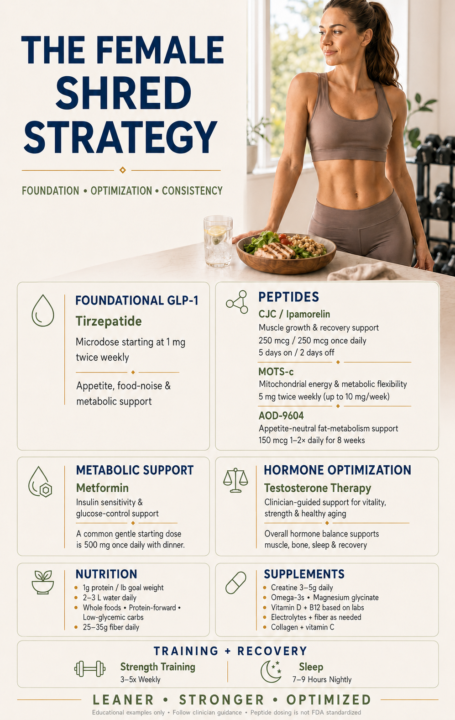
THE FEMALE SHRED STRATEGY 💪🏻
Ladies—it’s time to get leaner, stronger and optimized. But getting “shredded” isn’t about taking one product and hoping for the best. The real strategy is supporting appetite, metabolism, hormones, muscle, nutrition, training and recovery together. Here’s how the complete strategy comes together 👇🏻 💙 Use code JessVIP20 for 20% off at Real Peptides ━━━━━━━━━━━━━━━━━━━━ 1️⃣ FOUNDATIONAL GLP-1 Tirzepatide Tirzepatide supports appetite regulation, reduced food noise, improved fullness, insulin sensitivity and metabolic health. Educational microdose example: • Start at 1 mg twice weekly • Adjust only according to individual response GLYCON-X™ (Tirzepatide): https://www.realpeptides.co/products/glycon-x/ref/377/ ━━━━━━━━━━━━━━━━━━━━ 2️⃣ PEPTIDE SUPPORT CJC-1295 / Ipamorelin Studied for growth-hormone signaling, overnight recovery, muscle growth, tissue repair and sleep-linked regeneration. • 250 mcg CJC-1295/250 mcg Ipamorelin Once daily, Five days on and two days off; 8 weeks • PM Fasted https://www.realpeptides.co/products/cjc1295-ipamorelin-5mg-5mg/ MOTS-c A mitochondrial-derived peptide studied for cellular energy, metabolic flexibility, insulin signaling and exercise performance. Educational protocol example: • 5 mg twice weekly (Up to 10 mg total per week); 8 weeks • AM https://www.realpeptides.co/products/mots-c-peptide/ AOD-9604 An appetite-neutral peptide studied for fat-metabolism and lipolysis pathways. Educational protocol example: • 150 mcg once or twice daily; 8 weeks • AM Fasted https://www.realpeptides.co/products/aod9604/ref/377/ ━━━━━━━━━━━━━━━━━━━━ 3️⃣ METABOLIC SUPPORT Metformin ER Metformin may help reduce liver glucose production and improve insulin sensitivity and glucose control. A common gentle starting dose is:
3
0
5d •
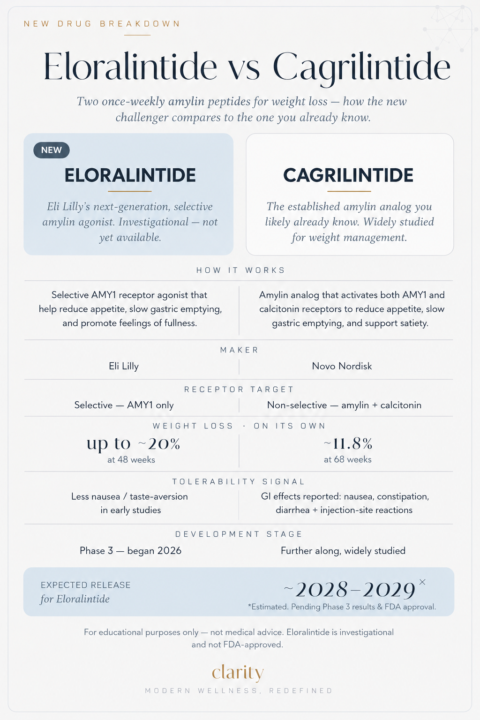
🚨 NEW DRUG ALERT: Meet Eloralintide — The Next-Gen Amylin
Eloralintide is an amylin receptor agonist — the same family as cagrilintide. Amylin is a natural hormone your body releases alongside insulin that signals to your brain, "I'm full." These drugs amplify that signal: more satiety, slower gastric emptying, and less food intake. The amylin space is heating up fast, and this is shaping up to be a serious next-wave player alongside the GLP-1s. So if you already understand cagrilintide, you understand the basics here. Same hormone pathway, same once-weekly injection, same goal. ————————————— 🆚 HOW IT'S DIFFERENT FROM CAGRILINTIDE Although Similar, the two drugs take opposite design approaches: Cagrilintide = NON-selective. It activates multiple amylin and calcitonin receptors. Eloralintide = SELECTIVE. It targets one specific receptor (AMY1R) — the theory being a cleaner, more targeted effect with fewer off-target reactions. In animal studies, that selectivity translated to LESS nausea and taste-aversion than cagrilintide. The holy grail in this space: strong results with easier tolerability. And the head-to-head monotherapy weight-loss numbers? Eloralintide came out ahead: ➡️ Eloralintide (top doses): up to ~20% weight loss at 48 weeks ➡️ Cagrilintide (2.4mg solo): ~11.8% weight loss at 68 weeks That's nearly DOUBLE the weight loss — in less time. (Worth noting: these are separate trials, so it's not a perfect apples-to-apples, but the gap is striking.) ————————————— 📊 THE STATS THAT STAND OUT ➡️ Dose-dependent weight loss: ~9% (1mg) climbing to ~20% (9mg), versus just 0.4% on placebo ➡️ Weight loss had NOT plateaued at 48 weeks — meaning the true ceiling could be even higher ➡️ 81–92% of people in the higher-dose groups lost 10% or more of their body weight ➡️ Waist circumference dropped up to ~17 cm — that's 6–7 inches, or several belt holes ➡️ Most of the weight lost was FAT, not muscle (confirmed by DEXA scans) ➡️ Bonus wins: improved cholesterol and A1c, plus up to a 64% drop in hsCRP (a key inflammation marker)
0
0
Jan 6 •
Trusted Partners
Real Peptides ➡️ https://www.realpeptides.co/ref/377/ ⭐️Use Code JessVIP20 for a 20% discount⭐️ Felix Chems ➡️ https://felixchem.is/refer/5549/ 10% Discount with code JESSICAD10 Tirz: https://felixchem.is/product/peptide-t-15mg/refer/5549/?attribute_select-vial-quantity=Single Reta: https://felixchem.is/product/peptide-r-10mg/refer/5549/?attribute_select-vial-quantity=Single ➡️ BioLongevity Labs Cutting Edge | USA Made https://go.biolongevitylabs.com/SH1A Jess15 at checkout for 15% Off ➡️ Scantifix Cosmetic, Oral peptides, and Longevity Tech + DIY Peptide Serums Our code: jess15 https://www.scantifix.com/Jessica Jess15 at checkout for 15% Off ➡️ Rythm Health at Monthly at-home Blood Tests https://rythm.health/jessica-fd0j $20 off your first lab test

Jan 21 •
GLP-1 Zoom Meetup - Tomorrow 6 PM EST
Join me TOMORROW NIGHT, Wednesday, Jan 21 at 6 PM EST for a casual GLP-1 chat via Zoom! We’ll talk getting started, what’s right for YOU, realistic expectations, sourcing, side effects, stacking with other peptides… whatever’s on your mind. No scripts. No pressure. Just real talk and honest answers. Get your questions ready. Grab your favorite bevvie and let’s do this! 🎉 📅 Join Zoom Meeting: https://us06web.zoom.us/j/81707647821?pwd=4w5O3AwIdxfWfuQAjquTCMY2RoStp6.1 ❓Submit Questions: https://form.jotform.com/260198762764065

Jan 16 •
Free GLP-1 Coaching Call - vote for the best time!
Help me pick the best time for a FREE GLP-1 coaching group call via Zoom. Which time works best for you? If none of the times work, drop your preference in the comments or DM me :) Topics: • Protocols • Picking the right GLP-1 for your goals • Supportive peptide therapies • Side effects + lifestyle modifications.. and more!
Poll
5 members have voted

1-17 of 17
powered by
skool.com/glp-1-peptide-clarity-group-5837
Learn how Peptides, GLP-1s, and lifestyle strategies support energy, balance, body composition, and lasting vitality from within.
Suggested communities
Powered by