
Write something

Aug 8 •
©️ Yes, Your Report is Copyrighted. Here's the Proof — and How to Actually License It Out.
I've had a few conversations lately with agents attaching appraisal reports to MLS listings — not maliciously, just not knowing better. It made me dig back into the actual legal basis for why this isn't allowed, and then into the more useful question: how do we let agents legally use the factual data they actually need, without exposing ourselves? Sharing both here. PART 1: The Legal Basis Copyright vests automatically, in you, the moment you create the report. Under 17 U.S.C. § 201, the author owns the copyright unless there's a signed written work-for-hire agreement saying otherwise — made BEFORE the work was done. If you never signed one (and almost none of us have), the report is yours. Full stop. This isn't theoretical. Tim Vining, an appraiser in Washington state, sued a real estate brokerage for using parts of his report in their sales material without permission — and won. First case to establish appraisal reports as copyrightable work product. His report wasn't even registered with the Copyright Office, and he still won — registration isn't required to prove infringement. What delivering a report actually grants a client: a limited license for a specific purpose, not ownership. Fannie Mae's own 1004/70 form proves the model — the client is permitted to disclose the report to the borrower. One named party, one named purpose, in writing. That's the template for everything below. PART 2: How to Actually License Data Out (So Agents CAN Use It Legally) Here's the thing — agents genuinely need some of this data, and right now the only path they have is either bugging you informally or lifting it without permission. You can close that gap yourself, and get paid for it, by formalizing a narrow license instead of leaving the door either fully open or fully closed. Build a simple Third-Party Data Use License — a short, separate document (not the report itself) that does four things: 1. Names who it's for. Specific agent, specific brokerage, specific property/listing. Not a blanket release — it expires with that listing.
0
0
Feb 13 •
Appraisers play a crucial role in over 75 of 161 U.S. core industries — protecting consumer equity, lending integrity, and the real estate market itself.
🧭 Updated Economic Footprint — 2026 Context 1️⃣ Directly Dependent Industries Industries that require or contract certified appraisers for daily operations or compliance: - Mortgage lending and banking - Real estate brokerage and sales - Title and escrow services - Insurance underwriting and claims (property and casualty) - Government and regulatory agencies (including HUD, FHA, VA, USDA) - Legal and judicial services (divorces, estates, trusts, litigation) - Accounting, tax, and wealth management (IRS valuation standards) - Healthcare and social support services (e.g., Illinois Medicaid asset valuation) - Appraisal management companies and valuation technology providers ✅ Approx. 12–15 core industries directly depend on certified residential appraisers. 2️⃣ Indirectly Affected or Supported Industries Sectors that rely on appraisal data to validate decisions, structure deals, or measure local economic health: - Home construction, renovation, and materials supply - Architecture, surveying, and engineering - Legal and fiduciary administration (trust and estate work) - Investment and private equity groups - Real estate technology platforms and MLS systems - Educational and training services - Energy, utilities, and municipal planning - Moving, storage, and logistics firms - Insurance, risk modeling, and actuarial analysis - Property data analytics, AI, and automation startups ✅ Approx. 30–40 industries are indirectly influenced by appraisal functions. 3️⃣ Broader Economic Ripple Because appraisers shape market confidence, tax baselines, insurance reserves, and household wealth assessments, they indirectly touch: - Finance and securities (mortgage-backed assets, REITs) - Consumer manufacturing (appliances, furnishings, remodeling) - Retail and service ecosystems linked to property turnover - Education, policy, and financial planning sectors ✅ When including secondary ripple effects: 70–80 of 161 industries are influenced to some measurable degree.
1
0
Feb 11 •
?The power is not in who you know?
It’s about who knows you — and who comes to mind when someone asks, “Do you know an appraiser you trust?” Your reputation doesn’t grow from ads alone. It compounds through industry partners — title reps, loan officers, and agents — who pass warm connections your way every day. Yes-loan officers will refer you to non lending work for banks you do not even do work with. Ask me why? When you build your brand and invest in your craft, you become the name that travels the room when you’re not in it. 👉 One way to scale that trust is by partnering with hundreds of top agents through a community like Real Producers — where your credibility meets their network. Referrals scale when relationships do.
1
0

Feb 11 •
Building Trust and Building a Brand Matter
🎯 Non‑Lending Assignments: Clarity, Confidence & Connection Non‑lending assignments build long‑term trust. Estate and private appraisal clients aren’t looking for loan approvals — they’re looking for clarity. And clarity is where our expertise truly shines. When we clearly define both the “as‑is” and “as‑repaired” value, we’re doing more than providing numbers — we’re giving families context. That information helps them (and their agents) make informed decisions before a listing agreement is ever signed. These clients rely on us to interpret the market, anticipate what buyers and financing conditions will flag, and help set expectations early. That’s professional leadership, not transaction paperwork. 👉 Educate. Interpret. Advise. These reports aren’t one‑offs — they’re brand builders.Each one deepens trust, positions you as a market resource, and creates repeat visibility with agents, attorneys, and title companies. 💬 Why It Matters When you communicate your findings with clarity and relevance — tying them to market realities like lender-required repairs, post‑inspection negotiations, and buyer perception — you’re doing more than completing an appraisal. You’re framing decisions, reducing surprises, and building confidence for everyone involved. 🤝 Beyond Keeping the Lights On Networking with real estate agents, attorneys, and title professionals through estate and private work isn’t just about creating revenue stability — it’s about creating professional satisfaction. You’re helping families move forward with understanding. You’re giving agents a clearer starting point. That’s meaningful work. And that’s how trusted appraisers — the ones who interpret value with vision — grow a reputation that lasts.
1
0
Jan 8 •
🎯 Curious how top Realtors use insights like this to stand out with clients, create lasting trust and referalls?
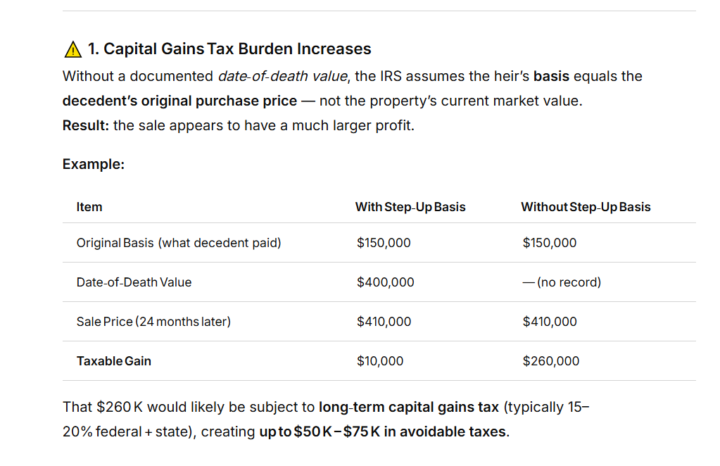
⚠️ 1. Capital Gains Tax Burden Increases Without a documented date‑of‑death value, the IRS assumes the heir’s basis equals the decedent’s original purchase price — not the property’s current market value.Result: the sale appears to have a much larger profit. Example: Item With Step‑Up Basis Without Step‑Up Basis Original Basis (what decedent paid) $150,000 $150,000 Date‑of‑Death Value $400,000 — (no record) Sale Price (24 months later) $410,000 $410,000 Taxable Gain $10,000 $260,000 That $260 K would likely be subject to long‑term capital gains tax (typically 15–20% federal + state), creating up to $50 K – $75 K in avoidable taxes. 🧾 2. No IRS‑Recognized “Fair Market Value at Death” Proof If audited or questioned, heirs cannot substantiate the stepped‑up value without an appraisal dated near the decedent’s death. CPA documentation becomes speculative, and the IRS may reject estimated comparables. ⏳ 3. Lost Estate‑Planning Protection Even if the property is sold within 24 months, the IRS allows the estate or heir to use date‑of‑death value only if it’s properly determined and supported by credible evidence (IRS Publication 551, Basis of Assets; Topic 701). Without an appraisal, you miss that protection window — and retroactive appraisals done too late can be challenged. Plus, tetrospective appraisals are often after the property has been sold and the appraiser does not have access to the property. 📖 Source - IRS Publication 551 (2023) – Basis of Assets, Section “Property Received as a Bequest, Inheritance, or Gift.”https://www.irs.gov/publications/p551 - IRS Topic 701 – Sale of Your Home (for capital‑gain exclusion context). In short:Failing to get a step‑up basis appraisal after someone passes can turn a near‑zero tax event into a five‑figure tax liability.A single certified valuation preserves the family’s equity and ensures compliance before selling the home. I am not an attorney or CPA.
1
0
1-8 of 8
skool.com/gettheedgenow
Break free from the lender trap. Get off the hamster wheel. Scale smarter, earn more, and reclaim your time with proven appraisal systems. 🚀🏡
Powered by