
Write something
Jan 12 •
Other Dog Odor At Trials (how it can lead to false alerts)
In training, your dog often knows the environment well. They may train alone, at home, or with the same few dogs — which means background scent is predictable. Trials change that picture completely. In a trial environment, your dog is suddenly exposed to: • Residual dog odor from dozens of unfamiliar dogs • Leash paths, corners, and furniture heavily trafficked by dogs • Possible drool or pheromone scent where dogs have paused, waited, or been rewarded • Scent pictures that don’t exist in your normal training spaces For some dogs, this creates a totally new kind of scent picture. Dogs sometime alert where another dog alerted even if that other dog was wrong. Other times this creates a handler challenge where the dog isn't actually indicating, but shows a change of behaviour that the handler incorrectly identifies as source odor. This is especially common for dogs that have limited experience: • Training only at home • Training with the same dogs • Training in low-traffic environments How to work through this in training Instead of trying to “ignore dog odor,” teach your dog how to sort through it: • Train in spaces used by unfamiliar dogs --- especially if those other dogs a drooly • Intentionally run searches after other dogs have worked • Reinforce clear sourcing away from dog odor • Occasionally train with no target odor in high dog-traffic areas (for teams that have progressed to blank searches) The goal isn’t to eliminate dog odor — it’s to help your dog learn that dog scent is just part of the environment, not the answer. Has your dog ever "falsed" and you've come to find out later that dogs ahead of you incorrectly indicated to the same spot? Could be that your dog is picking up on scent from the other dog! Although it could also mean that multiple dogs are getting tripped up by the same problem.
Dec '25 •
Intro to Nosework Videos Added
I've added links to the YouTube videos I've done for Intro to Nosework so you can start playing along at home if you have a dog that you haven't started in nosework yet!
Jan 6 •
Handler Behaviour At Trials (how it can lead to false alerts)
Even when you may not feel stressed at a scent detection trial your dog knows something is different. In a trial environment, handlers often change their behavior in subtle ways, including: • Slower or hesitant movement • Holding their breath/changing breathing patterns • Tighter leash handling/clumsy line management • Stopping longer at “interesting” areas • Looking harder, leaning in, or hovering over objects • Talking more than usual or repeating verbal cues • Taking the lead or presenting/prompting more than in training To your dog, these changes can look like information. Many dogs will indicate simply because you look like you’re expecting one. That doesn’t mean your dog is guessing — it means your dog is responding to you. How to work through this in training? Simply trying to “not be stressed” isn't the solution. What we can do in training is proof against handler behaviour! • Committed Movement: In training, even when you know where the hides are in a search area, make sure that you commit to your path whether odor is present or not. I'll be honest that this point has a lot of grey area, but when we're working hides known to the handler in training I consistently see patterns where the handler will hover towards where odor is and avoid where odor isn't. They'll follow their dog deep into a "hot" section of the search area, but stand back when the dog heads towards a blank area. Smart dogs often start using this to predict where source will be and suddenly when the search is blind and the handler lingers too long somewhere the dog might indicate (or the opposite problem where the dog misses hides because their handler doesn't follow them). • Train with intentionally “wrong” handler cues so your dog learns to trust odor, not body language; run searches where you deliberately stop, hover, or hesitate where no odor is present • Try the "Silly Handler" exercise where you might breathe different, talk more (or less) than usual, move strangely, or other silly things (keeping in mind that we don't want to spook your dog)
Jan 5 •
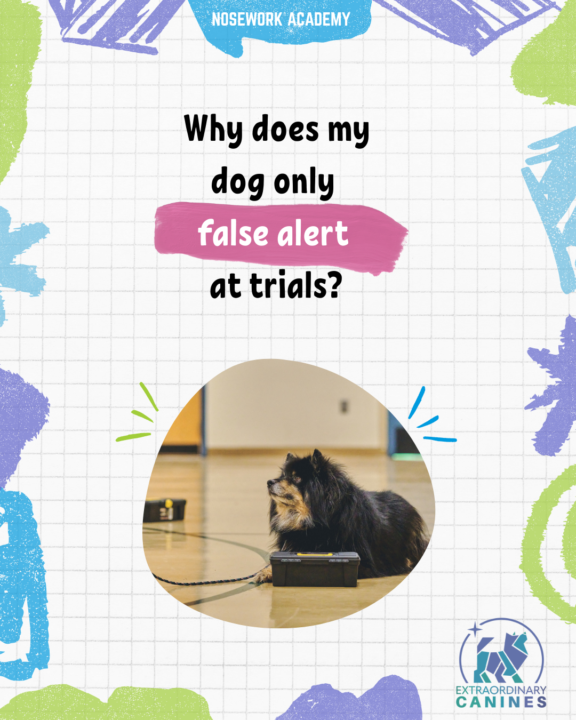
Nosework False Alerts
Does this sound familiar? You’ve been training hard, and your dog is a rockstar in class, training with friends, or even working solo… yet the moment you step into a trial search, something changes. Suddenly your dog is confidently indicating on items that earn you a “No” from the judge. You go back to training and try to recreate the problem — but your dog can’t seem to get it wrong unless you’re at a trial. So… what’s really going on? Every dog is different, but here are 4 big differences between training and trial environments that can lead to "false alerts": 1) Handler behavior Trial nerves change everything — body language, leash tension, breathing, timing. Dogs read us incredibly well, even when we think we’re being neutral. 2) Other dog odor If you mostly train alone, at home, or with the same dogs, trials introduce a LOT of new scent: stress, excitement, residual dog odor, and traffic patterns your dog hasn’t had to filter before. 3) Odor aging Fresh hides behave very differently than aged ones. If you don’t regularly practice with older hides, your dog may struggle to source accurately in trials. 4) Odor concentration Your training odor could be weaker (or stronger) than what’s used by the organization you’re trialing under. If your dog hasn’t experienced that range, they may alert early, imprecisely, or not at all. The takeaway: false alerts are usually a training gap and often we can work on these things. Make sure to obtain video whenever possible! Some organizations will take official video available to purchase later while others may allow someone to record your run from your phone. If you'd like to learn more stay tuned here on Skool over the next few weeks!
2
0
1-4 of 4
Suggested communities
Powered by