
Write something

11d •
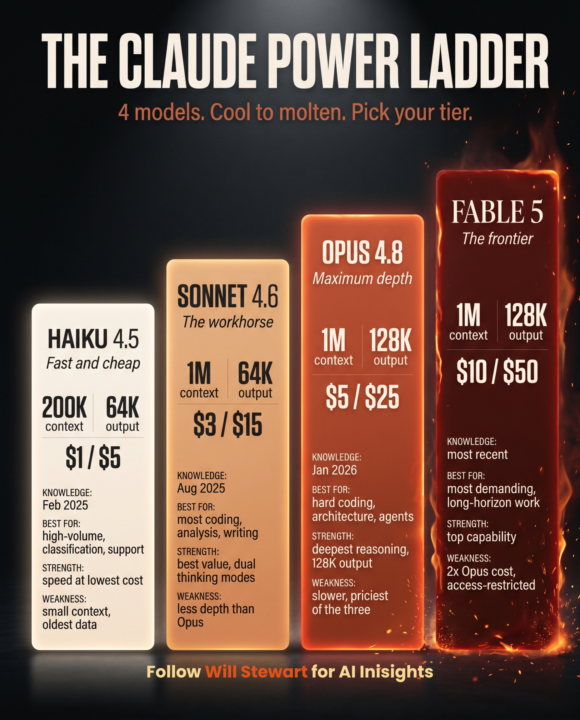
The Claude Power Ladder
I've spent over a year building with Claude. Creating things, tearing them down, building them again a little better each time. And I still catch myself making one dumb move. When I'm slammed, I don't drop down to a lighter model for the easy work. I just stay on the heavy one, because it's already open and I'm moving fast. Multiply that across a busy month and my spend crept up. It wasn't a crisis. When I reach for Opus on the hard stuff, I get every dollar back. But I was paying flagship prices for work that never needed flagship power. Then there's Fable 5. I had access for three days before it went unavailable. In those three days it did things I didn't think were on the table yet. The ceiling is real. But here's what all of it taught me. Using Claude well is like using a set of knives. You grab a chef's knife for one job. A paring knife for another. A butter knife for another. You don't reach for a butcher's knife to cut butter. It works. Of course it works. But it's overkill, and you knew that before you picked it up. You also wouldn't cut raw meat with a butter knife. You could force it. It's just not a smart move. Not everything needs to be new. Some things just need to be gently warmed. The next level of using AI is not learning more features. It's learning when to throttle the power up, and when to throttle it back down. Real example from my own work. The multi-agent CRM I built (drafts emails, runs prospecting, follows up on leads, several agents working at once) needs real power. Haiku would choke on it. Sonnet handles it well. Fable 5 would be the perfect fit, the day I get my access back. But a quick summary or a tidy-up task? That's a butter knife job. Running it on the flagship is cutting butter with a cleaver. Refining your use cases, task by task, is how you get better at this. It's also how a business stops overpaying and starts maximizing what it spends on AI
0
0
25d •
Check this right now. It takes 10 seconds
Go to mxtoolbox.com/dmarc.aspx and type in your business domain. If it comes back empty, anyone on the internet can send an email that looks like it came from you. Your clients can't tell the difference. Their inbox shows your name, your domain, your email address. But it's not you. I scanned 5 businesses this week. 3 of them had no DMARC record. One had an email deliverability score of 20 out of 100. A CPA firm handling their clients' tax documents. The fix takes 5 minutes. One DNS record. Your hosting provider or IT person can do it while you're on the phone with them. Go check yours. Drop your result in the comments. I'll tell you what it means.
0
0
27d •
The 30-word prompt lie.
Some AI influencer said he only uses 30-word prompts. Tells Claude to ask him questions instead. Says it saves tokens. Sure. It also saves you from getting good output. Here’s what actually happens with short prompts. You type 30 words. The AI doesn’t have enough context. So it asks you a question. You answer. It asks another. You answer. Five rounds later you’ve spent MORE tokens than a long prompt and the AI is still guessing. Worse: the AI is now driving the conversation. It decides what to ask. Its assumptions shape your output. You handed the steering wheel to the machine. Now try this instead. Give the AI everything up front. Your situation. Your constraints. Your audience. Your history. What worked before. What failed. The full picture. The output on the FIRST try will be better than anything the 30-word approach produces after five rounds of back and forth. I tested this today. One long, context-rich prompt. AI connected details from three separate conversations, referenced a specific person’s LinkedIn post, identified a security vulnerability in their email infrastructure, and closed with a personal connection I never would have thought to mention. All in one pass. A 30-word prompt would have gotten me a template. The principle: whoever drives the conversation controls the output. Short prompts put the AI in the driver’s seat. Long, specific prompts put YOU in the driver’s seat. That’s the difference between people using AI as a toy and people using AI as a system. Stop optimizing for tokens. Start optimizing for outcome. This is what we mean by “stay the human in the middle.”
0
0
1-3 of 3
powered by

skool.com/empowercore-ai-lab-2521
AI should make you money AND save you time. If it's not doing both, the problem is your system, not the tool. No hype. Just systems.
Suggested communities
Powered by