
Write something

May 20 •
Saying “This is a safe space” doesn’t create safety
“This is a safe space.” - the wrong thing to say as a facilitator if you want psychological safety in difficult rooms. Especially in AI workshops. Because people don’t feel safe just because we announce it. They feel safe when the see the proof. When someone can challenge a senior stakeholder. Ask a basic question without being judged. Admit they don’t understand x,y,z or the tech. Say, “I don’t think this AI use case makes sense.” That’s when you know. That's when you also know difficult discussions can happen, debates will take place, decisions will get made, and people will stand behind them. I wrote an article what psychological safety actually looks like in AI sessions and what facilitators can do to create the conditions for it. Curious to learn your thoughts :) https://danavetan.substack.com/p/nobody-in-your-ai-workshop-is-willing
May 15 •
How do you help clients decide what they need — Design Thinking or a Design Sprint?
Clients often arrive asking for "Design Thinking" when what they need is a sprint that fits inside their quarter. Or they ask for a Design Sprint when the problem is too broad and ambiguous to scope into four days. Both are common, and both produce work that disappoints. Here's the full breakdown — including when each one is the right call: https://www.designsprint.academy/blog/design-sprint-vs-design-thinking
0
0
May 14 •
What are you deliberately bad at as a facilitator?
Most of us are trying to be great at everything in a workshop. Engaging. Inclusive. Smooth. Warm. Sharp on the content. Confident on the close. I've stopped being patient with that instinct. It's the most reliable way to produce a session that's fine at everything and great at nothing — and AI work is the wrong domain to be fine. I wrote more about it here : https://danavetan.substack.com/p/why-ai-facilitators-need-to-get-comfortable So my question to you is: What are you deliberately bad at in your sessions — and what does that protect?
1
0
Apr 9 •
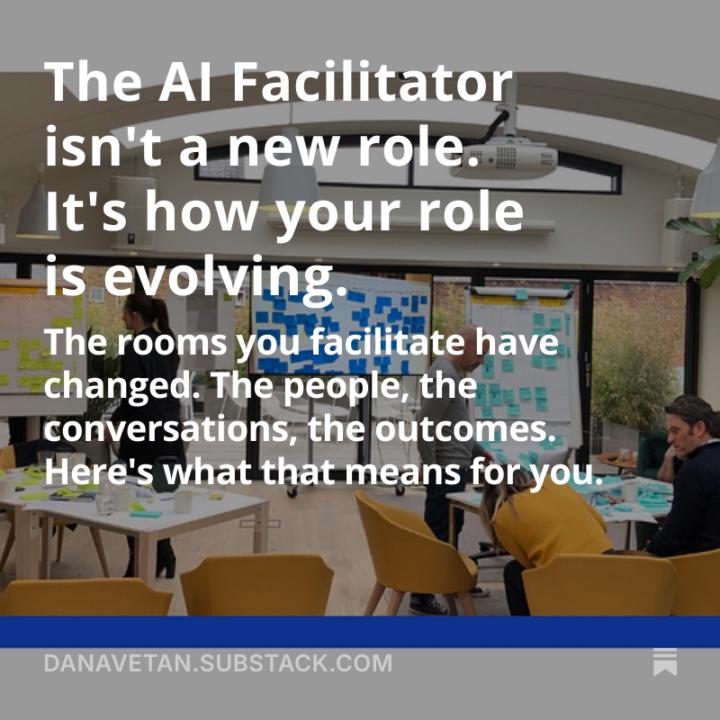
AI + Facilitation — a new Substack
I'm starting a newsletter :). Why now? Because I needed a place to document what I'm working through. AI is changing the workshops I design and facilitate. I'm having to rethink methods I've used for years — what still works, what needs adapting, what needs replacing entirely. And at some point I thought: if I'm doing this work anyway, why not share it? Hey, maybe even get some feedback on it :). That's what AI + Facilitation is. A bi-weekly Substack where I document what I'm learning as I adapt my practice. Facilitation techniques remapped for AI contexts. Moves I'm actually testing. A clear point of view on what's shifting. You're the first community I'm sharing this with — because if anyone gets why this work matters, it's you. First issue is live. https://open.substack.com/pub/danavetan/p/the-ai-facilitator-isnt-a-new-role?r=1w2obo&utm_campaign=post&utm_medium=web
1
0
Nov '25 •
🌟AI Facilitator Job Description
We received so many questions after our webinar about the role of the AI Facilitator that we decided to write a full Job Description for it. It’s ready for employers to copy-paste — or for facilitators, consultants, and designers to add directly to their resumes. Hope it helps. https://www.designsprint.academy/blog/the-most-important-role-you-havent-hired-yet-the-ai-facilitator
1-10 of 10

skool.com/design-sprint-masters
A place for facilitators to share tips and experiences on design sprints, problem-framing, and design thinking workshops.
Powered by