
Write something
Pinned

⭐
🔥
19h •
That Moment Your Dough “Falls Apart” After Adding Salt 🧂
If you’ve been doing fermentolyse with me, you’ve probably had this moment. You add the salt. You start working it in. And suddenly the dough looks like it’s coming apart. Tearing. Going lumpy. Falling away in pieces in your hands. A lot of bakers panic right there. Some grab more flour. Some start over. Some assume they ruined the bake. Don’t. This is normal. And here’s why it happens. Salt tightens gluten. That’s its job. But when you sprinkle salt across the top of a dough and start pinching it in, the salt doesn’t hit the dough evenly. There’s more salt in some spots than others. The gluten where the salt is concentrated tightens fast. The gluten where there’s no salt yet stays slack. Tight gluten next to slack gluten means the dough literally pulls apart. You’re watching two different doughs in the same bowl, briefly, while the salt finds its way through. Keep working it. Pinch and fold. Wet hands. Two to three minutes of patient incorporation. The salt distributes, the gluten evens out, and the dough comes back together stronger than it was before. Then rest for 45 minutes before your first coil fold. That’s when you’ll really see the structure show up. This is the kind of thing you only learn by watching the dough through the moment instead of bailing on it. Trust the process. Saturday’s poppy seed bake is going to give a lot of you this exact moment. Now you know what to do when it shows up. Perfection is not required. Progress is. Henry ⭐🔥

Pinned
⭐
🔥
2d •
🌾 Quick Update on the Poppy Seed Loaf Recipe
🌾 Small but important update on the poppy seed loaf in the Recipe Pantry. The original version called for T55 French wheat flour, and I'll be straight with you, that was a miss on my part. Most of us don't have T55 sitting on the shelf, and we shouldn't have to chase down specialty flour just to bake a poppy seed loaf at home. So I pulled it back and rewrote it. ✅ What Changed Both versions, yeasted and sourdough, now call for bread flour as the primary flour. If you've got AP on hand, that works too. If you happen to have T55, use it. The recipe works with any of the three. But the default is now whatever's already in your pantry. 🍞 Yeasted Version https://skoo.ly/yeasted-poppy-seed 🥖 Sourdough Version https://skoo.ly/sourdough-poppy-seed 📝 Quick Note on Flour Swaps 🔹 Bread flour gives you slightly more structure and a bit more chew. That's what I'd reach for first. 🔹 All-purpose flour gives you a softer, more tender crumb, which honestly suits a poppy seed loaf just as well. If you use AP, drop your water by about 5 to 10 grams because AP absorbs a touch less. 🔹 T55, if you have it, sits right in the middle around 11% protein. Use it the same way you'd use AP. That's it. No other changes to the recipe. Same hydration, same timing, same method. 👋 Your Turn If you've baked the old version, tell me how it went. If you're baking it this week, post your loaf in the thread. I want to see them. Perfection is not required. Progress is. Henry ⭐🔥
Pinned
⭐
🔥
4d •
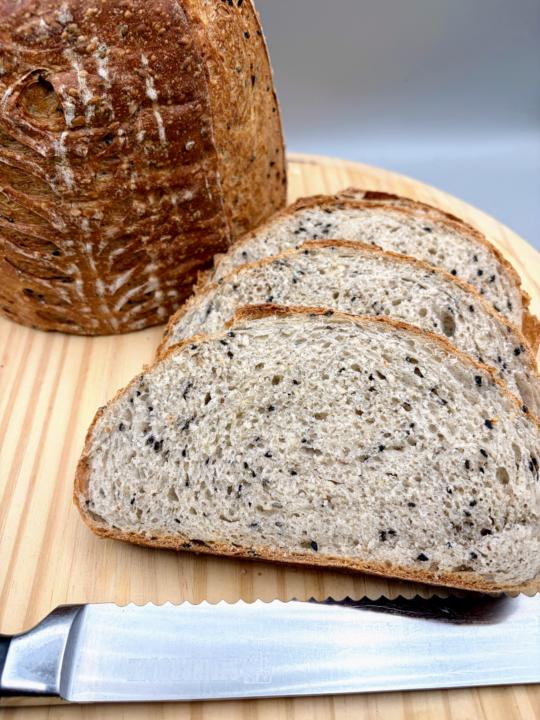
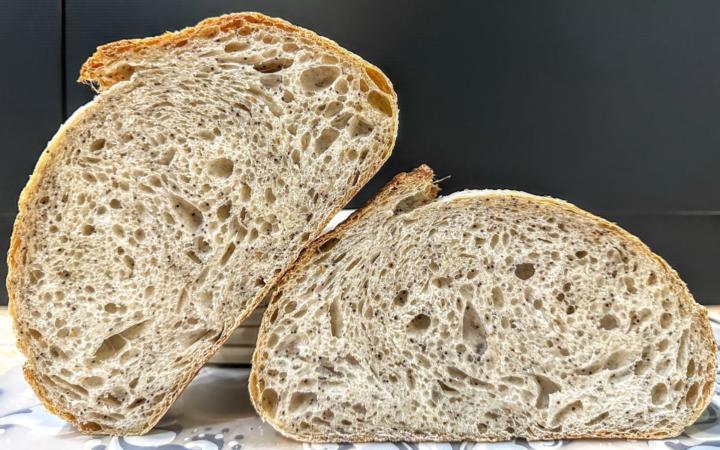
🥖 Saturday Bake: Poppy Seed Loaf, Two Ways 🌾
We’re staying on the road we’ve been building together. Baguettes. Pretzel bread. The Foolproof Sourdough Loaf. And this Saturday, we’re going somewhere beautiful. ✨ Poppy seed bread. ✨ Two versions. ✨ One bake-along. 📌 Why two versions? Some of you are deep into sourdough and ready to push hydration. Some of you are still building your starter, or just want to bake bread this weekend without a multi-day commitment. This Saturday, both of you get to bake the same loaf alongside everyone else. 🥖 The Sourdough Version T55 French flour and a touch of wholemeal at 80% hydration. The poppy seeds get folded in during the first coil, which laminates them through the crumb instead of mixing them away. The result is what you see in the photo: ✨ Open ✨ Airy ✨ Flecked with seed ✨ That nutty crunch you only get when the seeds keep their integrity This one teaches you: 🌾 How to handle higher hydration 🌾 How to time bulk fermentation in a warmer kitchen 🌾 Why we use 3.5 sets of coils instead of 4 (Hint: 80% hydration with wholemeal doesn’t want a fourth set. It tightens the crumb.) 📖 Full sourdough recipe in the Recipe Pantry: https://pantry.bakinggreatbread.com/recipes/poppy-seed-sourdough-loaf 🍞 The Yeasted Version Same flavor. Same beautiful crumb. Simpler timeline. ✅ Same-day bake ✅ No starter required We’ll use the same poppy seed lamination technique with a commercial yeast dough, so you still get that gorgeous seeded crumb without the multi-day fermentation. If you’ve been wanting to bake along but felt like sourdough was a barrier, this is your week. 📌 I’ll have the yeasted version uploaded to the Recipe Pantry by end of day today. Watch for the post. 🛒 What you need to know now: 🌾 Pick up poppy seeds this weekMost grocery stores carry them in the spice aisle. 🌾 If you can find T55 flour, grab it.If not, a strong all-purpose around 11–12% protein works beautifully.(King Arthur AP is the closest match.)

2h •
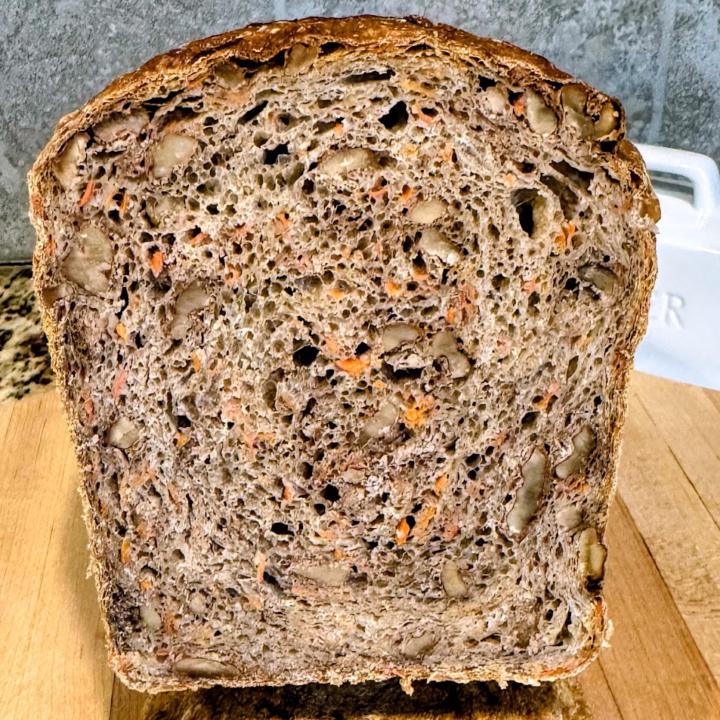
‘Whole Wheat Carrot and Walnut Pan Bread’
‘Whole Wheat Carrot and Walnut Pan Bread’ 50% Whole Wheat & 50% Inclusions and she still stands ‘Tall & Airy.’ The main contribution made by the carrots is moisture retention. This bread has excellent shelf life.” This is a 'hybrid'; it has both a sourdough levain and instant yeast. Note the high percentage of levain, 35%. A larger amount of levain introduces more organic acids into the dough immediately. This acidity acts as a natural dough conditioner, strengthening the gluten network and making the dough easier to handle. I always use at least 33% levain on a same-day bake without an overnight cold retard. I scaled the recipe to make one 1,157-gram loaf to fit in a 1.5 L Zyliss tin (8 in. x 4 in. x 5 in.). Total flour: 500 grams: 50% KA Bread flour, 50% KA Whole Wheat flour, 78% hydration, 2.1% salt, 25% walnuts, 25% shredded carrots, 1.3% instant yeast, and 35% levain (100% hydration). Ingredients: - Bread flour - 163 (g) - Whole Wheat flour - 250 (g) - Water - 303 (g) - Salt - 11 (g) - Walnuts - 125 (g) - Carrots - 125 (g) - Instant yeast - 6 (g) - Levain - 175 (g) - Method: 1. Mix the levain the night before. 2. Mix all with stand mixer except the inclusions, salt, and yeast 3. 30 min. rest (fermentolyse) 4. Knead for 5 min with stand mixer, then rest 3 min. 5. Add salt and yeast, mix for 3 min. in a stand mixer 6. 3 min. rest, mix in inclusions with stand mixer #1 7. 30 min rest > S&F-1 > 30 min > S&F-2 Fully proofed. This took 1 more hour. (Brod & Taylor @ 78°F) 8. Shape and place in tin 9. Final proof to 1 inch over rim 10. Preheat the oven to 500°F. 11. Lower the heat to 460°F and bake with tin for cover for 15 min. Lower the heat to 420°F, remove the cover, and bake for 15-20 minutes. The 100% hydration levain is a 1:5:5 build, fermented overnight at 70°F. 16 grams (100% hydration starter), 79 grams bread flour, and 79 grams water Fully proofed and baked in a 1.5 L Zyliss tin with a second tin for a cover. No score required.
⭐
🔥
3d •
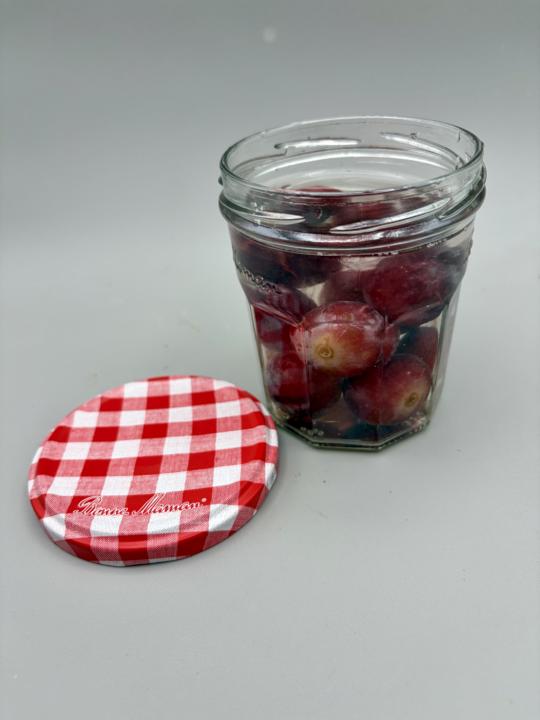
Yeast Water Project: Day 3 🍇
Shook the jar this morning and there it was. Tiny bubbles racing across the surface, gone in a second. Water’s a little cloudier. Grapes are riding higher. No off smells, just clean fruit. 🍎 Day three is the moment. The yeast just punched the clock. There’s finally enough of them in there to make a scene. Quick teaching points for today: See that dusty haze on the grapes? Don’t wash it off. That powdery, almost frosted look on the skin is called the bloom. It’s a natural coating of wild yeasts and bacteria that lives on the fruit, and it’s exactly what you’re trying to capture. Rinse if you must, but a gentle one, never scrub. The bloom is the whole point. Wash it off and you’ve thrown the inoculum down the drain. This is also why organic, unwaxed fruit matters. Conventional grapes are often coated with food-grade wax or treated post-harvest, and that interferes with the wild population you’re trying to grow. Loosen the lid. Active fermentation means gas needs an escape route. Snug, not sealed. Size your jar to the recipe. If you’ll use 300g of yeast water in your bake, you need a jar that holds more than 300g of water plus the fruit plus headspace. Think backwards from the recipe and add a buffer for evaporation and pour-off. Trust your nose. Fruity, slightly sweet, a little tangy is exactly where you want to be. Solvent, sulfur, or anything sharp tells a different story. Drop your Day 3 photos below. Let’s see those jars. Henry ⭐🔥
1-30 of 1,691
powered by

skool.com/crust-crumb-academy-7621
#1 Sourdough Community on Skool 🍞
Coaching, not judgment. Sourdough, starter, yeasted, enriched & every bread between.
✅ ProveWorth Certified ⭐⭐⭐⭐⭐
Suggested communities
Powered by