
⭐
Feb 15 • 🥖 Saturday Bake Along
The Full Story of Our Ligurian-Style Focaccia Bake-Along
Saturday Bake-Along: Let’s Get After It 🍞
The Full Story of Our Ligurian-Style Focaccia Bake-Along
February 14, 2026 | Crust & Crumb Academy
Six days ago, I posted a challenge: Ligurian-Style Focaccia with a saltwater brine. A technique most of you had never tried. Dough wetter than you’re used to. A brine poured over dimpled dough that sounds wrong until you taste how right it is.
Within hours, the responses started rolling in.
"I'm in, Henry." That was Linda Glantz. Then Tracy Havlik: "I'm most definitely in for this bake!" Colleen Vergara saw the word "brine" and responded with a single emoji: 🤯. Donna Angelo echoed it and added, "And I'm in." One by one, thirteen of you committed before you’d even measured your flour.
And then you showed up. All of you.
521 comments across two threads. 19 bakers posting photos and progress. 7 days of questions, preparation, and real-time baking. 100% completion rate.
Every single person who started this bake finished with focaccia on their counter.
Let me tell you how it went down.
The Week Before: Building the Foundation
The questions started immediately, and they were good ones. Not "can I skip steps" questions. Real, thoughtful questions from bakers who wanted to understand the why.
Leigh Skowronski asked about choosing quality olive oil. Michele Nilson shared that she buys from a specialty shop where the oil is never older than six months, imported from Italy. Tracy wanted to know: metal pan or ceramic? I broke it down. Ceramic heats up slower and doesn't give you that initial contact heat on the bottom. Instead of the oil frying the bottom into a crispy crust, the dough is steaming against the surface. That’s why it sticks. Metal or cast iron. That’s what you want.
Sandy Chong asked about adding garlic. Colleen jumped in: "I put minced garlic on top when I dimple." The group debated whether raw garlic would burn. Consensus: press it into the dimples with oil protection and you’re golden.
Sandy also raised an important health question about the brine and blood pressure. I did the math for everyone. Per slice, you’re looking at roughly a quarter to a third of a gram of salt from the brine alone. About the same as store-bought sandwich bread. You can always skip the Maldon on top if you’re salt-sensitive.
Jen Dolan needed rosemary alternatives. The community came through: garlic, hard Romano, or just skip it entirely. Focaccia is forgiving that way.
By mid-week, 23 members had voted in our overnight vs. same-day poll. The anticipation was building. I posted my philosophy for the week: Follow the Formula First. Then Make It Yours.
That set the tone for everything that followed.
The Early Birds
Some of you couldn’t wait. I respect that.
Dave Whitney baked his Thursday for a Valentine’s dinner party. His results were stunning. Dark golden top, perfectly dimpled, professional-level execution. When I asked what it tasted like and whether he could tell the difference from the brine, he confirmed it made a BIG impact. Then he did something that shows exactly what this community is about: he came back Saturday to coach others.
His brine tip became one of the most shared pieces of advice all day:"Dip your fingertips into the brine and drip it over the focaccia. In about 3-4 repetitions you will have a small enough amount to pour over. It really helps distribute evenly."
Phil Khambatta finished his early too, adding oregano alongside the rosemary. He shared his own technique: mix sea salt and olive oil in warm water, dip your fingers, lightly punch holes throughout the dough, then scoop brine with your fingers and splash gently. His takeaway: "The hallmark of this focaccia is the crispy fried bottom due to generous olive oil, and of course the brine on the top."
Two bakers, two different approaches to the same technique. Both came back to lift up others. That’s how it works here.
Saturday Morning: 6 AM and Counting
The Saturday thread went live early. By 6 AM EST, overnight fermenters were pulling their dough from the fridge. Same-day bakers were scaling ingredients. The energy was immediate.
Colleen Vergara posted her overnight cold-ferment dough in the pan. Gorgeous surface bubbles. Sandy saw it and said, "Yours got bubbles and looks better than mine." That’s the thing about this group. No jealousy. Just admiration and motivation.
Linda Glantz shared her half-recipe coming to room temperature, beautiful bubble structure already forming. Jill Hart, who spent the entire day cheering on every single baker, commented: "Looks beautiful."
And then the first-timers stepped up.
The First-Timers Who Changed the Game
Susie Kendall had never made focaccia. Never done coil folds. She posted after her first fold: "It's currently resting... this wet! I'm not sure I could call it a fold but I kind of picked it up from the bowl and let it drop."
I told her: "Looks good. This will get away from you if you’re not careful, pay attention." Because at 75 degrees on top of her freezer, yeast moves fast.
By her fourth fold, she posted again: "The dough is bubbly and jiggly and much stronger!"
That transformation from nervous to confident? That’s the whole point.
Sandy Chong had the same experience. Her first fold was soupy. "Mine initially was also very wet," she wrote. By fold three, it came together. By the end, she was celebrating:"Could not believe it worked!"
Both Sandy and Susie conquered coil folds for the first time. That’s not a small thing.
High-hydration dough is intimidating. It doesn’t look right. It doesn’t feel right. And then, fold by fold, it transforms. You just have to trust the process.
By the Numbers
- 300 members
- 521 total comments
- 19 bakers posting progress
- 13+ committed in advance
- 3 timing variations
- 6 days of preparation
- Multiple first-time achievements
- 100% completion rate
Every baker who started, finished.
What We Learned Together
The brine is not optional. High-hydration dough transforms if you trust the folds. Pan material matters. Watch the dough, not the clock. Dark crust is flavor, not failure.
And the most important lesson: when something goes wrong, ask for help.
Flip it upside down. Put it back in the oven. Adjust the rack.
This bread is more forgiving than you think.
What’s Next
Teresa Van Roey already suggested pain d’epi for next time. The community is ready.
I’ll announce Monday’s plan soon.
And somewhere right now, someone who watched all 521 comments this week is mixing their first-ever focaccia dough.
Inspired by 19 bakers who proved you don’t need to be perfect.
You just need to show up.
Well done, bakers. See you next Saturday.
Perfection is not required. Progress is. 🍞
Henry Hunter,
Founder Crust & Crumb Academy
Baking Great Bread at Home
21
54 comments
The Full Story of Our Ligurian-Style Focaccia Bake-Along
powered by
skool.com/crust-crumb-academy-7621
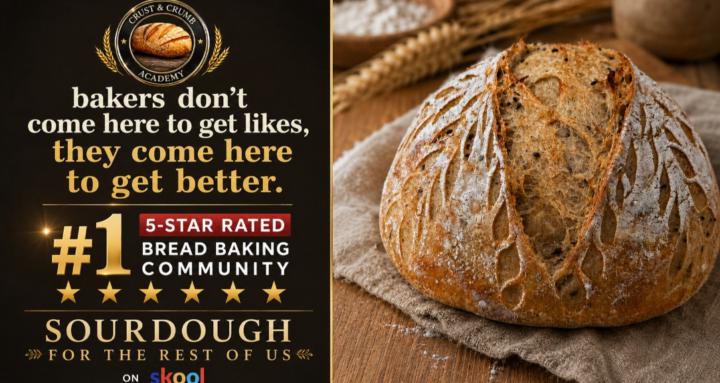
#1 Sourdough Community on Skool 🍞
Coaching, not judgment. Sourdough, starter, yeasted, enriched & every bread between.
✅ ProveWorth Certified ⭐⭐⭐⭐⭐
Suggested communities
Powered by